


I was asked by a family member the other day if I would send them some information on “bugging out” if the country actually degrades in stability or collapses altogether in the near or distant future. Should we stock up on water? Have a carbine and a truckload of ammunition? What about defensible space? What are you supposed to do if you live in a major city?
Yes, there is a lot of talk about this kind of thing in the entertainment industry, and much, much more online. But there is a stark, cold reality people need to understand about this topic, and I figured I could take a moment to lay out my thoughts.
So, let’s jump in and figure all this out!
!! BUGGING OUT !!

Introduction
So, if you have been watching the news lately, you might be feeling uneasy about the current decisions the government has made or is making regarding our social net, what we might consider essential services for many people, and the overall “ickiness” of what is happening. I mean, we’ve all seen it the last few years. It at least “seems” as if the world—the culture in which we live today—is falling apart around us.
Political Divisiveness
- Our government officials, over the last several years, seem perfectly happy to fight with each other rather than reach a compromise or do what is in the best interest of “the people.” Unfortunately, aside from the typical platitudes, there is very little the average person can do about this. We have the government, the leaders, the systems, and the country that previous generations created, and now we must live with those consequences. We can disagree with it. We can get really angry about it (I see picketers on the street now every time we drive into the city—a lot of people are mad on both sides of the aisle these days). But the reality is, it is what it is. There is little to nothing we can do about it to “actually change” the direction our country is going in.
- There are hints at civil war wherever you go. People are talking about. People are calling for it. There is an intentional effort at foot these days to undermine the foundations of the United States, to burn it all down so it can be rebuilt in their own image. This is not a new fear or a new desire. But it seems more possible now than when I was a kid. I remember reading the Bible passage as a new believer, “Let no one deceive you by any means; for that Day will not come unless the falling away comes first, and the man of sin is revealed,” (2 Thess 2:3). I remember thinking to myself, “This is never going to happen in my lifetime. Christianity is too solidified (even if it isn’t the Christianity of the Bible), it makes way too much money. I will never see a “falling away” like this.” Well, it only took 30 years, and now we are seeing it everywhere. People are leaving the organized church in droves. Whole denominations are dying out. Biblical Christianity (those who follow the Bible rather than traditions or teachings of mere men) is increasingly becoming a divisive topic. Now I can see this is a real and present possibility in the near future, if not within the next generation.
- We see rioting in the streets of major cities, driven by a range of grievances. Whether these are legitimate or not, I cannot determine. But what it is doing, regardless, is it is making life impossible for many people who have nothing to do with the issues they are all fighting over.
Rampant Homelessness
- Everyone has seen it. From the big cities of LA to Seattle, across the country, and even in rural towns without stoplights. Homeless people are everywhere. I would say the reason is a complex set of issues that cannot be easily resolved. I think one major driver is drug and alcohol addiction. The other driver has untreated mental health issues. The systemic lack of adequate housing across the country is also a contributing factor. Pair all of this with a new cultural ideology that no longer prizes the meritocratic system that once placed the United States on the map as the leader of the free world. I’m not saying this is right or wrong. I am the first to be vocal about the damage capitalism and consumerism have caused to people the world over. But the reality is, it’s simply not working anymore, and one of the devastating results of that breakdown is more and more people falling through the cracks.
- Even in our hometown of just over a thousand people, we have had the last year or more a homeless couple living in the town park. They have also had two or three RVs parked in and around town, causing significant distress to our community and the meager services available here. This ended when the last RV they had (with a boat being towed behind it) was driven off the road and fell into a marsh. But, despite them being gone, I’m wondering when they will be replaced by another homeless person or group of homeless people.
- A local church in our town has tried to be a bridge for the homeless community in and around our town (there is a homeless camp just outside of town in the woods), and they have been broken into, raided of their food supplies, preyed upon by scammers and swindlers, etc. This year, they ceased operations of their homeless shelter because their volunteer pool dried up.
Breakdown in Services
- Lastly, over the last few years, we’ve seen a fundamental breakdown in services and standards in the United States. From basic needs to what we perceive as “needs” to basic expectations in the business community and in work life.
- Medical insurance is astronomical, and insurance companies are desperate to cut and deny anyone for anything just to save a buck and keep their bottom line intact.
- The other day, I walked into a Staples store to drop off a package. There were three agents working on shift at the time. I watched them for a few minutes as I stood waiting in line. One was working at the counter where I was, processing Amazon returns. Another one was wandering aimlessly around the store, intentionally avoiding customers so he didn’t have to help them. Then there was a young woman, probably in her early 20s, at the main cash register, on her phone. She did not look up or welcome people as they came into the store. She was oblivious to customers around the store and reluctant to disengage from her screen whenever a customer approached her register. All of this is a problem. And we see it all over. Businesses are closing down entirely because they cannot keep people employed. I don’t think there is a single fast-food restaurant we have been to in the last year that hasn’t sacrificed food quality while raising prices. It seems to be simply a sign of the times.
A Realistic Bug Out Bag (72 Hours)
The reality is, the potential for short-or mid-term disruption to our basic needs or lifestyle is high. This, of course, depends a great deal on where you happen to live. If you live in a rural area far from a major metropolitan area, it will affect you less than it would for those living in those major cities. But, regardless of where we live, life happens. And it does hit the fan from time to time. Natural disasters? A broken water pipe leaves you without running water for two days as the city tries to fix it. Anything can happen and at some point it usually does.
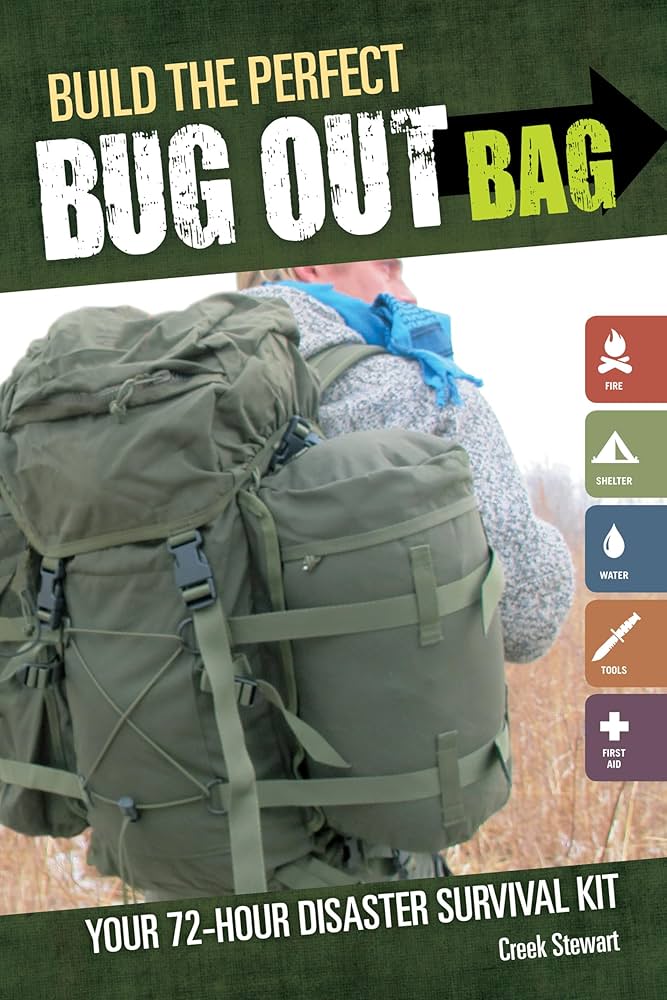
BUILD THE PERFECT BUG OUT BAG
by Creek Stewart
I would strongly recommend this book. You should purchase a copy and study it from cover to cover. It will explain in great detail how to build a 72-hour survival kit that will actually be usable. Don’t fall for the pre-made “kits” that are being sold out there. They are often scams or terribly made products.
The perfect but extreme example of this kind of disruption is the War in Ukraine. It started in 2022, nearly overnight, and without much warning at all. Before our eyes, the world watched as Russia invaded a sovereign nation in hopes of creating a no-man’s-land between it and NATO. There were no immediate plans for Ukraine to join, but Russia demanded that NATO give guarantees that the tiny country on its western border would never become part of the Western alliance. After this demand was rejected, Russia invaded to accomplish what NATO refused. This resulted in the devastation of the people of Ukraine. Men, fathers, husbands, all lined up at train stations to ensure their family members could board trains heading west, while they had to return to defend their country and their way of life. That war has taken countless lives. Overnight, their world has been shattered and will never be the same again.
Again, this is an extreme situation, with rare circumstances unlikely to be repeated. But it should give every person pause to consider what they would do if something similar happened to them. What would you do if your region were struck by a magnitude 9 earthquake in the middle of the night? What if you live in an area (like we do) where most bridges will collapse, most older buildings will fall down, and roads will be virtually cut off from the fall of thousands of trees? We would essentially be cut off from emergency services for a week or more, and possibly longer if the disaster affected an entire region.
Military Tactical Backpack for Men 35L 45L Molle Army 3 Day Assault Pack Bug Out Bag Travel Hiking Rucksack
This is the bag that I decided to go with. It was about $38 from Amazon. The actual bag does not matter. What is important is that it is made of high-quality material, is comfortable to wear for long periods, and, most importantly, will hold your stuff. A bag that’s too small, and you have to leave stuff behind. A bag that’s too big tempts you to take too much. I found 45L to be the perfect size for my situation.

This is why many non-profits and government agencies stress the need to store 72 hours’ worth of water, have adequate food provisions available, and keep basic first-aid supplies on hand, just in case. Why 72 hours? Because the statistics do not lie. In the first 24 hours of a natural disaster, 90% will survive. By the second day, only 30% typically survive. After 72 hours, only 10% will survive. It typically takes 24-72 hours for FEMA or other government agencies, or NGOs, to reach a people group after a disaster. Emergency food stamps generally take 3 days or more to be activated. It took FEMA seven days to deliver water to the Louisiana Superdome after Hurricane Katrina.
Having a 72-hour kit is essential for any survival plan, regardless of the disaster—man-made or God-inspired. So, let’s talk about what you should have in your bag:
- Water: Pack at least 1 gallon of water per person per day for drinking and sanitation, plus extra for pets (if you have pets, you are at a disadvantage).
- Water purification: Include water filters or purification tablets for treating water from questionable sources.
- Non-perishable food: Pack a three-day supply of non-perishable, ready-to-eat food that doesn’t require refrigeration or much preparation. Good options include energy bars, freeze-dried meals (these can be very costly, and companies selling them are often predatory, so be careful). I would recommend regular store-bought items like peanut butter, granola bars, etc. Canned foods are not the best option if you are planning to be mobile, as they are difficult to pack. But they can be perfect if you plan to ride out the disaster at home and will remain there for the duration.
- First aid kit: Include a standard kit with bandages, sterile gauze, antibiotic ointment, and antiseptic wipes.
- Medicines and prescriptions: Pack a supply of any prescription medications, prescription eyeglasses, and over-the-counter medicines like pain relievers, anti-diarrhea medication, and antacids.
- Medical information: Keep a list of your medications and dosages, a copy of your health insurance cards, and emergency contact numbers.
- First aid manual: A physical manual can be helpful for treating injuries and medical issues during a disaster. You don’t know what you don’t know, and this is doubly true in an emergency when tensions are running high. This is an easy addition that can save someone’s life.
- Light sources: Pack flashlights (a hand-crank or rechargeable one is good for backup), extra batteries, and possibly a headlamp for hands-free illumination. I prefer headlamps, but in reality, I use light sparingly. It is a dead giveaway in hostile environments.
- Radio: Include a battery-powered or hand-crank radio with a NOAA Weather Radio function to receive emergency alerts.
- Multi-tool or knife: A multi-purpose tool with a knife, screwdrivers, and pliers can be essential.
- Fire starter: Pack waterproof matches or a fire starter kit to create fire for warmth, cooking, and signaling. More importantly, you need to be highly skilled at starting a fire with various fuels (wood, gas, wet branches, etc.) and confident in your ability to do so when the weather is bad.
- Emergency blanket: Include an aluminized mylar thermal blanket for insulation and warmth.
- Whistle: A whistle is important for signaling for help.
- Duct tape: A roll can be used for repairs, first aid, and shelter.
- Wrench or pliers: Use these tools to turn off utilities if necessary.
- Change of clothing: Pack a complete change of seasonal clothing, including a long-sleeved shirt, long pants, sturdy shoes, and extra socks.
- Warmth: A sleeping bag or warm blanket should be included for each person. You need this rated for the environment you will be trying to survive in. A 20-degree sleeping bag will do you no good in -40 below.
- Rain gear: Pack a rain poncho or waterproof jacket and pants to stay dry.
- Sanitation: Include toilet paper, moist towelettes, hand sanitizer, soap, and feminine hygiene supplies. Pack garbage bags and plastic ties for waste disposal. It is said that if there is ever a massive continental earthquake or disaster like an EMP strike, within one year, 90% of the population will be dead. Not from the strike, not from bad people (though there will be plenty of that). But most people will die of disease from bad sanitation. A large percentage will also die from starvation.
- Cash: Include a supply of small-denomination cash in case credit card systems are down.
- Important documents: Store copies of birth certificates, insurance policies, and other important documents in a waterproof bag or container.
- Contact information: Keep a written list of important emergency contacts.
- Children and pets: If you have children, include diapers, formula, and age-appropriate games or books. Pack pet food, extra water, and comfort items for your pets.
- Evacuation plan: Develop and practice a family evacuation plan with designated meeting points. Be aware of possible evacuation routes that don’t rely on GPS.
- Vehicle kit: Keep a separate emergency kit in your vehicle, especially if you live in an area prone to harsh weather.
Leaving a City (Where to Go?)
Now we get to one of the issues for my family member. My wife and children live in a small, rural town of about 1200 people. We are one hour from towns of 20,000 to 100,000 people. The biggest city in our region has a population of 600,000. All of these are north east of us, and we are near the Pacific Ocean, so we are about as far west as we can get. There are many forests surrounding us, both public and private. There are extensive hiking trails and remote, backwoods areas. There are areas we know well (meaning we have spent extensive time in them) that lack roads or are not easily accessible to regular people. We have a remote property on a lake with no road access, adjacent to those other properties, and surrounded on three sides by the lake. And we are still in great danger of dying from accidents, tree falls, disease, starvation, and malicious intent by others. The forests here are hundreds of square miles of tree farms. Meaning, the lumber industry has stripped the forest landscape of variety and diversity; they have polluted the water table and runoff with petroleum products from fertilizers for the trees. The lakes, streams, and ponds all have fish, but most are stocked by the government each year. This means fish and game are resource-restricted. Any major catastrophe (man-made or natural) with just a hundred people or so abruptly switching from the grocery store to the wild to procure their food, and there will suddenly be no more food for anyone. But, all that said, the odds for our family member are much, much worse.
Larger cities, especially with populations over 100,000, will not only tax the limited resources available, but you will also have to contend with potential lockdowns, martial law, curfews, and the deployment of the National Guard. These protocols and organizations are all good “in theory,” but their actual use always comes with a price. And that is a price that innocent people always have to pay.
If you live in a larger city, the best option for you is to stay put and ride it out. I say this for several reasons:
- You are not going to make it out of the city anyway. The simple fact is, the best laid plans of mice and men always go awry. Grand plans to cross ten or more miles on foot (and if you have children, it’s even worse), swim across bodies of water, leap tall buildings in a single bound, etc. Between the hundred thousand other people in your city wanting to leave just as much or more than you do, to the lockdowns the city or national guard will place on residents, you have a very slim chance of getting out of your neighborhood, let alone the metro area without being stopped by police, and if there are no police then quite possibly the federalized National Guard, and even worse, a band of marauders who want what you have.
- Don’t be a moving target. The adage applies here. Out of sight, out of mind. If you are moving, you will first need to be extremely light, flexible, and quick to adapt. This is impossible with children, especially younger children. In a zombie apocalypse, the first person to be eaten alive by the flesh-eating horde is the person who is carrying a crying baby. It’s just logic. It is just human (and zombie) nature. But if you are held up in your apartment and you have done adequate fortification and preparation (like a 72-hour survival kit), you will be leaps and bounds better off than the guy trying to drive 20 miles out of town in a traffic jam. Plus, you are surrounded by neighbors on all sides of you. If you have been nice to them, you might have some goodwill in a time of crisis (be careful, though, typically it is not the stranger you need to watch out for, it is your neighbor who knows you and knows what you have and wants to take it).
Best Resources to Read/Watch
Watch this video first. He talks about bugging out realistically, not with the typical romantic spin. It may not be as exciting an idea as fleeing across a major metropolitan area, dodging monsters and maniacs, but it is simply realistic.

This is a great video talking about the REALITY of survival in a real-world scenario. He talks about when and how to leave, what supplies you need on hand, and how to get them.

Our Current State
We currently live in a culturally and politically polarized society and country. Regardless of where our affiliations fall, there is someone telling us for some reason that we need to hate everyone, that everyone hates us, and that the world as we know it is about to collapse in on itself. The problem with this kind of thinking, though, is that it is simply not true. Politicians and activists live on drama and controversy. If there isn’t enough already in the mix, they will fabricate more just so they feel better about themselves. This happens on both sides of the aisle. It is perpetrated by all walks within the political ecosystem. No one who has the ability to make true and lasting change actually wants to do so because if they did, then they would be out of business. Solutions proposed by radicals and career politicians are inherently deceptive. They are evil. It is simply the nature of mankind.
Are we about to see a major economic, cultural, and political shift in the near future? Maybe. But it is doubtful. Are we about to see major infrastructure meltdowns, the suspension of constitutional rights, or the enactment of martial law? Possibly. But it is not likely. And the reason why is that there is no vested interest in doing so. The government does not need to seize control because it already has it. Politicians and bureaucrats make life-altering decisions every day that the ordinary individual has no means or mechanism to counter the fallout. We simply are not in the loop. I would argue that we never were in the loop. Are radical activists wanting to liberate the oppressed population and give freedom to their comrades in arms? Not really. Not the individuals who are actually making the decisions and driving the narrative. Those people simply want what the established rule makers already have. They want to be them.
There is a lot of talk about the supposed instability in the world, especially in the West. But the fact is, it would take a massive event, shift, or transition in multiple areas to weaken the stability that exists. And that is one of the great things about the free economy: everyone involved has an invested interest in keeping things going. The rich have just as much to lose if society falls apart as the rest of us. Yes, they will most likely bounce back and survive, but it will not be without a cost.
Realities of Ukraine
Now, we say all of this, but we also need to acknowledge that things do sometimes happen. Terrible things. It is just as much a delusion to say everything will always be fine and will always work out for us as it is to say the sky is falling every day because of some news report we see, or because some talking head wants to sell us more boxes of ready-to-eat meals. And, as we already touched on, there is no more recent or more terror-inspiring reality that we have as an example of a people’s life dramatically changing for the worse than that of Ukraine.
Watch this video for an overview of the war currently, and why and how it started, and where it is currently heading:

Watch this video for a first-hand account of life in Ukraine since the war started:

Watch this video to see how, despite the catastrophic nature of war, the majority of the country is actually without war, and significant reconstruction has already taken place:

A Better Alternative
So, what are we to make of all this? What does it all mean? How can we prepare for when the SHTF? I would argue that we don’t. Or we do. Really, it doesn’t actually matter all that much what we do.
Yes, if you feel like you need to put together a 72-hour go bag, by all means, do so. Follow this list to get all your supplies. Don’t fall for the hype and buy something “ready-made.” They are just trying to steal your money. Watch this video for how to put together a go bag:

Conclusion
In the end, all the preparation you invest in will be useless if luck, providence, or destiny is stacked against you. You can put together the perfect go bag, have all the right stuff, and if you live in a very populated area and mayhem comes suddenly, there is a better than good chance you will not make it a mile from your house before someone else takes what you have and probably murders you as a thank you. You might live in the sticks and have a first-class bunker dug with three years of supplies safely stored for you and your family, and if you make a single mistake, a band of 3 well-armed men can take your bunker, your supplies, and leave your body in the mud.
The reality is, few people have any idea what it truly is like to survive in an SHTF scenario. Why are we kidding ourselves? Few people have any experience of what it is like to go hungry for more than a day. We don’t know what it is like to try and keep our kids safe while there are actual threats just a few blocks away, when there is no police force, when there is military roaming the streets, or even worse, mobs roaming the streets. If you take serious medications, the reality is, if it is a sustained SHTF scenario, you are already dead. It is only a matter of time before you run out of medications. The same goes for any supplies you cobble together beforehand. If the situation lasts more than a few weeks, your supplies will not last. And if you have stockpiled, that is going to be a magnet for those who want and are more than willing to murder you so they can have what you have.
!! The Solution !!
– Controversial Content Below Read at Your Own Risk –
We’ve talked a lot in this post about how to prepare for a scenario where our “normal” flies out the window and we are in immediate threat of injury, disease, or violence on behalf of others. This is a persistent fear for many people today. But I would suggest there is a solution that, while most people will not acknowledge or accept, has been a lasting one for my family and me over the last few years since we discovered it. If you would like to know what that solution is, click here and keep reading. But, I warn you, it is a severe solution that most will not accept or even believe is possible.
Please, comment below on what your own personal SHTF plans are so we will know what you are going to do so one of us can find you and take what you have [uhm…that means, whatever you do, DON’T TELL ANYONE].
!! Post below in the comments what your plan is if the SHTF!!

Please consider supporting my writing and efforts to reach people wherever they are by purchasing one or more of my books. I am a full-time author, and any support you choose to provide is GREATLY appreciated.
Excerpt from Our Daughter:
“Okay, Mom,” Randy said.
“You behave yourself and be nice. You’re lucky to have company while you wait for the doctors.”
The woman turned and started back the way she came.
“The nurse said it would be twenty or thirty more minutes, so we’ll eat quick and be back up here before they take you in, okay?”
“Okay, mom.”
“Sorry for him,” the woman said to Katie as she walked by.
“He’s funny.”
Katie grinned.
As the woman left, Katie noticed the boy moving around again on the bed. Before she realized what was happening, the tiny lump disappeared and she could hear the faint sound of bare hands and feet on the tile floor.
He was low crawling under the beds toward her.
A moment later, Randy popped his head out from under the nearest hospital bed, craning his neck around to look up at her.
“Hello, there,” Katie said.
Randy disappeared back under the bed, the bed sheet draping down almost to the floor. Katie could still see three little fingers pressed to the tile.
“What are you here for?” Katie asked, readjusting her seat in the chair, trying to get the ache in her chest to lessen.
For whatever reason, the wheelchair was really uncomfortable.
“Why are – “
Randy’s voice trailed off for a moment as he looked around.
“Why are you here?”
“I’m getting my leg fixed,” Katie said. “See?”
Randy poked his head back out from under the bed and looked at the leg she was pointing to.
“What’s wrong with it?”
“The doctor said it’s broken,” Katie said. “Shattered.”
“Ouch.”
“Yeah. Ouch.”
“Can you feel it?” Randy asked, able to stay out from his hiding place.
“I can feel it, but it’s not too bad,” Katie said, then tapped the IV in her arm. “This thing is giving me medicine of some kind for the pain. At least that’s what the nurses said.”
“Why are you – “
Randy stopped mid-sentence.
He scooted out from under the bed entirely and slowly crept over to er on all fours.
“What are you, some kind of spider?” Katie asked, giggling a little.
“What are you?” Randy echoed.
He was now only about a foot away from her chair and sat there, his legs folded up under him, gawking up at her.
“What are you staring at me for?”
“I’ve never – “
Randy put out a hesitant hand and ever so gently touched her arm.
“Are you some kind of ghost?”
He looked around again.
“Are you – ”
He leaned in, talking in a whisper.
“Are you dead?”
A nurse came around the corner and stopped abruptly, spotting the empty bed in the far corner where Randy should have been.
“Randy Andrews,” the nurse said, her hands now on her hips. “You get right back into the bed and you stop playing around, please. They are ready for you in surgery.”
Katie watched as Randy scrambled on all fours under the beds and back up onto his, pulling the sheet back over top of himself again.
She started to ask him about his question, but couldn’t get the words out before his parents appeared at the door.
Katie sat there quietly, watching Randy stare back at her from under his sheet. She glanced over at his parents and the nurse, noticed Randy’s dad had no hair on the top of his head.
Are you dead?
What kind of question was that?
The snap of the wheel locks being disengaged on Randy’s hospital bed jarred Katie out of the confusion she was in.
The doctor she’d first seen was now at the door, waiting for Randy.
He was his surgeon.
They wheeled Randy out of the room, his parents following right behind, disappearing to the left, heading for his operating room.
The pre-op room was empty again.
Dead.
Are you dead?
What kind of crazy question was that?
The nurse came back through the double doors.
“It won’t be long now,” she said.
“Okay.”
Katie tried not to think about the dull ache growing just behind her sternum.
The nurse disappeared around the corner as Katie watched the double doors to the operating rooms slowly shut.
Buy my book Our Daughter and begin the adventure of a lifetime, as you uncover the mysteries behind Katie Cadora’s new life after the horrible accident that stole her mother away from her. Will she find sure footing again? Will the pain ever stop? Will she discover the secrets her new foster family are keeping from her? Is the boy’s question right? Is Katie Cadora actually dead?
Click here and grab your copy today and jump into this Witch Gnostic Heresy trilogy with both feet!
But, trust me when I tell you, there are deceivers in our midsts! Get started in this bone chilling suspense novel right away and find out why….sometimes….you’re just better off DEAD!
What do you think?