


End of Month Post & Theological Synthesis
Alright! Welcome back to the March installment of my ongoing Isaac Hunter’s Online Bible Study. This month, I worked through the Epistle of James with a very specific focus:
- To understand what real, lived faith actually looks like when it collides with pressure
- To examine the relationship between belief, obedience, and action
- To confront whether my own life reflects what I claim to believe
James is not abstract. It doesn’t allow distance. It forces evaluation.
– End of Month Study Summary –
!! ISAAC HUNTER’s BIBLE STUDY !!
I am reading through the Epistle of James multiple times with focused attention on:
- Recurring themes related to faith, works, and maturity
- The relationship between trials and spiritual formation
- How wisdom is defined and contrasted (earthly vs. from above)
- Ethical instruction rooted in Second Temple Jewish thought
- How practical obedience reflects underlying belief
Difficult or weight-bearing passages—especially those concerning faith and works, the use of the law, and the role of speech—are cross-checked against the Greek and supported by major commentaries and early Jewish and Christian interpretive frameworks.
For a full breakdown of this study method, refer to the original post on the Study page.
James — A Theological Synthesis
James: Profession without Evidence
James presents a believer whose theology may be correct but remains unverified. The issue is not misunderstanding truth, but failing to embody it. A person can affirm the right things about God, agree with sound doctrine, and still lack the corresponding transformation that validates those claims.
Theologically, James exposes a decisive fault line: the separation of confession from action. Faith, when reduced to agreement alone, becomes indistinguishable from empty acknowledgment. Obedience is not an added layer to belief—it is the necessary expression of it. Where action is absent, faith is not weakened but invalidated.
The book leaves no neutral ground. It forces a direct evaluation: not whether belief is present in the word, but whether it is demonstrated in reality.
A Singular Confrontation
James exposes a different but equally dangerous distortion: claiming faith without submitting to what that faith requires. It is not open rebellion, but functional contradiction—affirming truth while living in ways that deny it.
What appears stable on the surface—correct language, right beliefs, outward alignment—can, under examination, prove hollow. The issue is not whether faith is claimed, but whether it is substantiated.
James presses a single, unavoidable question: whether belief will remain verbal, or become embodied through obedience.
There is no middle category.

James
James is often remembered for its emphasis on works, but works are not the starting point. The letter centers on a faith that must prove itself under pressure. James confronts the gap between what is claimed and what is lived, exposing a belief that remains verbal rather than becoming embodied. It challenges speech, partiality, endurance, and obedience, forcing a direct evaluation of whether faith is real or merely asserted.
Join the Study
If you are reading along, I invite you to engage in the comments by answering the following questions:
- James argues that faith without works is dead. Where do you see a gap between what you claim to believe and what is consistently visible in your actions?
- James places heavy emphasis on the tongue as a measure of spiritual maturity. What patterns in your speech reveal alignment—or misalignment—with what you say you believe?
- The letter connects trials with endurance and formation. Do you tend to view pressure as something to escape or something that exposes and refines? What does that reveal about your understanding of growth?
- James confronts partiality as a contradiction of faith. Where might you be making judgments—subtle or overt—based on external factors rather than aligned with the standard James presents?
This study remains intentionally transparent. I’m not presenting final answers—only careful reading, honest wrestling, and faithful attention to the text.
!! Use the Form Below to Join the Study !!
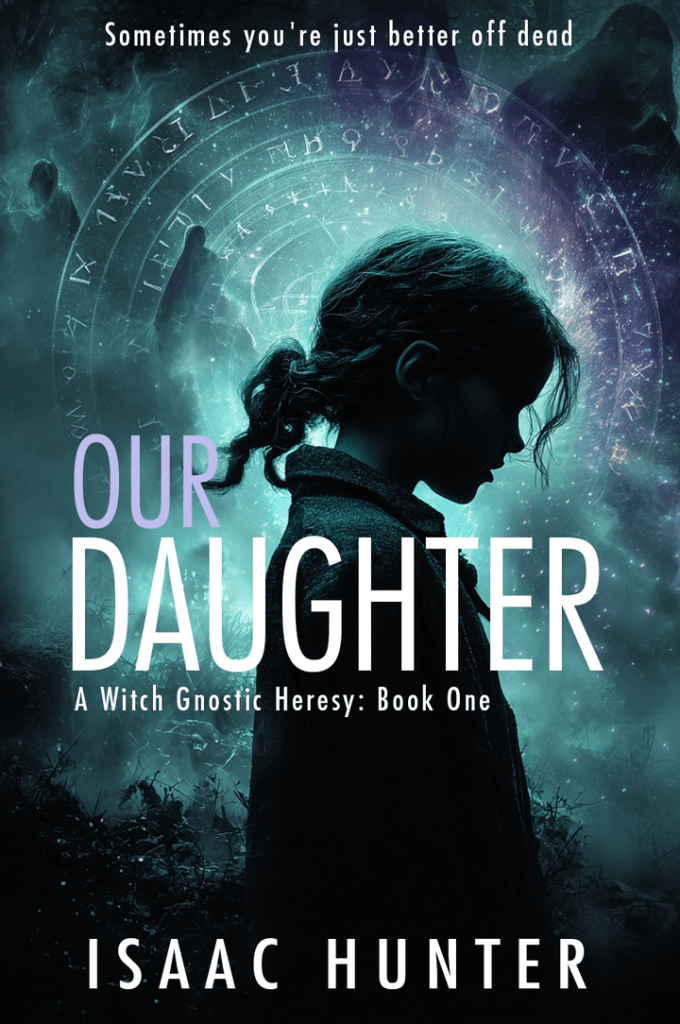
!! IF YOU LIKE JAMES, YOU WILL LOVE MY BOOK, OUR DAUGHTER !!

You can purchase the first book in the Witch Gnostic Heresies right now for a limited time up to 70% OFF, so act now while we still have copies in stock!
Check out this excerpt from my novel, Our Daughter:
“Okay, mom,” Randy said.
“You behave yourself and be nice. You’re lucky to have company while you wait for the doctors.”
The woman turned and started back the way she came.
“The nurse said it would be twenty or thirty more minutes, so we’ll eat quick and be back up here before they take you in, okay?”
“Okay, mom.”
“Sorry for him,” the woman said to Katie as she walked by.
“He’s funny.”
Katie grinned.
As the woman left, Katie noticed the boy moving around again on the bed. Before she realized what was happening, the tiny lump disappeared and she could hear the faint sound of bare hands and feet on the tile floor.
He was low crawling under the beds toward her.
A moment later, Randy popped his head out from under the nearest hospital bed, craning his neck around to look up at her.
“Hello, there,” Katie said.
Randy disappeared back under the bed, the bed sheet draping down almost to the floor. Katie could still see three little fingers pressed to the tile.
“What are you here for?” Katie asked, readjusting her seat in the chair, trying to get the ache in her chest to lessen.
For whatever reason, the wheelchair was really uncomfortable.
“Why are – “
Randy’s voice trailed off for a moment as he looked around.
“Why are you here?”
“I’m getting my leg fixed,” Katie said. “See?”
Randy poked his head back out from under the bed and looked at the leg she was pointing to.
“What’s wrong with it?”
“The doctor said it’s broken,” Katie said. “Shattered.”
“Ouch.”
“Yeah. Ouch.”
“Can you feel it?” Randy asked, able to stay out from his hiding place.
“I can feel it, but it’s not too bad,” Katie said, then tapped the IV in her arm. “This thing is giving me medicine of some kind for the pain. At least that’s what the nurses said.”
“Why are you – “
Randy stopped mid-sentence.
He scooted out from under the bed entirely and slowly crept over to er on all fours.
“What are you, some kind of spider?” Katie asked, giggling a little.
“What are you?” Randy echoed.
He was now only about a foot away from her chair and sat there, his legs folded up under him, gawking up at her.
“What are you staring at me for?”
“I’ve never – “
Randy put out a hesitant hand and ever so gently touched her arm.
“Are you some kind of ghost?”
He looked around again.
“Are you – ”
He leaned in, talking in a whisper.
“Are you dead?”
A nurse came around the corner and stopped abruptly, spotting the empty bed in the far corner where Randy should have been.
“Randy Andrews,” the nurse said, her hands now on her hips. “You get right back into the bed and you stop playing around, please. They are ready for you in surgery.”
Katie watched as Randy scrambled on all fours under the beds and back up onto his, pulling the sheet back over top of himself again.
She started to ask him about his question, but couldn’t get the words out before his parents appeared at the door.
Katie sat there quietly, watching Randy stare back at her from under his sheet. She glanced over at his parents and the nurse, noticed Randy’s dad had no hair on the top of his head.
Are you dead?
What kind of question was that?
The snap of the wheel locks being disengaged on Randy’s hospital bed jarred Katie out of the confusion she was in.
The doctor she’d first seen was now at the door, waiting for Randy.
He was his surgeon.
They wheeled Randy out of the room, his parents following right behind, disappearing to the left, heading for his operating room.
The pre-op room was empty again.
Dead.
Are you dead?
What kind of crazy question was that?
The nurse came back through the double doors.
“It won’t be long now,” she said.
“Okay.”
Katie tried not to think about the dull ache growing just behind her sternum.
The nurse disappeared around the corner as Katie watched the double doors to the operating rooms slowly shut.
Buy my book Our Daughter and begin the adventure of a lifetime, as you uncover the mysteries behind Katie Cadora’s new life after the horrible accident that stole her mother away from her. Will she find sure footing again? Will the pain ever stop? Will she discover the secrets her new foster family are keeping from her? Is the boy’s question right? Is Katie Cadora actually dead?
Click here and grab your copy today and jump into this Witch Gnostic Heresy trilogy with both feet!
But, trust me when I tell you, there are deceivers in our midsts! Get started in this bone chilling suspense novel right away and find out why….sometimes….you’re just better off DEAD!
!! Get Your Copy Today !!


What do you think?