


The next course I selected as part of my Unschooled Master of Theology program was the KI course, Proverbs + Log, which covers the book of Proverbs, plus has an accompanying log book or journal. I have included both here in this post.
As a reminder, you can find all of my course assignments for the uThM here.
So, let’s get started….
What do I Already Know?
It has been quite awhile since I’ve done any kind of systematic study of Acts. So, this is an interesting inquiry at an interesting time. I’ve taken up this course at KI because 1. It is part of my Gold requirements, and, 2. Our pastor has recently started this book on Sunday mornings and will be going through it for the next two years! I pray it will not take me this long. But I want to streamline my studies and maximize the ROI.
About the Book of Acts? I know Luke is the author, the gentile doctor. He is a companion, I believe, of Paul. It is argued by Dr. Missler that this book, along with the Gospel of Luke, is most likely court documents for Paul at his trial. If this is the case, that would mean that the courts at that time allowed the representation of the supernatural.
I know most of Acts follows Paul and his journey’s until just before his death (not sure the exact timespan between the end of the book and his death). It is an extension of the four gospels, and it is considered a historical document. It is basically an accounting of what occurred for the disciples immediately after Jesus’ ascension and the years following, documenting the spread of the gospel and the interactions Paul and others had with their world while preaching and teaching the good news of Jesus Christ.
What do I Want to Learn?
1. I would like to develop a much clearer understanding of the entire book of Acts. This is my main aim in studying at KI. This occurred for the book of Jude, and it has been very helpful for me over the last few years. I would like to be able to do this for all 66 books of the Bible at some point.
2. I would like to be able to utilize the material here to be better informed during Sunday services to add to comprehensive notes I’m developing for each book of the Bible.
3. I would like to be able to leverage the knowledge learned in this course for other courses I will teach in the future: Sunday school, small groups, and Digging Deeper courses, as well as Online Isaac Hunter Community courses.

Lecture 1
Who should have replaced Judas? Justify your answer using appropriate Scripture.
It appears as if Matthias was the correct person to replace Judas. They selected two by the church, then chose between them by lots (Acts 1:23, 26). It was never intended to be Paul. Paul was considered to be one “born out of due time” (1 Co 15:8). He was called to be an apostle to the mystery of God, the Church. He is the 13th apostle, not part of the 12, which will rule from the 12 thrones (Matt 19:28; Luke 22:30). Instead, he is separate, just like the church, part of the mystery and will reside in heaven in Jesus’ presence forever.
Discuss the possibility the two books by Luke were legal documents supporting Paul’s appeal to Caesar.
It is said that Theophilus sponsored the documents of the Gospel of Luke and the Book of Acts. They are believed to be trial documents, required by Roman law to have legal background and an account of events preceding Paul’s appeal to Caesar. Evidence for this is the fact that the documents, especially the book of Acts, states the uprisings were always caused by the Jews, that Paul nor any of the Christians were ever instigators, and that the Romans are not portrayed in a negative light.
Divide the book of Acts into two sections, and explain your reason(s).
The book of Acts is divided by the two primary characters focused on: Peter and Paul. The purpose of the book is to show God’s intention for his plan of salvation to include a population from both the Jews and the Gentiles. Peter was called to minister to the Jews while Paul was called to minister to the Gentiles. This is primarily demarcated as Peter: Acts 1-15, and Paul: Acts 6-28, but there are various different divisions considered by scholars.
Discuss how the return of Jesus Christ affects your daily living?
This is something I long for. It is something I pray for. It is a deep seated desire to have this world restored back to the original intention God had for it. I long for a day when there will be no more sin nature, when we will be in the presence of Christ, when death and its prison, Hades, will be no more, and the devil and all the host of him will be put away in the Lake of Fire for all eternity. I am excited and anxious for whatever it is we will be stepping into in the next iteration of our existence. Will we be tasked with new jobs, new occupations, new vocations in the Kingdom of God? How similar will we be to the host of heaven (angels)? We will certainly be counted as Sons of God. Will there be a new iteration of redemption for another group of living beings and we will serve as messengers and on the divine counsel as the previous Sons of God did and do? How expansive, and complex is the Kingdom of God (heaven, the supernatural realm, etc)? What does it consist of? What are its boundaries? What are its limits? Why does God seem to be at war? Who would he be fighting against? The devil only? Someone or something else? What is the purpose for our redemptive iteration? Why did Jesus die in our iteration? Does he die in all iterations? Are there even other iterations?
When Jesus returns it will be the “culmination of all things.” I long for it and I do my best to hasten its arrival.
Compare and contrast the life of Judas with the life of Peter? How did each handle their spiritual failure?
The lives of these two individuals is distinctly different. Peter at his betrayal of Jesus was full of shame and sorrow for what he did, and rightly so. But he was eventually restored as a disciple of Jesus and went on to become very prominent in the church and confident that he knew who Jesus was, that he was the Christ, the son of the living God.
Judas on the other hand was, at his betrayal, overcome by despair and remorse, and those intense feelings led him to kill himself. He was never restored, and was driven to betray the Lord because of greed, and because of his disappointment that Jesus did not come to plot and execute a military revolt against Rome. He did not, in the end, know who Jesus truly was (Lord) but considered him instead to be just a teacher. But, the greatest difference in my mind between these two is, Peter was predestined to be a vessel of mercy and Judas was predestined to be a vessel of wrath. Satan entered Judas and possessed him (Luke 22:3), and this would indicate that he was no believer at all (if it is true that demons cannot possess believers).
Discuss the similarities you see between the beginning of Jesus’ ministry in the gospel of Luke and the start of the Apostles ministry in Acts?
There are some similarities between these two ministries, but I’m not certain I would make any hard and fast rules concerning them. Jesus began his ministry, according to Luke, by being tempted by the devil. The apostles also were tempted by enduring the crucifixion, the death of their Lord. Jesus declared his ministry in the synagogue, reading Isaiah 61, but leaving out verse 2b. The apostles also had their ministry declared by the receiving of the Holy Spirit at Pentecost. Almost immediately after for both, there ministries were authenticated by miracles and healings. Jesus healed the demon-possessed man, and Peter healed someone near the temple. Both Jesus and Peter identified their ministries as fulfillments of the prophetic record, and ultimately there was multiplication of their followers after this.
K-W-L Self Assessment: L- Describe what you LEARNED from this session.
I like what Dr. Missler states here: The Book of Acts is a fragmentary, incomplete book. In the conceptual sense we can say that it is still continuing, as it ushers in the Church, the Ecclesia, the “called-out ones,” and this is still continuing. Acts covers the first 40 years; Revelation Chapters 2 – 3, the next 2000+.
It’s interesting that there seems to be a pattern in which Jesus sent out his disciples and then subsequently how the apostles and Paul spread the gospel throughout the entire world. The gospel was first sent to Jerusalem, then Judea, then Samaria, and then to the utter most parts of the earth. This is a rough outline of the book of Acts. I would argue this has ultimately been fulfilled. The gospel has reached the last stage. We could then say we are at the end of the gospel message, we just don’t know how long that will last.
I thought it strange that Dr. Missler claimed the cloud Jesus was received up into was not an normal atmospheric cloud but was a special cloud (Acts 1:9). I will need to look into this more.
I have been wanting to explore Zech 14:4 more, as this is the point at which Jesus sets foot on the mount of olives and sets up his millennial kingdom. I believe (though it is conjecture) that this will be the time in which he redeems Israel, and they will populate his kingdom on earth.
I need to look more into the idea that the saints come with Jesus at his second coming. I would agree with this if only it happens AFTER the rapture. The rapture necessitates all Christians being in Hades beforehand, so they can be brought back to life and come out of their graves, and then be caught up in the air with those who are still alive at Jesus’ coming (Col 3:4; 2 Th 1:10).
I like the idea that the book of Acts could be considered a transition from the Kingdom to the Church, and the Book of Revelation a transition from the Church back to the Kingdom.
Lecture 2
Explain the historical and prophetic application of the seven Feasts of Moses.
I was not so familiar with the Jewish Feasts of Moses. I knew they had them, but I did not know how many there were or what their significance really was. I knew that the law had passed away and that we as believers in Jesus are no longer bound by the law, so I never thought there was really a point to celebrating them. I knew one man and his family who had incorporated the Jewish festivals into their lifestyle as a replacement for the traditional, now secular holidays of the west and I know he did this because of the rampant commercialization of those latter holidays.
There are seven total festivals or feasts celebrated and established by Moses. I did not really understand that the Jewish calendar was the Jews catechism. It is by the holidays that they remember, memorialize, teach, and prepare for what is to come. But, there appears to be even greater significances to the feasts.
There are 3 feasts that occur in the month of Nisan (1st month), which is in the Spring. They are the Passover, the Feast of Unleavened Bread, and the Feast of Firstfruits. There are 3 feasts that occur in the month of Tishri (7th month), which is in the Fall. They are the Feast of Trumpets, the Feast of Yom Kippur, and the Feast of Tabernacles. Lastly, there is a feast that occurs in between these two, which is the Feast of Pentecost, or the Feast of Weeks.
There is a significance to the Christian in these seven feasts I was not aware of. It appears as if the first three point to Jesus’ first coming, the last three point to his second coming, and the middle feast (Pentecost) points to the Church (possibly the birth and rapture of the Church).
There is also additional symbolism here: the Passover is the cross, the Firstfruits is the empty tomb, and Pentecost is the Church.
Peter draws from three Scriptures in the Old Testament. Give a brief exposition of each.
In Acts 2:14-47, Peter draws from three different Old Testament verses to prove his point when he spoke to the people.
Joel 2:28-32 – He was telling the people that those who spoke in tongues were not drunk but were fulfilling this prophecy, that God had “poured out his spirit on them,” that there would be many “wonders in heaven and signs in the earth.” He was not claiming that everything mentioned in this prophecy were being fulfilled at that point, but that it was starting to be fulfilled in them at that time.
Psalm 16:8-11 – He used the passage from the Psalms written by David to show that it had been prophesied beforehand that Jesus would die, but more importantly, that God would raise him from the dead. He would not leave his soul in Hades. He would not allow Jesus to be corrupted in body.
Psalm 110:1 – Lastly, he uses this psalm to explain how it was not David himself he was talking about, but it was Jesus that he prophesied about, because it had not been David who “ascended into the heavens.” It was actually Jesus who ascended to the right hand of the father and who took a seat on God’s throne until God would make all of Jesus’ enemies his footstool.
Discuss the significance of Acts 2:47.
Okay. This is a controversial understanding of evangelism and not at all favored in most evangelical circles. But I cannot helped but hold on to it because it reflects how I was saved, how I see others being saved, and what bears out in Scripture.
Acts 2:47 states, “And the Lord added to their number daily those who were being saved.” Dr. Missler makes mention that this means the early church “won souls daily.” I would disagree. I would argue that we do not “add people to the church” but we discover people who are being added to the church by God. This goes back to the usual adage of the Great Commission being a commandment for every believer who has ever lived or will ever live: we must go out and win souls for Christ, we must be door knockers, we must talk to our neighbor about Jesus. I simply do not see this. Matthew 28:16-20 does not speak to every Christian universally or, at least not directly. It was the eleven he was speaking to. He told them that all authority had been given to him both in heaven and on earth. He told THEM to go and make disciples of all nations, baptizing them in the triune, living God, teaching them all the doctrines they had received. This is it. And the eleven did just that. They all eventually scattered throughout the known world and they went to all the earth. In Mark 16:15 it says to go out into all the earth. They did this. The job has actually now been completed. The gospel is known the world over. Christianity has, for good or ill, been established firmly as a world religion. It has great influence over many nations even today. There are churches on just about every corner in just about every town in the west. It is big business. It is pervasive. The availability of the Word of God is massive. At no other time in human history has the Bible and the documents that make it up been so accessible to the common man.
I’m not saying that people should not evangelize. But I am arguing that only those who are called to evangelize should do so. Not everyone is called to be an evangelist. But each of us is given a particular gift from God and whatever that gift is we are to identify it, develop it, and exercise it for the building up of the body of Christ and for the glory of God. We each play a part in the bringing into the body of Christ. But we do not all play the same part. The teacher is a terrible evangelist. The shepherd is probably a terrible tentmaker and church starter. And there is a myriad of other gifts of service that are given to the multitude that are unidentified and I think because there are a myriad of ways in which the body edifies itself in love. Just as diverse and different as the individual people who are exercising those gifts and performing those activities.
I think Acts 2:47 is simply stating the obvious reality that they daily were adding to their numbers from those being saved, those being brought into the church by God. This could certainly be through the work of the evangelist. Timothy was told to do this kind of work. Paul is definitely an evangelist as well as an apostle. But he was no elder. One could argue he was a teacher, but that would be a bit of a stretch I think. He preached the gospel, planted churches, and then moved on in his circuit. He did not remain long after to establish those new believers in the doctrines of the faith. He did some of this, but not over many years, which is a different gifting of the body.
It illustrates what God was doing in the first century church, not necessarily what kind of activity they were doing. We don’t know what their evangelism looked like. There is Paul. There is Timothy. There is Peter. There is Philip. We know they were all evangelists in one way or another. But we do not know their approaches, their tactics, or their ministerial philosophy.
I think evangelicalism is in error in this aspect. We are not all evangelists. Ephesians 4:11-16, I believe, bears this out.
Discuss the meaning of “exclusionary truth,” giving contemporary examples. Explain why it is dangerous and provide a suggestive remedy.
Dr. Missler listed 2 Ti 3:16; Matt 4:4; Ro 15:4 in support that teaching to exclude a particular group or to ostracize a kind of people or lifestyle is short sided. Then again both Paul and the others do this frequently in the Bible. Paul excludes non-believers from the pool of people Christians can marry. He also limits those who claim to be Christian and yet act like the world from the hospitality of the true believer. We are commanded to not even associate with them. The examples Dr. Missler gives are Replacement Theology and Hyperdispensationalism.
Now, I know what Replacement Theology is (supersessionism), the belief that the church has replaced Israel and will receive the promises offered to Israel but rejected by her when she rejected her messiah. This kind of teaching has led to all sorts of heresy and seems to have led to the holocaust. It stems from deep-seated racism against Jewish people on behalf of the reformers like Martin Luther, which was born early on but late in the first century church, when Christianity began to separate itself from its Jewish roots. I would argue that this is a false doctrine, but not because it is exclusionary. It is wrong simply because it is not at all borne out in Scripture and in fact, is refuted in many places.
Hyperdispensationalism, on the other hand, states that the protestant church in the first century (in the book of Acts) was closed. It existed between Acts 9 and acts 15. This is often part of the Grace Movement. They argue that the four gospels, and many NT letters (epistles of Peter, James, Jude, Hebrews, and the epistles of John) apply only to the pre-Pauline Jewish-Christian church, the future David Kingdom, and have no bearing on the Gentile church. They would argue that Jesus’ teachings are not for the church, the Great Commission is not for the Gentile Church, and that there are at least two different gospels – that the gospel of grace was completely unknown until Paul received it. They would argue the Church Age that we know did not begin until Acts 28:28, when the offer to institute the kingdom of God on earth was withdrawn from Israel. They even argue that the book of Revelation does not apply to the mystery Gentile Church, but only to the Israelite church and the lost world.
I would argue that these kinds of doctrines are derived from a poor or unbalanced hermeneutic. But this can only go so far as we are unable to discern what we are not given to discern. So, ultimately, all we can do is acknowledge what has occurred and what is occurring in our inner life in what pertains to God and of God, and then throw ourselves on the mercy of Christ that he will bring us through all these destructive and deceiving heresies unscathed. We must continually and persistently be in prayer, we must surround ourselves with a host of witnesses, we must be diligent to present ourselves approved to God, a worker who does not need to be ashamed, rightly dividing the word of truth (2 Tim 2:15).
It is only by the grace of God that we can avoid these kinds of heresy. There are countless others who are helplessly deluded and caught in a strong delusion concerning their own faith and the religion they serve. Who are we to think we are any different?
Discuss why the Feast of Weeks involves leavened bread and explain why two loaves of bread are used?
So, I’m not certain I can agree with Dr. Missler here, that 1 Co 10:17 explains why there are two loaves used. I found one explanation: that the two loaves reference the Israelite wanderings when they found manna six days but on the seventh day they did not find any bread on the ground. They gathered twice as much bread on Friday. This has become a reminder for the Jewish people of this reality.
Explain Peter’s explanation of the Baptism of the Spirit, given at Pentecost, was or wasn’t a fulfillment of Joel 2.
Peter did not think that the entire prophecy was fulfilled, but this prophecy included what they had just seen. This will be seen throughout the entire event, with the climax occurring at the end that are spelled out in Joel.
Missler argues that because of this prophecy and because it extends throughout the entire period of the church, then the sign gifts will continue until the end of the church. But Missler does differentiate between genuine gifts and counterfeit gifts. Many things he says can mascarade as gifts, but are not actually that. They argue that gifts are finished because the canon is complete. But I would disagree that this is not the case. 7 thunders (Re 10:8). John’s testimony about what is included in canon. (1 Co 13:10).. That which is perfect is the return of our king, not the canon which is an incomplete message that bears still many multitude of questions unanswered. Missler states the canon will not be completed until the 7 thunders utter their voices. But, those have already uttered, it was just not delivered to us. So John knows what they said. Jesus, God, the Holy Spirit know. The 7 thunders know. The message of the Bible is limited to what God has revealed to us. There are many missing parts. It is not complete. I believe when we are in heaven, it will be complete. The other books are not included.
What drives the Cessationism is the rampant abuses of gifts and majority of which are counterfeit.
K-W-L Self Assessment: L- Describe what you LEARNED from this session.
Worship is tied intrinsically to wonder. When we awake we see the sunrise and wonder at the miracles and work of God.
I was thinking that if the church began on Pentecost (shevot) and Enoch is a type of the church because he was raptured and if it is true that he was born on the same day that they held Pentecost and he was raptured on the same day as Pentecost, then it stands to reason that the church will also be raptured on Pentecost. That is provocative to think about.
Lecture 3
Discuss what is suggestive with regard to the phrase, “38 years.”
The man that Peter healed had been lame fro 38 years from birth. He was healed by the power of Jesus who was the Christ, the name invoked by Peter, which healed him. It was not his faith, for there is no evidence in Scripture pointing to the lame man having believed in Christ.
But, this is akin to what happens to each one of us, as we are non-believers and, without our merit, Jesus comes to us, and births us again by the spirit, making us a new creation in Christ. The whole of society, of the entire human race before Jesus’ work on the cross was lame and without hope. And those who still remain unsaved, the church is in the world not to give out alms or provisions of limited means, but to empower them, gives life to men, puts them on their feet just like the lame man, and gives them the gift that cancels disability, that creates ability and worship.
The Sadducees were incensed by the man who was healed, but they could not say anything publicly against him or the apostles or Peter for healing him because it had already become well known to the masses in Jerusalem what had happened, and the man (who everyone knew) was standing right there beside them (Acts 4:14-16). Instead of arguing against and trying to discredit what had already happened, they just wanted to stop it from spreading.
I think it is interesting that Dr. Missler remarks that Acts 4:28, “determined beforehand” marks not only God’s sovereignty, but also the doctrine of predestination. The reality is, though, God is in control despite our current circumstances or world events. He is the author of them all.
Discuss the differences in worldviews between the (a) Pharisees, (b) Sadducees and (c).
The Pharisees were considered literalists of the Scriptures, they were also legalists, taking ever detail of their holy writings and making a law and burden of them. They were in short: extremists and contended with Jesus the most in the New Testament.
The Sadducees, on the other hand, were considered modernists, materialists, and they were liberals when it came to politics and also their worldview. They rejected the idea of an actual resurrection, of the existence of angels, or anything that pertained to the supernatural. They had some contention with Jesus, but mostly when he would perform some kind of miracle and spoke about the supernatural in a way that they couldn’t deny it. Those who chase after materialism, when they discover it is bankrupt, their only alternative is mysticism, and they do a deep dive into all manner of whackadoodle teaching (such as Kabbalah).
The Herodians were a political group of Hellenistic Jews who sought earnestly for political independence for the Jewish people. This was a shared belief with all the groups, but the Herodians sought to restore a member of the Herodian dynasty rather than the kingdom of David. They are mentioned only twice in the New Testament, and this is all that survives today in the written record. It is sometimes speculated that they are actually the Essenes of Qumran, who authored the Dead Sea Scrolls.
Jesus mostly had conflict with the Pharisees because they yielded the political power during the time of his ministry. By the time of the apostles ministry efforts, the Sadducees in the Sanhedrin had risen to prominence, who were always upset whenever the apostles taught that Jesus had risen from the dead.
Explain the doctrine of “hyperdispensationalism.”
Hyperdispensationalism is the worldview that the church as we know it, the mystery that is the bride of Christ, did not start in Acts 2 at Pentecost, but when Paul entered prison in Acts 28. They would argue that the “church” described between Acts 2 and 28 was the Jewish Church, a separate group or dispensation that was distinct from the OT saints and the gentile church. This kind of teaching is in line with Replacement Theology, which states that Israel forfeited the promises of God because they rejected the messiah, and now those promises were extended to the gentile church.
These are part of the Grace Movement, and believe that the four gospels, Peter, James, Jude, Hebrews, and John were all written to the Jewish Church and not to the mystery that is the gentile church. As such, none of these writings or teachings are binding on the church today. The Jewish church would be under the auspices of the Kingdom promises, not grace, and would be reestablished during the millennium.
They would claim that only the prison epistles of Paul are binding to the mystery church. The book of Revelation does not mention the mystery church either, but the 7 letters are directed to the Jewish church and the rest of Revelation is for those in the tribulation. They reject the ordinances of the church such as water baptism, the Lord’s Supper, and believe in soul sleep, annihilations, and even universalism to such an extent that Satan is pardoned of his sin.
Explain how the implications of the “Cities of Refuge” apply to believers today.
Peter claims that while people are accountable and responsible for their deeds, they do it in ignorance, so are not guilty of intentional sin, but “manslaughter.” The remedy in the Old Testament would be for the manslaughterer to flee to a City of Refuge and dwell there the remainder of their days, or suffer the risk of being murdered in retribution by the dead person’s family (Num 35:11-28).
We, as believers, are guilty of our sin, but we must flee to our “City of Refuge, which is Jesus. As long as we remain there we will not taste death but will receive everlasting life.
Explain the phrase “the time of restitution of all things,” and how it applies to us today.
Jesus opened his ministry by reading from Isaiah 61:1-2 and stopping at the comma (Lu 4:16-20). The last part of that passage is, “And the day of vengeance of our God.” This is the end here, when God pours out his wrath on the inhabitants of the world. Then we will find ourselves at the Great White Throne Judgment (Re 20:11ff), where we will all stand and give an account of what we’ve done against the books that contains everything we’ve ever done. It will be a time when “from whose face [God’s] the earth and the heaven fled away. And there was found no place for them” (Re 20:11), where “the heavens will be dissolved, being on fire, and the elements will melt with fervent heat” (2 Pe 3:12; Isa 34:4). After the judgment, there will be then a “new heaven and a new earth” (Re 21:1), and everything will be restored to its original splendor (before the effects of the fall). Romans 8:19-22 makes this clear: “the earnest expectation of the creation eagerly waits for the revealing of the sons of God. For the creation was subjected to futility, not willingly, but because of Him who subjected it in hope; because the creation itself also will be delivered from the bondage of corruption into the glorious liberty of the children of God.”
Write a devotional exposition of Psalm 2.
Voice of the Trinity 2:1-3
The faceless masses gather on the earth to bewail the plight of man before God. The trinity (Father, Son, Holy Spirit) stand as witness of the proceedings and question their behavior, wondering why the nations (the people) rage? Why do they plot a scheme that is futile? This could be indicative of the final battle before the end, the battle to destroy Israel and to fight against the Christ. It is the rulers of the earth, the Kings, who devise a plan and go out against God’s Anointed. They want to sever the authority that the trinity has over them (and the earth) and even sever the connections that exist between the godhead.
Voice of the Father 2:4-6
God’s response is one of derision and laughter and wrath. He speaks to them and retaliate in his wrath and displeasure. God declares, he has set his King in Jerusalem. This is not a negotiation. It is not a compromise. There is no appealing to his better nature. What God has done and is doing, he has declared it. He has done it. The case is closed.
Voice of the Son 2:7-9
This is what God has spoken through Jesus who is the Christ. God has said to him, “You are my Son, Today I have begotten you. Ask of me, and I will give you the nations for your inheritance, and the ends of the earth for your possession. We see this in Revelation 11:15ff when the seventh angel sounds his trumpet and loud voices in heaven say, “The kingdoms of this world have become the kingdoms of our Lord and of His Christ, and He shall reign forever and ever!” God tells Jesus, “You will break them with a rod of iron; you will dash them Ito pieces like a potter’s vessel.” The “rod of iron” is repeated throughout Revelation (Re 2:27; 12:5; 19:15-16), quoting from Psalm 2:9.
Voice of the Spirit 2:10-12
The Holy Spirit then advises the kings of the earth (who were bemoaning their predicament) to be wise, to be instructed. They are judges of the earth, they should be wise and informed (even though they are neither). He tells them to “serve the Lord with fear” (which they do not have), and that they should “rejoice with trembling.” It is akin to Pr 1:7, “The fear of the Lord is the beginning of knowledge.” He tells them to “kiss the son, lest he be angry and they perish in the way.” This will happen when his wrath is kindled but a little. Again, we see this play out in Luke 23:30; Is. 2:19; Hos. 10:8; Rev. 6:16-17; 9:6. The final advice offered to the lost world is the reality that seems to go unnoticed: “blessed are all those who put their trust in him.” This is because of what Peter said, “there salvation in any other, for there is no other name under heaven given among men by which we must be saved” (Acts 4:12; 1 Ti 2:5-6). For this is the purpose and the aim of the gospel, “to [Jesus] every knee shall bow and every tongue shall confess.”
K-W-L Self Assessment: L- Describe what you LEARNED from this session.
Nothing to add here.

Lecture 4
Explain the error(s) of Ananias and Sapphira.
Ananias and his wife, Sapphire, had it in their control and were allowed (giving in the church in the first century was not by compulsion but voluntary) to give as much or as little to the church as they wanted. But, they sold their land, and then gave a subset of those proceeds and then passed it off as if giving the whole amount. Their sin was not selling the land, or not giving all of it, but trying to convince everyone that they had.
There is something more significant going on also, since Peter says, “Ananias, why has Satan filled your heart to lie to the Holy Spirit and keep back part of the price of the land for yourself?” (Acts 5:3). What this means, exactly, that Satan has “filled his heart” and the result of this was for him to “lie” I think is unclear.
Explain the “shadow of Peter,” and its implications for today.
This is found in Acts 5:14-15 and it states that, “they brought the sick out into the streets and laid them on beds and couches, that at least the shadow of Peter passing by might fall on some of them.” (Acts 5:14–15).
First, it does not state that Peter’s shadow cured them of their illnesses. But, we do know that touching handkerchiefs did (Ac 19:12). Now, this was considered by Luke to be “unusual miracles” that God wrought through Paul. So, while we can tentatively suppose that Peter’s shadow was actually curing some people; why else who they be bringing people out to do it if it had not happened in the past, just like the stirring of the water in the pool (John 5:4). But, we cannot state this unequivocally. It can only be inferred.
Now, the implication this has for today is clear. There are a myriad of abuses happening in what is termed “the body of Christ,” but is really just pagan religion cloaked in Christian garb. There is a subset of Christianity that presumes, assumes, prefers that there are tangible signs of faith, that there are miracles, despite the indications to the otherwise in the Bible (John 17:20; 20:29; Rom. 8:24). We are told, “Faith is the substance of things hoped for, the evidence of things not seen” (Hebrews 11:1). We should not get caught up in the things of the world, and this includes the spiritual things, the folk theologies, the traditions of men. Too much of these things and they will drown out the truth and viability of the gospel altogether, they will choke out our salvation and render us “estranged from Christ….[and] fallen from grace” (Ga 5:4).
There are those who attempt to focus on miracles, on healings, on prophecy, on tongues, as if these things in and of themselves affirm the wielder’s spiritual maturity and prowess. It seems to delude them into thinking that, because they are able to do these things, they are approved of God, that he loves them and knows them. The problem is, these things are rife also in the pagan world, in all other religions, which tells me only one thing – they are most often to be considered doctrines and works of demons and not of God.
Explain the distinctions between the Pharisees, the Sadducees and the Herodians. Which are most likely to come to Christ, and why?
The Pharisees were conservative, spiritual, and religious zealots. They were extremists. They were academic. They were doctors and philosophers of the Oracles of God in the Jewish sect. Herodians were a political family party who sought to extract power and influence because of their heritage. Lastly, the Sadducees were similar to the Pharisees, yet, they were liberal, progressive, and rather atheistic. They did not affirm the supernatural, angels, ghosts, demons, and the like. They were politically motivated by the same aspirations of the Herodians, but with religious flare.
I would argue that, since salvation is based entirely upon predestination, that God created each one of us distinctly as a “vessel of mercy” or a “vessel of wrath,” then there is nothing we can do to change who it is we are. There is no altering the substance of what we are made of, the form in which we take (our image, shape, structure), nor the qualities and characteristics that drive us to our behaviors (our will). All of these things were preprogrammed before we were ever created so that, when being created, we would function in a specific way (the way in which we were intended to function).
So, with that said, and operating under this framework, I would argue that all three have the same chance as anyone else to be saved by God. God is the determining factor and his will shall be done. Now, Dr. Missler states that because the Sadducees are atheistic and unwilling to accept the supernatural, that they have the least chance of being saved since they have the most opposition to the gospel. He makes the comment that there is no account in the Bible of a Sadducee actually coming to faith in Christ.
Speaking as a believer who had no choice in becoming a believer, who has had no choice in the tasks God gives him to do, I would argue that even a Sadducee can be moved by God as God determines.
Summarize the seven “progress reports” in the Book of Acts.
The Lord added to them daily (Acts 2:47), the Word of God spread rapidly (Acts 6:7), everyone heard the gospel and God moved them to saving grace (Acts 9:31), the Word continued to increase and spread (Acts 12:24), the churches were strengthened and grew (Acts 16:5), it grew widely and grew in power (Acts 19:20), Paul encouraged the churches even in prison and house arrest (Acts 28:30-31).
Explain the “cause and effect” relationships that made it effective to “have all things in common.” What were the defects? What does the Bible teach about private property?
I have always thought that the New Testament church was a rudimentary or precursored example of socialism. But, as Dr. Missler points out, there is a fundamental difference between socialism and the Christianity community in the first century. First, the NT church was voluntary (cf. Acts 4:32, 34-35; 5:4). Peter tells Annanias that he had full control of what happened to the proceeds he received from the sale of the property. He could give it all, give none, or give a portion of it. Socialism, on the other hand, requires by compulsion the seizure, collection, redistribution of all wealth evenly. The Church, though, collected money from willing givers, then it distributed based on need, not based on some artificial or theoretical idea of equality.
The only defect I can see is everyone would be driven completely by the Holy Spirit or, at least, governed by those who were driven by the Holy Spirit. This would remove the possibility of personal possessions (to some extent but not as much as socialism), and the needs of the church would come before the needs of the individual.
The Bible does not really discuss private property or individual ownership. It does state quite clearly that these things should not come between us and God, nor should they become more important than the work God has called each of us to while we are here on earth.
Share some things you learned from the qualities and humility of Stephen.
It is said that Stephen was full of faith, full of power, and that he did great wonders and signs among them all. He was a man of full faith and full of the Holy Spirit. It is one thing to say we are Christian, but it is entirely another to be genuinely transformed by the God who made us. To be full of faith is to be imbued with a belief that is beyond reason, beyond logic. To be full of power is a litmus test of our salvation, of the indwelling of the Holy Spirit, for if we are saved we will be empowered by that spirit to accomplish things that are not possible with mere men.
These are all characteristics and behaviors that we can emulate in ourselves, that we can as God to provide for us (for without him we can do nothing).
K-W-L Self Assessment: L- Describe what you LEARNED from this session.
Nothing to add.
Lecture 5
Explain the implications of the terms, “Grecians,” “Hebrews,” and “Hellenists” as used in this session.
The Hebrews were national Israel (Palestinian Jews), who had been born and raised and lived in Israel. Those born outside of Israel, though still maintaining their Jewishness, were known as Grecians or Hellenists, terms synonymous that simply mean “born outside of Israel.” The Hebrews looked down on the Hellenists and considered them inferior in some way to themselves.
Explain the structural pattern of Stephen’s presentation to the Sanhedrin. What would have been his prophetic point if he had been allowed to continue?
The pattern of his speech is laid out for us: he talked about Abraham (Acts 7:4), Joseph (Acts 7:13), Moses (Acts 7:27), Law (Acts 7:35), and Joshua (Acts 7:45) and how all of these are a pattern of failure.
They were predestined to fail, for this was their pattern throughout their history: reject first then accept second. And, if Stephen would have been allowed to finish his speech he would have told the Sanhedrin that they were going to reject Jesus (they already head) but that a day would come in the second coming that Jesus would return and the blindness would be lifted from them and they would then believe.
Give examples of false witnesses and slanderers within the Church Body today?
I would argue that there are three distinct kinds of false witnesses today, and they are all found within the church. The first is the individual who perverts the gospel by adding to it or changing it in some way. Paul addresses this in Galatians 1:6-9, stating that if anyone brings any other gospel then they should be ἀνάθεμα (a curse).
Second, there are those today who erode the integrity of the Bible as the message of God. They claim that the original autographs were not inerrant, that the copies we have today are not infallible, and that nothing in Christianity is reliable for doctrine or correction. These are often the academics of the faith who are not necessarily believer or who have been indoctrinated into the academic religion.
Lastly, there are those who try to override Scripture with the use of our culture. They place culture and practicality and agenda above the truth and authority of the Bible, and claim that the Bible should be reinterpreted based on current cultural norms rather than the culture being changed by the Bible.
All three of these work in tandem to erode the supremacy and authority of the Bible and try to subvert the gospel by adding to its message and requirements or by eliminating some major element of it.
Discuss insights that emerge from Stephen’s summary of the Old Testament record which were not evident before this session.
A 25-year delay in responding to what God had called him to do, waiting for his father to die (Gen 11:31). This was evident with a closer inspection of the Genesis text.
The Israelites were continually unresponsive to God’s persistent purpose. They continually rejected the first time and got it the second time. This would echo in the last time, when Jesus first came and what will be when Jesus comes again in the future. While this was evident in the text for those who looked, it may not have been available to the Jews when the blindness was put on them. By the time Jesus arrived, they were entrenched in the idea that the Scriptures themselves gave them enteral life, rather than the message the Scriptures expounded upon.
Stephen always quoted from the Septuagint. 430 years in captivity in Egypt (Ex 12:40,41; Gal 3:17). Acts 7:6 has 400 years in bondage in Egypt. Not a discrepancy, but 30 years in Egypt under hospitable conditions, 400 subsequent years in bondage. But, my question is, if Joseph was 17 years old when he was sold into slavery (Genesis 37:2), then spent 13 years as a slave for Potiphar, and was 30 years old when he was made second in command of Egypt by Pharaoh (Ge 41:46), then he was 39 when his brothers came for grain, and 56 when his father, Jacob, died. How old was Joseph when the clock started on the captivity in Egypt? When Jacob entered the land (to live there) he was 130 years old (Ge 47:9) in around 1876 BC. The 7 year famine ended probably around 4-5 years later in 1872 BC. This would mean that the Israelites were in Egypt from 1876 to 1446 BC, when Moses led them out of Egypt. This is believed to be during the reign of Thutmoses III, who reigned from 1485-1431 BC. Which is a contradiction because, when Moses left Egypt, and they crossed the Red Sea, Pharaoh came after them with all his armies and they were all destroyed. If Thutmoses III reigned until 1431 BC, then he would be alive for 15 more years after the Red Sea events. There are also arguments that there were many different Pharoah’s that Joseph served during his time in Egypt, including: Sesostris I, Sesostris II, and Sesostris III, and Amenemhat III. This information is not available in the biblical text. But it is also not available in Stephen’s sermon either.
My question is: how could the Pharaoh forget so quickly who Joseph was? He had been second in command of the entire Egyptian Kingdom as well as Pharoah’s house. He was morned for like a King when he died. I could see an argument that the 30 years started at the time of Joseph’s death, and if the current Pharaoh died shortly after, then another came up and 30 years passed, but it does not provide ample opportunity (in my estimation) for the group of 70 to then grow expansive in the land in just 30 years. There was no birth control then, though. So it is entirely possible. If they had ample food, provisions, plentiful harvests, it is possible. But, there are two prevailing views: 30,000 or over 2 million. To get to 30K, they would require a birth rate of 22%. To get to 2 million, they would require a birth rate of 40%. This seems rather high to sustain. But, so does 22% when our population growth rate in America today is .4%.
Explain how God can increase the sphere of our influence.
I could not find a reference to this in the PDF notes or in the lecture video. But I will attempt to answer as best I can. Our sphere of influence is the amount of influence we wield over a group of people. For example, Joseph started with the influence over his family, his brothers in particular. This was a negative influence. They did not like him. Then he was sold to Egypt and had influence over very few people (aside from Potiphar and his wife and maybe other servants, or other administrators). He then went to prison and had influence only over the prisoners and the prison guards. Then he influenced the Baker and the wine-taster. Then he influenced Pharaoh. Then his influence was greatly expanded and he had influence over the entire Egyptian kingdom and over the surrounding nations. Lastly, his influence diminished rapidly after his death and he only directly influenced the descendants that came after him. Now, though, his influence is global and legendary, as the accounts of his life are recorded in the most read book ever published – the Bible. Now he has untold influence on generation after generation and will be established throughout all history and all eternity.
We are not in control of our influence. We can make our plans (our volition, free will), but it is God to guides our steps (our predestination, his sovereignty). We are but walking a path that has already been predetermined before we ever existed. This is his will and it will come about and will be completed. No part of his plan will be unrealized. We are destined to have a particular level of influence. Some, like Joseph, were destined to have massive influence multi-generationally. Others, like the countless unnamed individuals who were born, grew, lived, and died in the Middle Ages, have left literally no mark on this world. They were born into poverty, they suffered through life, enduring untold hardship, and then died as quickly and as anonymously as they were born. Their names (if they had even been given one) have been utterly forgotten by the world.
This is the fate of our influence. It is entirely in God’s hands.
Discuss what you think was the Holy Spirit’s plan for teaching the Eunuch more about the Christian life?
This account is found in Acts 8:26-40. It tells of the events surrounding Philip, being commanded by an angel to go out to the desert, following the southern road that leads from Jerusalem to Gaza. The Eunuch was a “man of Ethiopia” but it never specifically states his nationality. He had great authority under the Queen, Candace, and was in charge of her treasury. We are told this man had come to Jerusalem to worship. So, he was either a Jew by birth and subsequently found himself in Ethiopia as a eunuch and administrator of the Queen’s goods, or he was an Ethiopian convert and was coming to Jerusalem for pilgrimage.
Dr. Missler’s background on Ethiopia and their peculiar commitment to the Christian faith is quite fascinating. The idea that this man had been an envoy of the Ethiopian Queen who had been long waiting the return of the Jewish Messiah, might have dispatched the eunuch to go to Jerusalem to see about Jesus who had been declared “the King of the Jews.” They possibly wanted to know if the Messiah had, indeed, come, and if so, they wanted to present the Mercy Seat to him (Isaiah 18; Zephaniah 3:10). These passages are VERY vague. So it is impossible for me to say with any definite that Egypt has the actual Mercy Seat or the Ark, and if they will present it to the Messiah when he comes to set up his Millennial Kingdom. These are all conjectures at best. But it is fascinating, nonetheless.
Interestingly, he was not only wealthy and had means, but he also had a copy of at least the book of Isaiah, if not more of the Bible with him. This was what he was reading from when Philip came up to him. “He was led as a sheep to the slaughter; and as a lamb before its shearer is silent, So He opened not His mouth. In His humiliation His justice was taken away, And who will declare His generation? For His life is taken from the earth.”” (Acts 8:32–33). “He was oppressed and He was afflicted, Yet He opened not His mouth; He was led as a lamb to the slaughter, And as a sheep before its shearers is silent, So He opened not His mouth. [He was taken from prison and from judgment.] And who will declare His generation? For He was cut off from the land of the living; For the transgressions of My people He was stricken” (Isaiah 53:7–8). LXX “And because he was afflicted, he does not open his mouth; like a sheep is led to slaughter, and like a lamb is voiceless before the one who shears it, so he does not open his mouth. “His judgment was taken away in humiliation; who will describe his family? For his life was taken from the earth; he was led to death because of the lawless acts of my people.” (Isaiah 53:7–8).
I do appreciate Dr. Missler’s interpretation of these issues. He states that the eunuch had been sent to Jerusalem because the Queen had heard that the Messiah had been declared. This was what they had been waiting for for over 2000 years. She sent him to find out if it was true so they could then get ready to present the Mercy Seat to him. When the eunuch had arrived, he discovered that the supposed Messiah had been crucified, and this is why he was confused about what he was reading in Isaiah. He thought the Messiah had come and that his countrymen could finally deliver the long awaited present to the King of the Universe. But, because he had been killed, it required God to send Philip to him to explain things that Jesus would return again, so they needed to wait still more for the day to come.
My question is: when did the Ethiopians become Christians? Dr. Missler offers that the Ethiopian’s discussion with Philip was the starting point of this individuals conversion from Judaism to Christianity, and that he most likely returned to Ethiopia and
K-W-L Self Assessment: L- Describe what you LEARNED from this session.
Nothing to add.
Lecture 6
Explain whether the Philip, featured in this chapter, is the Apostle or the Deacon? Support your reasoning with Scripture.
We find Philip the apostle was from Bethsaida (John 1:44) and he was one of the original 12 who gathered the church together and said they should not put aside the ministry of the Word of God for the sake of waiting tables. They instructed them to choose 7 from among them to do this task. Philip (not the apostle) was chosen as part of the 7.
Now, it is presumed that the Philip that went down to Samaria to preach was the deacon, but I would argue that it was the apostle (Acts 8:5-6). The text does not actually tell us either way and there are two Philips to choose from. After Acts 6:2, “the twelve” are not mentioned again in a specific place (such as after Philip went to Gaza).
A Philip (apostle or deacon – I argue for apostle) went down to Samaria in Acts 8:26, where he had the altercation with Simon, and then went into the desert of Gaza where he had the experience with the Ethiopian Eunuch. I would argue that it is the same Philip who had the Simon altercation that had the Ethiopian experience, but there is no direct indication from the text which one it actually was.
After the Ethiopian’s baptism, Philip was sent supernaturally to Azotus (ἁρπάζω – same word for Rapture – indicating that God uses this method of extraction for more than the final Rapture).
Later, we see, unequivocally, Philip the Evangelist, one of the seven, in Acts 21:8. So, I would argue, because of the way the series of events are presented in the text, utilizing my own intuition, I would say that the Philip that is mentioned most is actually the Apostle, and that Philip the Evangelist is mentioned at the first separation of the seven, and then lastly when they stayed at his home.
Explain why the Ethiopian Treasurer was confused and discuss what was his apparent mission for the Queen?
Dr. Missler states that he is convinced that the Ethiopian people had already been waiting hundreds of years for the Messiah to come, because they had the Ark of the Covenant and, more importantly, the Mercy Seat, and they were destined to present this mercy seat to the Christ when he came. He argues that they were first Jewish, from the Levitical line by those Levites that took the Ark down to them to hide it. But, they were subsequently converted to Christianity when the Ethiopian was stopped by Philip (the apostle) while he was reading Isaiah 53. Dr. Missler states that this treasurer had been sent by the Queen of Ethiopia to suss out if the Messiah had come and the time was right for them to organize and head that way with the Mercy Seat. When the Eunuch arrived, he discovered that the Messiah had been killed by the Roman authorities and he was perplexed and confused as to what this all meant. He was reading the Hebrew Scriptures, what he had been taught by the Levitical Jews that had at least lived with them hundreds of years before if not intermarried with their women (something the Jews had a tendency to do). Philip expounded on Isaiah and taught the Ethiopian the gospel and he was baptized and left rejoicing. Dr. Missler speculates that this is the start of the Ethiopian conversion to Christianity, which they are so today. He came to see if the Messiah had come and learned that he had, and that he was now drawing people from every language and every country to be part of the mystery of God.
Today, the Ethiopians are still waiting for their Messiah to return, they are still in possession of the Mercy Seat (presumably), and its protection is mentioned in their constitution. I would not be surprised, at the institution of the Millennial Kingdom (1000 year reign) that the Ethiopians will mobilize a countrywide caravan that goes from Ethiopia to Jerusalem, and they present to the Messiah the throne he will place in the new temple from which point he will reign over the entire earth.
Contrast the arguments in favor and against the possible presence of the Ark of the Covenant currently being in Ethiopia.
First, there appears to be a lot of misinformation presented in how the Ark came into their possession. It is a lineage question, but I’m not certain it really matters how it got there. I would argue for Dr. Missler’s arguments over that of the Ethiopians and the Queen of Sheba having an affair with Solomon and producing a son. But, that being said, it is entirely possible. Solomon was known to be quite the lady’s man. So it is not out of the realm of possibility.
Second, why all the secrecy? Why the cloak and dagger? Except for Ethiopian is no longer a world power, a mighty people, they are poor and destitute throughout much of their country. This could cause them to be a little more sheepish in what they reveal to the world: the ark would be a prized possession to any country. It is an interesting idea that there is one man each generation who guards the Ark, and the replacement takes over only when that first man finally dies. What a life to live in service to God.
It was commented that they have no eschatology, and I know they to not hold to the supernatural view of Genesis 6:2 even though they include the Book of Enoch in their Scriptures. It seems to be a concoction of blindness and clarity simultaneously.
Personally, I think they have the Mercy Seat and they will in the end present it to Christ when he comes into his Kingdom on earth. But, I have no way to prove this.
Is cremation a Biblical alternative to burial? Justify your answer.
Nowhere in the Bible does it forbid or condone the practice of cremation. The Catholics approved it officially in 1963. It is simply not discussed. I’ve heard over the years arguments against it that they do not want to “burn up” as if they were in hell and could somehow feel their body burning into ash. There is the presumed argument that if they were cremated that somehow God could not figure out how to put their body back together again. There is also the argument that Dr. Missler makes that cremation was predominately a pagan practice in biblical times, and, thus, should be avoided.
My only issue with this latter argument is, if this is true (which is probably is), then that is fine. But that means all Christians need to abstain from Christmas, Easter, and just about every other western holiday as they are all pagan in origin.
I, personally, prefer the idea of cremation because it will allow my ashes to be scattered or deposited in a place that burying my body would be forbidden. I do not personally subscribe to the idea that God needs our original bodies at the resurrection. He doesn’t need the physical atoms that he first used in creating us. Mostly because much of our body from our childhood has been shed and discarded with new atoms taking their place. Our bodies do not mark our identity. They are simply a shell. God can just as easily use new or different atoms to recreate us and our bodies would be identical to the one we have now.
Originally (2+ to 8 years ago) my plan was to die in a particular woods and let my body be consumed by the forest and forgotten. This was my hope. Or, at best, die in my hermit shelter and let the woods consume my body and the entire shelter as well, and then be again forgotten. The likelihood that I could remain there (my body remain there, I would no longer be tethered to my body) would be difficult. If in the woods in a lot that did not get logged, then there would be a possibility. If in the tree line the possibility would be faint since I would last maybe 20 years and then the clear cutters would most likely discover my remains. Same for on my property, unless I was able to get up the side of the mountain (not likely if I am elderly or sick) and hide in the ferns and logs. If I died in my shelter or elsewhere on my property (such as the shoreline or on or near my dock) my remains would quickly be discovered by the passerby in a boat, trespassers, or those who eventually purchased my property at auction. Though, I always thought that would be a great story for some kid to grow up with, having discovered the remains of a latter day hermit who had died in an under group dugout laying in a hammock for 20 years waiting to be discovered.
It actually will be part of my book series when the author actually dies and his daughter from another world finds his body in his dugout shelter years after his death. She finds among his things a hand written journal that he wrote to her, even though there was no way he could have known that she existed (since she was from the other world of the books he writes). But, because he was the “author” of her world, he somehow found out about her existence and now she is able to read the messages he sent her from beyond the grave.
Give contemporary examples of “zeal without knowledge” and its damages.
I would argue the Pentecostal groups in America and around the world who, though they proclaim Christ, their actions and behaviors I do not see Christ in. They are VERY energetic and excited and determined that everyone should seek after these “sign gifts,” these slayings in the spirit, speaking in tongues (to the point that they will teach people how to do it), all for the sake of verification that they are devout, that they are more religious and more spiritual than others. It’s damage: so many of their leaders take advantage of the gullible and excise their money from their pockets and enrich themselves. Additional damage occurs when their doctrine is warped and they believe that their favor before God is predicated on them not having sin in their lives, which becomes a works based faith and don’t a faith based on grace.
Additionally, I also see zeal without knowledge in the form of fundamentalism in American Churches. These are those who are stuck in a culture of the 1950s, who don’t allow women to wear pants, who don’t allow men to wear shorts, who argue that God has preserved his Word ONLY in the King James Bible 1611. These arguments are all out of fear if not ignorance. It is a delusion and pervert and condemn the liberty we have in Christ.
Discuss the distinctives between the Ark of the Covenant and the Mercy Seat in Scripture. What are their respective roles and destinies?
The Ark is a wood box that is, I believe, overlaid with gold. The mercy seat I believe is pure gold and is the lid on top of the Ark. The Ark of the covenant was used during Moses time and later to carry the tablets that were the Ten Commandments. This was stolen once and the people who stole it were stricken with illness and I believe boils. But, the ark disappeared after or just before or during the Babylonian captivity. It was in the temple before then but not in the temples after the return from Babylon. The Ark is destined to be lost but the mercy seat is destined to be the throne seat of Christ in the millennium, if the argument is correct.
K-W-L Self Assessment: L- Describe what you LEARNED from this session.
Nothing to add.
Lecture 7
Discuss what was unusual about Peter lodging with Simon the tanner?
So, it was not kosher for a Jewish person during that time period to stay with someone that came in contact with blood. The tanner would be constantly around and working with blood of animals that he killed and tanned. Plus, this person was most likely a Gentile, given his occupation. Dr. Missler states that this is probably Peter already loosening his Jewish tendencies (Acts 9:43, 10:6). He was told to kill and eat a pig in his vision (Acts 10:13). But, this his staying at the Tanner’s house was before the vision and before the visitation of the men from Cornelius the centurion, by direction of an angel to call Peter to him so he could hear what he had to say (Acts 10:22). It is obvious that either Peter did not have a hard and fast rule of associating with the Gentiles since he was fine eating with Gentiles when there were no other Jews around (Ga 2:11ff), or he was softening on this by this point. It depends which book was written first (Acts/Galatians). Acts was written in 63-70 AD while Galatians is said to have been written either in 49 AD or later in 61-63 AD. So, if Galatians is early, then Paul confronted Peter long before his dream/vision about hunting and killing the pig and his visitation by the men of Cornelius the centurion. If later, they coincided pretty closely with one another, which means he could have confronted him before or after the visitation. Either way, we know Peter started to soften or was already willing to eat with Gentiles (as long as Jews were not around). But, at what point he was willing to stay with a tanner is unclear. We just know at some point he did.
The door to the Gentiles was opened by Peter, not Paul. Explain why?
Peter first preached the gospel to those in Cornelius the centurion’s house (Acts 10:34ff), then, not until Acts 19:9, do we find Paul preaching and teaching the gospel to the gentiles. So Peter began the transition, first preaching to those in Jerusalem, then to Judea, then to Samaria, then Paul took it throughout the known world. Today the gospel is global and has reached to the ends of the earth (Acts 1:8).
Contrast the conversion accounts of Saul as recorded in Acts 9, 22, & 26.
When comparing these three accounts Paul gives in the book of Acts, there are a few differences but nothing substantial. They are essentially the same account of the events. In Acts 9, he talks about going to Damascus to persecuting the Christians who were there. While on the road, a light from heaven struck him and his companions. They all fell to the ground, and then he heard a voice. He was told by the Lord that he needed to go to Damascus and wait. He went there, blind, and waited three days. After the third day, Ananias came to him, laid hands on him, and his blindness was healed, and he departed and went into the Synagogues and preached to them about Jesus.
If we use this one as the baseline (since it is the first account), we can see that Acts 22 is very similar. Paul states that he was persecuting the Christinas, that he went to Damascus to do so, and that a great light from heaven struck him. The first difference is found here, when he states that it was about noonday when all this took place. Additionally, the part about him “kicking against the goads” is not mentioned here at all. He was told to go into the city to wait, then Ananias healed him, and it was Ananias that tells him what he is going to be doing for God in the future. He skips over his time in Damascus, but then talks about being in Jerusalem.
Acts 26 has a different take entirely. He first talks about his childhood and being raised as a Pharisee. He talks about persecuting the church, about Jesus being raised from the dead, about his trip to Damascus, about the events of the heavenly light happening at around noon, that he heard a voice, and this voice was in Hebrew, which is not something that was mentioned in either of the other two accounts. The “kicking against the goads” is mentioned, and Jesus tells him what he will be doing in the future. He talks about going to Damascus, then to Jerusalem, then to Judea, then to the Gentiles, and it is at this point that Festus tells Paul all of his learning has basically gone to his head, and has driven him insane.
I would argue that, while there are some differences in perspectives, or the accounts here, there may be also several years between each account, which would stand to reason that he would emphasize some things in the early accounts that he wouldn’t have in the later accounts. This is typical based on our memories, our experiences, and new perspectives. There is nothing really “contradictory” to speak of. Just different emphasis on different aspects. He brushes past some events at different times, but at other times focuses on certain areas in the story. I do this with my own testimony, given the context in which I am telling it.
Summarize the gifts of the Spirit in 1 Corinthians 12 & 14. Are all the gifts for today? Justify your answer.
While the lists are different they are complimentary. Neither seems to be a complete list. 1 Corinthians 12 states, “word of wisdom, word of knowledge, faith, gifts of healing, working of miracles, prophecy, discerning of spirits, and tongues.” 1 Corinthians 14, on the other hand, lists “tongues, prophecy, interpretation, psalms, and teaching.” These are not in any particular order, though in 1 Corinthians 14 there seems to be a focus on what is practical and presentable in the assembly of the Church. Order is paramount in the assembly and all the gifts, apparently, are at the discretion and in the full control of the individual who is receiving it (something that the Pentecostal movement would like to argue against).
I would argue that all the gifts are available and applicable for today, but, with caveats. I would argue that the gift of tongues is NOT a personal prayer language. If it is, it should be exercised ONLY in our prayer closet, not in the presence of others, especially those who are unconvinced of this kind of gifting. I would argue the gift of tongues is the supernatural manifestation of an ability to speak in a foreign language to a person who is a speaker of that language for the expressed purpose of preaching the gospel to them. This is often not needed today because language is no longer a divider as most everyone in most every country speaks some level of English. Additionally, the Bible has been codified and translated into 95% of all languages on earth. Third, technology has advanced to such a degree that any known language can be translated on the fly with a phone held in the hand.
With that said, I would argue that there is no reason to think that the “authentic” gifts are not available to us today. God can do anything. He can give anyone any kind of gift at any particular time at his discretion (Ro 11:29; 1 Co 12:7). He can even give someone the gift of marriage who had previously been given the gift of celibacy and singleness, and vice versa (1 Co 7:7). Of course, there is no argumentation by Scripture to prove that the gifts are still valid today, because Scripture does not make this assertion. But, we can argue that the gifts God gives are irrevocable (Ro 11:29). But, there are the arguments presented against the continuation of the gifts that can be presented and resolved.
1 Co 14:2ff – Paul does seem to indicate here that there is a personal prayer language in which men are equipped with to communicate with God. I cannot say I understand this manifestation and I have never experienced it. I have felt and experienced the “groaning that cannot be uttered” (Rom 8:26). This is a bulk of my prayer, especially when in distress or confusion.
1 Co 14:23; Matt 6:6 – But, Paul also very clearly states that such prayer languages should not be expressed among other people, but should be exercised only in private and in our prayer closets.
1 Co 13:1 – Paul does talk about there being different languages, prayer language, angelic languages, etc.
1 Co 13:8-12 – This is the weighty verse that is oft used to support cessationism. It states that “when perfection comes” all the gifts will “cease.” My more fundamental friends argue that this means when the “bible was canonized” the gifts stopped and were no longer needed. Unfortunately, while we could argue that the canon is “complete” in the sense that God is not currently adding to the Bible, that doesn’t mean that God couldn’t add to the Bible in the future if he chose to. But, despite this, we cannot look at the Bible as being “perfect” as in “complete” because it is missing letters, books, and even words spoken by “the seven thunders” (Re 10:4). Not only this, but we can unequivocally say that the Bible message itself is not “complete” in its overall message. There are many aspects of God’s plan that are not revealed to us in or through the Bible. There are a myriad of questions that remain unanswered, unexplored, or intentionally shrouded. Where did the angels come from? What/who are they substantively? If the supernatural view of Genesis 6:2 is correct, then how are angels so anatomically and biologically similar to humans that they can effectively procreate with mortal women? What is the supernatural realm or what we colloquially call heaven? How is it different than our reality (or the physical universe)? What will happen after everyone stands before the judgment seat of Christ and final disposition is complete (the lost to the Lake of Fire, the saved enter into eternal glory)? Will there be another redemptive iteration similar but distinct from our own? How many have there been in the past? How many will there be in the future? Will there be a new Bible each time? Will some not have a written record? Where are the books housed in heaven? All these questions and the limitless number of additional ones predicate that the Bible is neither exhaustive nor complete. It is a limited message to us revealing some things about God’s plan, but not others. Thus, perfection has not come. Only when we see “face to face” and we “know just as we are known” will perfection come (1 Co 13:12).
Additionally, there is the argument that the gifts ceased with the apostles, for they were primarily used to authenticate their ministry. This can be seen in 1 Co 12:31, Eph 2:20).
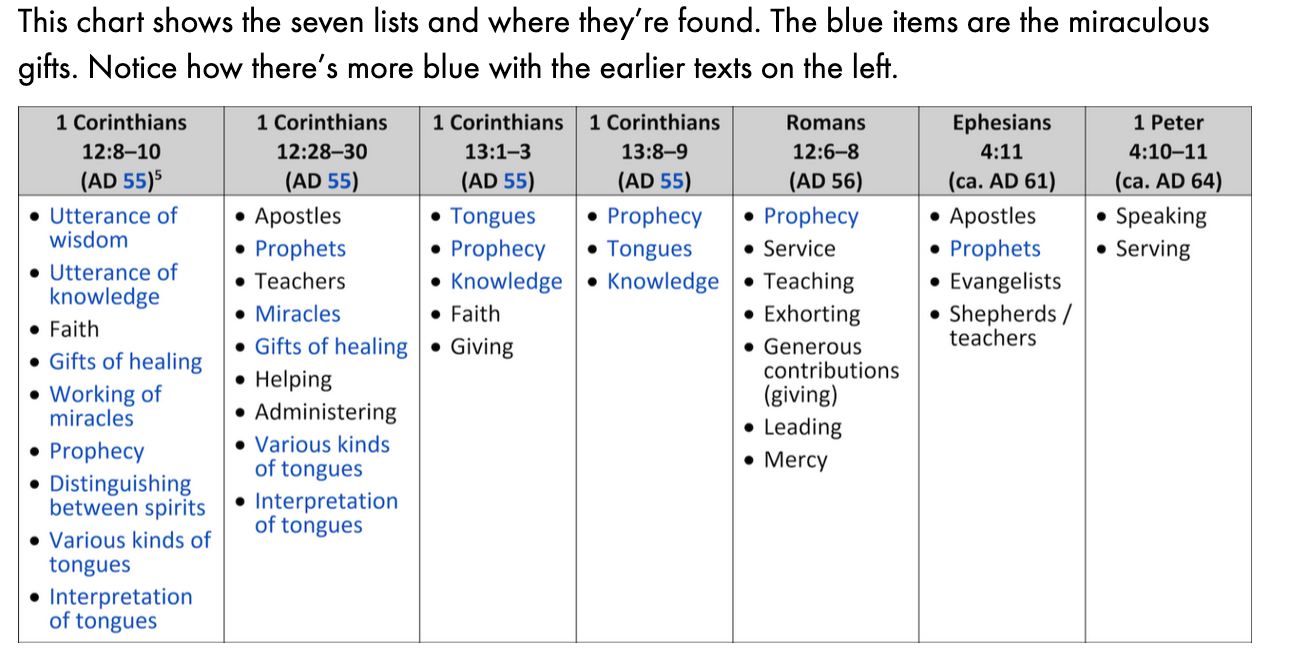
Also, Augustine said God seemed to use the supernatural gifts in the early days of the church. But he wasn’t using them anymore. For example, he talked about miracles when he said “Even though such things happened at that time, manifestly these ceased later.” He even reasoned that “miracles were not allowed to continue till our time, lest the mind should always seek visible things…”
The argument that gifts are for today because we see them occurring today is error since there will be many false wonders in the end times. Many antichrists have gone out into the world. We are warned again and again by Jesus and the apostles to not be deceived. Just because someone speaks in a tongue or “cures” someone, or “has a word” does not mean they are speaking on behalf of God. Plus, we are called to “Test all things; hold fast what is good” (1 Thessalonians 5:21). Only chaos and confusion and perversion come from the Pentecostal streams of Christianity.
Personally, I am somewhere in-between the two views. I can argue for continuationism because there is no mechanism by which the gifts should cease, until Perfection comes, which I would argue is Jesus. Then again, there does seem to be argumentation for them ceasing from both the decrease in importance in the biblical text as well as them being negatively referenced in the church fathers. Additionally, the myriad of counterfeits, heretical doctrines, and wackadoodles that populate the continuationist landscape does not help its authenticity. I would argue that it doesn’t matter. Whether there are these gifts (such as speaking in tongues) today, we should not be utilizing them in the assembly (which seems to be where everyone wants to do it). If there are miracles, they should be judged based on each instance, and if they are false, there should be immediate and draconian consequences in the church (so as to discourage the counterfeits in the future).
But, there is a plethora of churches, leaders, charismatic influencers, who propagate such insanity that it cannot be stopped. All we can do is protect our own churches, and the doctrine that is from the Bible. We are not to judge another man’s servant. God knows who are his. He will one day judge the entire world.
Discuss Saul’s family background and how he was unique?
Paul was not only a pharisee, but he was also raised as a hellenist, a Jewish person raised outside of Jerusalem. He was well educated, not only in Jewish custom and the Old Testament, but also in Greek culture and literature. He was part of the Sanhedrin, and was a persecutor of the church. This made him the perfect individual for God to utilize for his glory. If God can save Paul then he could save anyone, even the Gentiles.
Explain why you feel Jesus chose one of the biggest enemies of Christianity to be an Apostle?
This was addressed in the previous question. I believe God chose Paul, made Paul the way he was from the very beginning, to serve his purpose. Paul is the litmus test for the rest of us. If Paul can be saved then there is no telling who God will show mercy on and bring to salvation. It was his testimony that paved the way, in that period of time, in that culture, to spread the gospel far and wide, into every province, to every reach of the world.
K-W-L Self Assessment: L- Describe what you LEARNED from this session.
Nothing to add.
Lecture 8
Discuss the current implications of olam eybah of the Edomites.
This phrase is Hebrew for the “everlasting hatred.” It began with Esau and Jacob in Genesis 25:19-26, but continued on through the Edomites of the New Testament. This continues today in the war between the “Arabs” and the Israelites. The Edomites became the Idumeans, which assimilated into the “Palestinians” of today.
In which ways was Antioch an example of “new wine in new skins”?
I cannot fine an answer to this question. I have looked in the PDF, I have searched the transcripts of the video, I have watched the video. There is no mention of Antioch being an example of new wine in new skins.
Is anti-Semitism prevalent in the churches of today? Explain in what way(s) this is an unfortunate situation for today’s church.
Anti-semitism was rampant in the early church by the time of the 400s AD. There was a distinct distancing between Jew and Gentile by this point, save among the believing Jews and believing Gentiles. After the sacking of Jerusalem in 70 AD, the Jewish people were scattered. After this came the major persecutions of the church, and already after the first century persecution which was predominately at the hand of the Jewish non-believers. This and the hesitancy of the Jewish people to accept Christ in later centuries, promoted a hatred for the Jews, that is echoed in Martin Luther’s writing, and other legendary theologians of the time. This eventually grew into Ammillennialism, Preterism, and Supersessionism (or Replacement Theology). It was Replacement Theology that, in part, allowed the Holocaust to be perpetuated because the pulpits were by and large silent on the Jewish troubles.
Today we see a large swath of the church is anti-Semitic, does not stand with Israel in her right to exist, and accepts revisionist histories that perpetuate lies about the origins of the Palestinian people. We have seen support against Israel on college and university campuses in recent months and years, as well as the perpetuation of doctrines such as Supersessionism in churches.
Explain the phrase “who are those which say they are Jews, and are not, but are the synagogue of Satan?”
This is in reference to Re 2:9 and 3:9 and the “synagogue of Satan” or “those who say they are Jews but who are not.”
It is possible this is referring to legalists, or those who attempt to bring believers back under the law. But, Dr. Missler argues that this is referring instead to revisionists, those who are “false Jews.” Basically, he is referring to those who propose replacement theology and ammillennialism, that the church replaces Israel and receives the promises forfeited by Israel when they rejected the messiah. This presents them as “spiritual Israel” and would be argued those who “claim to be Jews but who are not actually Jews.”
Explain who are the “Edomites” of today?
Edomites are Palestinians of today as defined in the olam eybah question above. The Edomites became the Idumeans, which assimilated into the “Palestinians.”
Explain “Quartodecmism” and its implications for the early church and today’s church.
Passover and Easter are different celebrations that are co-located due to anti-Semitism in the early church. When Easter is spoken of in the Bible it is actually referring to Passover, not the pagan holiday of easter. This concept Quartodecmism refers to fourteenism, or the fixing of the celebration of the passover on the 14th day of Nisan (Lev 23:5; Ex 12:14). There were Jewish Christians that understood passover was central to the crucifixion of Christ and his offering himself as the sacrifice to God and wanted to celebrate it on the Jewish Calendar on the 14th of Nisan. But, the church wanted to separate themselves from the Jewish people because they were against the Jewish people (because of their blindness) and they excommunicated all who wanted to celebrate the Passover on the 14th of Nisan.
The church instead chose to worship Passover on a Sunday since 115-125 AD the time of Xystrus and Sixtus I. In 154 AD Polycarp tried to find a compromise with Anisettes, but Polycrates of Ephesus was in support of the Quartodecmists. The Council of Nicea ruled that Easter should always fall on a day that was not the traditional Passover date for the Jewish people. If you were trying to be biblical within the Christian church you were excommunicated.
The crusades witnessed horrid atrocities against the Jews in the name of Christ. Hitler was not only a Christian but he was never excommunicated by the Church. And now, we see the world and the church turning away from Israel once again.
K-W-L Self Assessment: L- Describe what you LEARNED from this session.
Nothing to add.
Conclusion
Great course. I think it provide a good overall survey of the first half of the book. I look forward to jumping into the second part of Acts and finishing it out. This next class will be my final one; then I will finish Silver and be moving on to Gold at Koinonia Institute.
Until my next post….

Excerpt from The Light Aurora:
The door’s lock released and Dr. Lewis looked around at each of them.
“Stay close, and be ready for anything. I’m not sure if they’re all in the Command Center or if they are trying to secure Level 4. Hell, they could all be evacuating.”
He stared at Scott as he came up onto the landing.
“Let’s go,” Scott said.
Dr. Lewis pushed the door open and walked out into the hall, followed by the others – in ones and twos. Level 2 was similar to the other level, with a long corridor, doors on either side, all with security displays recessed into the wall next to them.
But, as they entered the corridor, Scott’s breath caught in his throat. As he stood there with the others, he couldn’t believe what he was seeing. In front of them, probably no more than a few yards away, were three bodies lying on the floor. One was sitting up against the wall, the side of his face melted, exposing his right eyeball and a good portion of his right skull. Another one was laying face down, his entire back opened up at the spine, as if his spinal cord had been ripped out of him from behind. The last one was a few more feet away from the others, on his back, his eyes seared from his head, black, burnt flesh where his eyes used to be.
The intercom came back to crackling life.
“Professor?” Derrick said over the intercom.
“Don’t worry. You can answer,” he said. “I can hear you.”
Scott looked up, then fixed his gaze on the security camera at the end of the corridor.
“Yes?” Scott finally asked.
There was a pause, static.
“What are you doing, Derrick?” he asked. “Did you do this?”
“Indeed,” Derrick said, coming back on.
“Why?”
“They refused to help me.”
“What are you trying to do, Derrick?” Scott asked.
There was another pause.
“I want to go home, Professor,” the boy said.
“Home?”
“Yes,” Derrick said, his tone soaked with some other-worldly confidence that did not belong in an innocent, ten year old boy.
“I want to go home, Professor,” he said again. “Would you be interested in coming home with me?”
Buy the entire story The Light Aurora today and get ready for the thrill ride of a lifetime! What is this foreign and hostile place these strangers find themselves in? What does it all mean? Will all of them survive?
Click here and grab your copy today! All three books in one!
But, trust me when I say, reading this book will change your life forever.

What do you think?