

The next course I selected as part of my Unschooled Master of Theology program was the KI course, The Book of Acts Part 2, which is a detailed, verse by verse study of the second half of the Book of Acts.
As a reminder, you can all of my course assignments for the uThM here.
So, let’s get started….
KWL – What I Knew Before Starting This Study?
I know that the book of acts was most likely a trial document prepared by Luke for Theophilus to be used in Paul’s trial. But this is, of course, speculation alone. The book itself covers the work of Peter for the first several chapters, then concludes the rest of the book with the accounts of Paul. It always presents the issues surrounding the apostles troubles and challenges to be the fault of the Jews and not the Romans.
KWL – What I Want to Find Out in This Study?
Mostly I would like to develop a clear picture of the first century church and how she was organized, functioned, and dealt with challenges.

Lecture 9
Who ordained Barnabas? Was this unique? Explain.
It was actually the Holy Spirit that said, “Set apart Barnabas and Saul for the work to which I have called them” (Acts 13:2). And so then the church fasted and prayed, laid hands on the two, and then sent them away.
Dr. Missler discusses briefly that there is no certainty concerning the “laying on of hands” in the Bible. Some claim that it is a mystical event, while others state it is just a “partnering with” those God is sending out.
In the second respect, I would argue this being “sept apart” by the Holy Spirit is no different than any other calling before God. For, none of us is called by each other, but we are called by God and equipped, gifted, and so sent by God. The church may or may not recognize our gifting, our calling, and partner with our sending.
I am confronted with this very possible reality in future months, as my wife and I venture down the road (prompted in no small part by KI) of full time para-church ministry. I have no idea where it will ultimately lead, if it will actually accomplish anything for the Lord. I pray it would. But, I am now (again, thanks in no small part to KI) a part of a local assembly of believers where I serve full time, and this church will have an opportunity in the future to “partner with us” in prayer and the then eldership of the church, could opt to lay hands on us and send us out for this work. Or, they could not. The ministry in which we are engaging in is not a little controversial. It is highly evangelical but deceptively so. It operates entirely upon Paul’s statement, “I have become all things to all men, that I might by all means save some” (1 Corinthians 9:22) and, “Whatever your hand finds to do, do it with your might” (Ecc 9:10), and “And whatever you do in word or deed, do all in the name of the Lord Jesus, giving thanks to God the Father through Him.” (Colossians 3:17).
We plan to have a “new age” looking business establishment in the middle of our tiny town, in effect. I will be engaged in writing paranormal, supernatural, suspense novels that focus on serial killers, witches, ghosts, and all matter of macabre. But, God has moved and shaped this work (that was not Christian per se in the beginning) for his purposes, and now we can use these stories as a platform to hopefully and prayerfully speak to people who are the “nones” of society. We would hope that God would give us the ability and the call to reach out to those who are in this subculture, who are pagan, who are self-proclaimed witches or Wiccans, who are Satanists, and through the use of these stories, workbook classes, in house classes, external community classes, and online discussion classes, and in-person speaking engagements be able to help those who are being drawn by God to Christ find Jesus and enter the church that they would otherwise avoided at all cost.
I am uniquely prepared for this work as God has given me the ability and desire and gifting to speak through the written word. He has given me the ability to create stories that others seem to enjoy and who want to read. If it be his will, he could use this platform for his glory. I also have a similar history as these, being a Satanist in my early childhood, then a Buddhist, and being overly enamored with the macabre, and also being provisioned and blessed with a family that is likewise so oriented, we are all very comfortable in these subgroups and do not shrink back from such supernatural or demonic activities. And, so we step out in faith and hope and pray he will guide us in our way and in this work.
But, the local church is very conservative. They are very fearful of things they do not understand. Just the mention of Halloween sends some of them reeling the other way. The leadership of the church may not agree, may not see the validity of this work. They could see this as too great a compromise for the sake of reaching some for the gospel. Then what? I know they would be willing to pray for us and our ministry efforts regardless. But, I would personally want the blessing, prayers, and for the elders of the church to lay hands on my entire family and send us out for this important work. But, I feel as if I cannot ask this.
But, what happened here in Acts 13:2 provides some comfort to me in that it was the Holy Spirit who calls us, and sends us, not necessarily the church, who just partners with us in the sending. Just because the local church does not agree or understand, does not negate the “ordination.”
Why was Paul stressed over Mark’s departure?
This issue centered around the circumstance that apparently had happened in Pamphylia, when Mark had abandoned them and had not gone along with them to finish the work there. Paul considered this a violation or resulted in Mark’s unworthiness or unreliableness for another trip (essentially to the same places). This was Barnabas’ cousin (Col. 4:10) and so he did not agree with Paul. This became such an issue that Barnabas and Saul split and went different routes. But, in the end, Paul would find a great use in Mark (2 Tim. 4:11) and the differences between them were resolved. But, as Dr. Missler has stated in other lectures, it was this disagreement that split the team into two so that twice the ground could be covered. We don’t often view disagreements this way, but we are promised that “And we know that all things work together for good to those who love God, to those who are the called according to His purpose” (Romans 8:28). Even our disputes with one another are opportunities and can sometimes (if not all the time) be provisions and situations prompted by God.
List occasions in which there were attempts to worship mortal people in the Biblical narratives.
The main scene we are dealing with is the point at which Paul and the others went through Iconium, Lystra, Derbe, where they were worshiped as gods; then stoned (to death?)…These were the Galatians of Paul’s later letter (Acts 14:11–18). These were, like many others, illustrating the point made, “Professing to be wise, they became fools, “and changed the glory of the incorruptible God into an image made like corruptible man—and birds and four-footed animals and creeping things.” (Romans 1:22–23).
This can also be seen throughout biblical history, such as Nebuchadnezzar’s gold statue (which was possibly in his image) in Daniel 3, the Egyptian Pharaoh worship, emperor worship in the Roman Empire where the people were instructed to give a pinch of incense and were punished if they did not, and Augustus (Octavian) being included in the Imperial Cult where he was worshiped and where people prayed to him.
Today people often view God through a cultural lens that is less than biblical. Folk theologies, false theologies, unbiblical versions of Christianity all skew who Jesus truly is. They often discount the inerrancy of Scripture, the miracle of Creation (and replace it with an evolutionary worldview), others demand that God is a God of “love” and no hate, no jealousy, no vengeance, because their own worldview demands complete inclusion regardless of absolute truth (they would even argue to say there is no absolute truth). This is taking the Word of God and interpreting it through their own cultural lens and through their own ideologies.
Why are the “missing years” of Paul relevant?
The three missing years occurred after the experience on the road to Damascus to his working in Jerusalem, which it is presumed he spent this time in Arabia. It is presumed by some that Paul spent at least two of the three years in the desert and received instruction directly from Jesus (Acts 20:24; 1 Cor 11:23; Gal 1:12).
What does it mean to be “God-fearing”?
The phrase “καὶ οἱ φοβούμενοι τὸν θεόν” (Acts 13:16) reminds us immediately of Proverbs 9:10 “fear of the Lord is the beginning of wisdom” and Proverbs 1:7 “fear of the Lord is the beginning of knowledge.” But, as Missler states, “there are seventeen words in the Hebrew that are translated into fear in English bibles, but they miss the impact of most of those words. Almost all of those words involve trembling and terror. We need to recognize that we are dealing with the God of the universe.”
It is not simply awe or the payment of homage. We are dealing with a very severe and sobering situation when it comes to God. Paul concluded in his letter to the Hebrews, “It is a fearful thing to fall into the hands of the living God” (Hebrews 10:31) and Jesus himself stated, “I will show you whom you should fear: Fear Him who, after He has killed, has power to cast into hell; yes, I say to you, fear Him!” (Luke 12:5).
To be god-fearing is to recognize first who God is, and then in response recognize who we are before him. We should tremble at the thought of it all.
Explain Paul’s tactfulness in dealing with Elymas.
In Acts 13:6-12 we find Paul and company going through the island to Paphos, and a Jewish sorcerer, a false prophet, named Bar-Jesus (presuming this is the same man as Elymas the sorcerer, his name being translated to this from Bar-Jesus; Elymas is Arabic meaning “all knowing one, wise one”) withstood them trying to turn the proconsul away from the faith.
Paul’s response to the man is anything but tactful. He simply tells him that he is:
1. Full of all deceit and fraud
2. He is the son of the devil
3. He is the enemy of all righteousness
4. He never ceases from perverting the straight way of the Lord
5. The hand of the Lord is actually on him
6. He would be blinded by God (for a time).
The sorcerer is then blinded by God and he had to be guided by other people.
K-W-L Self Assessment: L- Describe what you LEARNED from this session.
Nothing to Add.

Lecture 10
What were the two primary concerns addressed in the Council of Jerusalem? How were they each resolved?
The first was, do the Gentiles need to come under the law in order to be saved. The second was akin to the first: if the Gentiles do not need to come under the law to be saved, then what becomes of Israel?
This was addressed by the apostles at the “council” when they determined that the Jews would be saved in the same manner as the Gentiles. That they would both be saved by grace through faith.
I would argue that, while this is technically true, the Jews will be saved corporately, while the church is saved individually. After the Jewish people rejected their messiah, they received a blindness (or the blindness was given beforehand so that they would reject their messiah) that would continue until the last person of the church was brought into the church. The church would be a drawing out of all the nations (including Israel) of a people for his name, and this has progressed now for 2000+ years. But, once the final person is saved and added to the church (I would argue his name is already written in the Book of Life, but only God has access to this book), then God will tell Jesus to go get his bride, and Jesus will return for us, we will be resurrected and then subsequently raptured to meet him in the air and “forever be with the Lord.”
Once the rapture takes place, God will then return his attention on Israel, they will be pressed to the wall, they will have the blindness lifted from them, and they will endure the 7 years of tribulation. They will then go through the 1000 year reign of Christ (I don’t know if they will completely accept him yet), and then the final battle, then God’s deliverance, and final judgment at the Great White Throne. At the final battle, just before the Israelites (and the saints, whoever these are) are wiped out, God rescues them, and they see him for who he is, and they will accept him and then “all Israel will be saved.”
Why does the Scofield Bible suggest Acts 15:13 is the most important dispensational passage in the New Testament?
It talks about the divine purpose for this age and the beginning of the next. Scofield here points to 1. The gathering of the church, the calling out of those from every nation and tongue, which has been happening over the course of 2000+ years. 2. The turning of his attention back toward Israel once the church is complete and raptured from the earth. 3. The reestablishment of the Davidic Covenant, the building of the tabernacle of David. This will be the reestablishment of Davidic rule over Israel.
Discuss how the Holy Spirit guided Paul’s moves in this session. What are the lessons for us?
First, they went to Phrygia and Galatia but were forbidden to preach in Asia. They were likewise stopped from going into Bithynia. We have to be available and willing to redirect, rethink, and accept when God tells us no, regardless of whether we understand it or not. We also need to be self-aware enough to discern accurately what God is telling us. Otherwise, we would be hit and miss or would be deceived.
Discuss who constitutes “the synagogue of Satan”?
These are believers who claim in some fashion to be “Jewish” but who are anything but. Many would argue these are the judiazers, those who are “believers” in name, but in doctrine try to subvert the gospel and bring others back under the law. But, Dr. Missler believes these are those who accept replacement theology. This is referring to those who claim that the church has replaced Israel that Israel has forfeited the promises in the Bible and that the church would receive those promises instead.
I would argue that the latter interpretation would more closely fit the literalness of the phrase. But, again, there is no way to be sure. There is not enough information to go on, not enough contextual clues to help us orient the text toward anyone in a particular part of human history. One of the main problems is, we have no idea what God is doing about timespan. As Peter reminds us, “The Lord is not slack concerning His promise, as some count slackness, but is longsuffering toward us, not willing that any should perish but that all should come to repentance” (2 Pet 3:8-9).
It is entirely possible, more probable, that the entirety of societies known to us today and throughout our human history will cease to exist, by one measure or another. New societies will form and fall, throughout God’s long-suffering, and that in some distant, yet unknown and unknowable future, this phrase is about.
Paul would have no concept of a 2000+ year-old church. He was convinced that the time was short, and the day had dawned (1 Cor 7:29-31; Ro 13:11; 1 Pe 4:7). It is just as possible that we, as the modern church, are still actually part of the Early Church in the scope of God’s plan of salvation. There could be another 5000 years left of redemption and the age of Grace. Another 10,000. 50,000 even. God is long-suffering and we have no concept of what lengths God will go to to save those he has predestined.
Give personal contemporary examples of how the Spirit guides you.
I would argue there are primarily four ways in which God has or does guide me through life:
1. Personal Conviction – I would say this is not the most prevalent method that he uses, but it is ever-present in my life and my daily walk. It can overtake me at any moment, and it carries with it a surety, a clarity, and an unrelenting purposefulness that is sometimes refreshing but other times quite disconcerting. The personal conviction that I should prepare for a future wife two years ago. The conviction that I needed to go back into service to the church and to other believers after having left the ministry back in my twenties. Now the conviction that, regardless of what happens geopolitically in our state, we are to remain here and to serve the church in whatever capacity necessary. These are all direct and personal convictions that do not waver. They ring true as the sun does shine, for good or ill. And the convictions in the past have predominately come to fruition.
2. The Word of God – This is much more prevalent than the first, and has been the primary guiding force in my life since I was 17 years old. At that time God gave me an insatiable thirst for his Word, and I have served and fed that preoccupation all these years. It has been natural, comforting, and soothing to devote my free time, my vocation, my whole to the study of the Word. He has made it a personal and intimate joy in my life. I am certainly not a perfect man, and have not walked so circumspectly that I am without sin or without need of pulling the plank out of my own eye. But, I have endeavored, or do endeavor to live by the Word of God as my personal ethic and code; it is my rule of life.
3. Other People – this is more prevalent as of late, as only recently has God placed me in the predicament that I am forced to be around people, to be involved in people’s lives, and to submit to them in the love of Christ. In their encouragement, in their rebuke, and in their correction, in the trials produced by interaction with them, I am forced to allow patience to have its perfect work in me. I am thoroughly encouraged, humbled, befuddled, and blessed to be now in this way truly a part of the life of the church.
4. Experiences – this is the last way in which I am guided by God in my life. These are the ordinary trials, struggles, and difficulties that arise from simply living. But, God has promised us who love him that, “all things work together for good, to those who are called according to his purpose” (Ro 8:28). For everything, the good, the bad, and the indifferent, it is all for my benefit. Even the dark shadows that we walk through in life, they are promises to us that God loves us and that he will protect us and he will preserve us, regardless of what happens to us in this mortal life. It is a promise that no one else truly has. It is something that only we who hold truly the message of the Bible, can carry into our infirmities, in our afflictions, that whatever it is we are going through, it is for our benefit, for the benefit of someone close to us, or for the benefit of someone who we might not even yet know.
What is the “Kingdom Perspective,” and how is it distinctive among Christians today?
I couldn’t find this referenced in the lecture specifically, but I think he is referring to the idea that we should be focused on the return of Christ, the premillennial reign of Christ for 1000 years on the earth, as is predicted in Scripture, and not allegorize it away as is the most prevalent view in modern times (Dan 9; Isa 63; Zech 12, 14; Rev 12; Hosea 5).
We have seen the restoration of Israel in the modern era. This is a miracle in and of itself and it seemingly came into existence through miraculous means and against heavy opposition. But, this is not the Tabernacle of David, nor was David’s thrown active during the time of Jesus (the Romans ruled Israel). Yet, we see too often, the church obfuscating and re-explaining the Word of God to conform to their own presuppositions. They want the church to be the replacement for Israel, out of a deep-seated animosity against the Jewish people for early persecution, for fanatical antisemitism, because of the blindness that Israel has against her messiah and the gospel message.
But, we are not called to judge another man’s servant. We are simply to declare the message of the gospel and to incorporate those who are being drawn to Christ by the Father. There will be false teachers, there will be ravenous wolves, there will be struggle and trial and tribulation, for this is how we are to enter the kingdom of God (Acts 14:22). We need to avoid those false “kingdom now” doctrines, the dominionists, the deconstructionists, and instead put our reliance on the pure, unadulterated message of the Bible and recognize that God promised that David’s throne would again be established (Lk 1:32-33).
K-W-L Self Assessment: L- Describe what you LEARNED from this session.
It is interesting in Acts 15:12 that Barnabas is mentioned before Paul as if Paul did not yet have prominence in the early church. It was, in fact, Barnabas who introduced Paul to the assembly in Jerusalem (Acts 9:26-27). Who was Barnabas, an apostle, before Jesus (Ga 2:11-13; Acts 14:14)? I am certain we see Paul taking over as a leader of the church only in the context of our perspective from the Bible. In reality, God is working through the lives of countless individuals in a myriad of ways, throughout the world and in all contexts of time. We all play only our small part. Paul is neither greater or lesser than Barnabas, but, they each serve their individual purposes to bring the body of Christ into the fullness of Christ (Eph 4:16).
I thought Dr. Missler brought up a good question, in that, if winning and losing was settled at the cross, why does Satan continue his attempts at thwarting the plan of God? Why is he after Christians? Why is he after the Jewish people? The reason is the second coming of Christ (Hosea 5:15). The Jewish people must acknowledge their offense. He Satan can destroy the Jewish people and especially jewish believers, then he can at least impede the final judgment against him. He is trying to slow down the clock.
This lends to the next statement Dr. Missler made in that he thinks the “fullness of the gentiles” is coming soon because now Jewish Christians is a manifestation that is relatively accepted in Israel when 20 or 30 years ago it was not. He believes this means the “blindness in part” is being lifted from the Jews.
Lecture 11
Explain how you apply the attitude of the Bereans in your life.
Acts 17:11 states, “These were more fair-minded than those in Thessalonica, in that they received the word with all readiness, and searched the Scriptures daily to find out whether these things were so.” This is known as the faithfulness of the Bereans, in that even though they fully believed and were indwelt by the Holy Spirit, they still endeavored and wrestled with the Scriptures daily, making certain that what was being taught to them by the teachers and apostles and other leaders was the actual truth of the Word of God.
As Dr. Missler stated in the lecture, the first critical step is “fear of God” (Pr 9:10). This is the readiness of the mind that is a prerequisite to the acquisition of truth. He stated that we are to seek protection in the Word alone, and not in other people, in denominationalism, ideologies, worldviews, or in our reasoning. This is because, as Jesus stated to the Jews, “You search the Scriptures, for in them you think you have eternal life; and these are they which testify of Me.” (John 5:39).
We are, without the Bible, which is the message of God to man, lost in a sea of relativism, of oscillating and competing opinions and ideas, bounding on incessant waves of indeterminacy. As Paul prescribed a solution in Ephesians 4:14, “That we should no longer be children, tossed to and fro and carried about with every wind of doctrine, by the trickery of men, in the cunning craftiness of deceitful plotting.” We are in Acts 17:11, warned to not follow a single individual but to rely instead on the Holy Spirit, as Paul echoes again in 1 Corinthians 3:3–7. The reality is, that there will be in the future miracles and supernatural events that will fool the masses and we are to be wise to have the antidote to this (James 1:16; 1 Cor 6:9; 15:33; Gal 6:7; Luke 21:8; 2 Thess 2:11Rom. 1:28).
As for myself, I was supernaturally instilled with a predilection for the Word of God at the age of 17. It was not my doing. It was not something that I desired to pursue. It pursued me. I tried to run, I tried to throw it off, I tried to reject him and return to my old ways, to my old ideologies. But, God held me fast, he would not relent. And his word had its way.
Early on, though, I recognized the fallibility of men in Christian circles. There was a plethora of ideas, of opinions, but the Bible was superior to all of them, and the Holy Spirit has been placed in me for the particular and peculiar task of “teaching me all things, and bringing me to remembrance of all things” (John 14:26). I quickly learned that my final authority rests in the Scripture and not in the opinions or doctrines of men. I recognized that, while often useful and edifying, the teachings and opinions of individuals and institutions can and do change, can be and often are deceptive, misleading, and confusing, and many times the terminology could be intentionally or inadvertently conflated with what is true.
Thankfully, within three years of being saved by God at 17, he led me to a small Baptist church where I was exposed for the first time to Dr. Missler’s teachings via cassette tape. He was pointedly different from the sea of voices that were pressing to convert me, convince me, and condemn me as he pointed to the Scripture and said “This is what I think it means, but you need to determine that for yourself. Do not take my word for it.”
And, so, I early on adopted the rule to “search the Scriptures daily to find out if what others said was found in the Bible.” Likewise, I was driven by an insatiable thirst for his Word over the years, replacing many if not all of my other preoccupations, so that I would and could study full-time. By becoming intimately familiar with the original, I was able to more easily identify the counterfeit when it came around. This has served me well over the years and continues to do so.
Give examples of idolatry in our lives today. Why is idolatry hated by God?
Without the overtures, we still have all of the same idolatries that we had during the Athenian days. We are still idolaters at heart (Ex 20:3-6; Isa 44:9-20; Jer 10:3-5; 1 Cor 1:21). We are hedonists, we are materialists, we are deniers of the afterlife, and pleasure seekers. We are becoming more so pantheists, apathetic, fatalistic, passionless, nitpickers, and now we see ourselves inundated with the religious odd-ball, with many held captive by superstition, the delusion of self-sufficiency, and an outright revival of demonism, witchcraft, and sorcery.
But, more than any of this, we find ourselves idolators of distraction. All manner of our life can and often does get in the way, gets in between us and the God we serve. He wants us to lean on him and not on our own understanding. Yet, we continually second guess Scripture, continue to undermine it, and perpetually relegate it to myth, to moral teaching, etc all so we can disregard it whenever it suits us best. Many churches today have no appetite for the real message of the Bible and so they compartmentalize it, allegorize it, and brush it aside for their moralistic futility.
God hates idolatry because it places something in between God and man. It identifies true loyalty or lack thereof and this world is ultimately about choosing sides in the war that is raging all around us.
Discuss the merits and dangers of Henley’s poem, Invictus.
I did a little searching (actually trying out Grammarly’s AI Chat for the first time) and found some background on Henley and the possible motivations for writing the poem. It appears he wrote Invictus, a Latin word that means “unconquerable” or “undefeated,” in 1875 during a time when Henley had been diagnosed with tuberculosis of the bone and the age of twelve and subsequently had his leg amputated below the knee. But, despite his hardships, he persevered, and this poem came out of those trials in his life.
The first Stanza:
Out of the night that covers me,
Black as the Pit from pole to pole,
I thank whatever gods may be
For my unconquerable soul.
The first line talks about emersion from trial and tribulation. From darkness to light, from trouble to salvation, from enslavement to freedom. The second line describes the “night” from the first line. It is black as “the Pit” from pole to pole, i.e. the “pit” is that proverbial Pit, Abaddon, the abyss, the bottomless pit, hades, the abode of the dead, and it is descriptive of the entirety of that forboded place (i.e. from pole to pole).
An issue arises in the third line, for Henley here announces his lack of loyalty or declaration to any one particular God, in his invocation to any gods that might be. This might be a linguistic license to indicate the depth of his desperation, in that he would invoke “any god” if it meant that he could have recourse. Or that he is so desperate in his affliction that if his particular God could not or could not accomplish the task, he would render homage to another, or any other. The difficulty, though is he “gives thanks” to “any God that may be.” This would lead me to believe he is willing to accept any God as long as his aspiration is achieved.
An “unconquerable” soul is an interesting concept. In my estimation, this is synonymous with an immortal soul. Unfortunately, without Christ, it is a condemned soul, regardless of its resilience.
The second Stanza:
In the fell clutch of circumstance
I have not winced nor cried aloud.
Under the bludgeonings of chance
My head is bloody, but unbowed.
This is a testament to his courage, resilience, and endurance under the pressure and burden of struggle and trial. We are called by God to “let patience do its perfect work” (James 1:4). But, of course, here we see him disregard the one individual to whom is responsible for his “fell clutch.” Namely, he has again disregarded God, the creator of the universe, the maker of everyone and everything. Instead, he has left fate to “circumstance” and “chance” in this world, it matters not what he does. He can cry aloud, he can keep silent. He can bow or refrain from doing so. Nothing matters in a Godless world that is determined by chance rather than providence. Again, in this stanza, he is unwillingly or unknowingly refusing to pay homage to the King of the universe.
The third Stanza:
Beyond this place of wrath and tears
Looms but the Horror of the shade,
And yet the menace of the years
Finds, and shall find, me unafraid.
It is well said that “this place” is one of “wrath and tears.” For the world is death and misery, and the people therein upon it are truly the hell in which we live. And, in this journey we all find ourselves placed upon, the horror of it is the impending death that waits for each one of us at the end of that journey. And it is a blind alley of unknowns. We recognize that our days are finite and numbered, but we do not know the number itself. Thus, we are left in limbo, second-guessing, and waylaid by uncertainty.
But, simultaneously, there is a “menacing” of the years as they tick by. We squander our time here on this earth, time with our loved ones, time with the good things of this life. The author claims that he is not in this camp, that, despite the misery of life (which would be much more his experience than ours today), despite the horror of encroaching death, and regardless of the uncertainty of our time here remaining on earth, he will stand against it all, unafraid. The struggle I have with this attitude and disposition is singular: “The fear of the Lord is the beginning of knowledge” (Pr 1:7, 29; 9:10; 14:27; 15:33; 16:6; 19:23; Ps 19:9; 111:10; Ecc 12:13), not the bombastic fearlessness of anything and everything including death and the incalculability of time itself.
The fourth Stanza:
It matters not how strait the gate,
How charged with punishments the scroll,
I am the master of my fate,
I am the captain of my soul.
Lastly, we come to the final stanza where the author makes an off-handed comment, I think, toward the “straight gate” of Jesus and to the “punishments” predicted in “the scroll” which I take to be a reference to the future prophecies found in the Bible of Christ’s second coming. He is basically stating that despite what the Bible says, despite the predicted condemnation coming onto all who are not saved in Christ, the author is resolved: he is “the matster of his fate,” and he is “the captain of his soul.”
While I actually have thought fondly of this last stanza, which is quite popular and well known, I think there is actualy some biblical validity to this last statement if, indeed, we are governed by “free will” in this life. If so, if we are autonomous beings that make choices freely without interference of our God (or any God for that matter), then it would stand to reason that we are in control, we are the ultimate determinator of our ends. As is often said colloquially in evangelical circles, “No one will be in hell by force, it is a choice. It is a failure to accept the free gift God has offered them.” While I can understand the impetus behind this kind of thinking, I do believe it is a little short-sighted and a bit superficial theologically.
I would argue against free will and for the providential sovereignty of God over everyone and everything. God knew us before we were ever born, created, or conceived. He wrote down everything that we would ever do before any of those things existed before we did them (Ps 139:16; Eph 2:10). It is, likewise, God who determined before he made each one of us, who we would ultimately be, for he made us this particular way, for his particular purpose (Ro 9:22). It is important to recognize the “straight gate” and the warnings we find in Scripture. For they are life to flesh and strength to our bones (Pr 3:8). After all, as Paul so eloquently concluded, “It is a fearful thing to fall into the hands of the living God” (He 10:31). No truer words have ever been spoken.
If providentially directed, we are neither masters of our fate nor are we the captains of our soul. In fact, it is God alone who can and will destroy both body and soul in the Lake of Fire. We are apt to listen to his admonition.
Discuss why university environments are so resistant to the Gospel?
This is a deep well of a subject in the age in which we live. It spans over 100 years in development and is now a metastasized cancer that has pervaded the entirety of our culture and social strata. It was likewise not by happenstance that we find ourselves here, but by concerted effort over the last several generations, through the progressive work of socialists, antichrists, and communists in this world, we find ourselves in the West being “overtaken” by a secular religion that permeates all of life and culture and society.
First, the Bible was removed from schools. Not to say that the culture of the 40s and 50s was anything at all biblical. But, to segregate life and society from the biblical message was detrimental to that societal life. This propagated “knowledge” for its own sake and elevated the secular above the theological, then entrenched over 50-100 years the new religion of “scientism” that is hostile to the biblical message or even the very concept of God. Relativism replaced absolute truth, and this eroded the knowledge base in the ivory tower of academia (which was the overall intent).
Public school became compulsory early on during this time period, forcing children to go through 12 years of increasing indoctrination into this new religion. This led to countless generations entering college and being further indoctrinated. Now, most of these institutions of higher learning are havens for thinking and ideologies that are hostile to the gospel, to the Bible, to Christianity, and ultimately to God. It has become the epitomy of 1 Co 1:23-24 “But we preach Christ crucified, to the Jews a stumbling block and to the Greeks foolishness, but to those who are called…Christ the power of God and the wisdom of God.”
Those who accept this strong delusion of Scientism and secularism, humanism, and the ideology of wokism, find themselves victims of Romans 1:18-26, for God has “given them up to their vile passions.” He has turned them over to a “futile mind.” They are set adrift and receive that for which they have clammored: a life void of God.
Contrast the distinctions between the Epicureans and the Stoics.
Epicureans were a materialistic group who denied God, and life after death, and sought as their chief concern tranquility through the experience of pleasure. This was considered by them one of the highest goods in life, and they lived for the moment, either as a mechanism to achieve genuine and lasting tranquility and fulfillment or as a hedonistic enjoyment of pleasure for its own sake. A major focus was the avoidance or absence of pain (ataraxia), and removing this was believed to provide tranquility. They focused on emotions unfettered, unlike the Stoics, and pursued pleasure as natural and commendable, emphasizing intellectual pleasure over the baser physical pleasures. They sought a contemplative life that was rooted in philosophical and introspective thought, but simultaneously highly prized the experiential.
Stoics, on the other hand, were hyper-focused on self-control. They wanted to control every aspect of their makeup, from their emotions, goals, and aspirations, to their thinking and their behaviors. They emphasized virtue, wisdom, justice, courage, and temperance in all things. They wanted to be in harmony with nature, and did so through rational thinking, ethical behavior, and surrender to the reality that they were powerless against external events, but were completely in control of their responses to those events. They did not pursue experience for its own sake but desired to control them, transform negative emotions into positive ones, and see pleasure as a secondary aim of life. Their first aim was the achievement of tranquility and inner peace through self-disciple and rationality.
In the end, both Stoicism and Epicureanism sought the same goal: inner peace and a well-lived life. Their process, the mechanism by which they derived their aim, though, was radically and diametrically opposed. Sadly, the one unifying characteristic of both, was their insistence that God in no way existed or was in control of anything.
Explain what Paul’s main focus was in Corinth? Where and to whom was he preaching?
Paul used strategic centers in his travels so that the gospel could be maximally spread organically. Cornith was the commercial and political center in Rome at the time he arrived there. It was a capital city, and the region was boasted as a university center, the residence of the great philosophers of Pericles, Demosthenes, Socrates, Plato, Aristotle, Sophocles, and Euripides. Despite being 400 years after the golden age of Greece, the area was still the center for art, beauty, culture, and knowledge. It was also still the center for all manner of paganism. Athens had Minerva (the goddess of wisdom), and Corinth had Venus (the goddess of love). These were two forces that enslaved the masses in this culture: intellectual pride and sexual lust.
Paul used this backdrop and centeredness to preach, teach, and profess the risen Christ, and this, in turn, spread the gospel far and wide. In writing to Cornith, he predominately focused on correction, attempting to fix the failures the believers there had succumbed to in his absence.
K-W-L Self Assessment: L- Describe what you LEARNED from this session.
[This was not in my original post submitted for at KI, but was added later.]
In Acts 18:5, there was an interesting comment Dr. Missler made about the text having a variant reading. I stopped and looked it up and found something quite bizarre. This verse reads differently:
“Paul was compelled by the Spirit” (NKJV).
“Paul began devoting himself completely to the word” (NASB).
The NIV states he was “Engrossed in the word,” or he “devoted
himself exclusively to preaching.” It is argued that this meant prior to Timothy coming, Paul had done bivocational ministry as a tentmaker. But, since Timothy brought funds fromt he church in Thessalonica, Paul could focus on preaching full-time.
The vulgate supports the critical reading with, “instabat verbo” which means “pressed with words” or “insisted with words.” I don’t pick sides any longer when it comes to textual variants. I take them all in and accept them all as what they are, and attempt to make no deduction as to who did what. Did the Critical text scribes remove the original? Did the Majority text scribes add or smooth out the text? My reasoning is this: in this instance, why would either need to do either? Looking at “συνείχετο τῷ πνεύματι” why would the Critical text scribe have issue with Paul being “pressed by the spirit?” And, if the Majority text scribe looked at “συνείχετο τῷ ⸀λόγῳ” why would he have any issue there as well? There is no driving motivation for the change. Accidental transcribal error? Possibly. Who cares. I’m thankful that we have both and that the documents are readily available and the difference in the texts are well documented. Scholars have gone to painstaking efforts to document, catelog all the textual variants found in the 6000+ NT manuscripts that we have existant today, all so we could have them at our fingertips in our apparatuses and in our Bible software, and even in our UBS, NA28, and Schofiled Textus Receptuses. It is truly a great age to be studying the miracles and mysteries of God’s Word!
Acts 14:14 is an interesting verse, which states, “But when the apostles Barnabas and Paul heard this…” There is no good explanation for this except to say that at least Luke concluded that Barnabas and Paul were both apostles. In like manner, some use Ro 16:7, “Greet Andronicus and Junia, my countrymen and my fellow prisoners, who are of note among the apostles, who also were in Christ before me.” to indicate that Paul considered Andronicus and Junia to be apostles as well, though the wording here is much less clear, as it could be translated that these two were “of note among the apostles,” meaning that the apostles (the 12) knew and were aware of these two (who were not themselves apostles). The first, though, is not as easily dismissed.
Lecture 12
Discuss the strengths and weaknesses of Apollo’s understanding.
In Acts 18:24-28 we are introduced to Apollos, who had many characteristics that were quite admirable. He was a man of eloquence, was knowledgable in the Scripture, and had been instructed in “the way” (Mt 3:3; Isa 40:3). He was described as being fervent or boiling in the Holy Spirit for the things of God and he taught accurately that which the Scriptures spoke of. He was not only highly competent in his knowledge and understanding, but he was highly teachable and open to correction.
This teachable and humble spirit led the way for Priscilla and Aquila to take him aside and explain to him the entire gospel message (Acts 19:4–5), which came after the teaching and baptism of John the Baptist. This was because Apollos only knew the baptism that John provided, which was a baptism of repentance for the forgiveness of sins which would be brought about by the one who would come “after” John, namely Jesus who was the Christ. In Apollos’ teachings, he was most likely missing the actual events and work of the cross, the resurrection of Jesus from the dead, his defeat over the power of the grave, and the indwelling of the Holy Spirit. The last was more significant for them as it was the first time we saw the Holy Spirit operating differently than in the past. Previously it would come and go as needed, but now the Holy Spirit was entering individual people permanently, sealing them for the day of redemption, and then working out the individual’s salvation through continual and progressive work in the life of a believer from the inside out.
Explain the meaning of an “entry” in spiritual warfare. In today’s culture, what “entries” are readily available?
In (Acts 19:11–20) we see the demons going after and humiliating the Jewish exorcists who attempted to exercise people in the name of Jesus. This represents an “entry” into the occult, into the paranormal, or the supernatural world. Interestingly, the exorcists were swimming out of their lane, as the demon replied to them, “Jesus I know, and Paul I know; but who are you?”
They were ultimately driven out of the house naked by the demon, humiliated. This sparked a kind of revival against the occult, where many believed, and confessed their sins, and many who practiced magic brought their enchanted books and burned them. These books also serve as an example of “entry” points to the occult and to the supernatural world. All the paraphernalia that are used in the occult practices are tools of entry. The same can be said for less overt items and activities, such as stories, television, video games, role-playing games, etc. While human beings are, apparently, not easily invaded by demonic beings, they can enter into an individual who provides explicit or implicit permission to do so. Dabbling in the occult is one way of providing such permission. These activities are not harmless entertainment.
As Dr. Missler points out, these creatures are not euphemistic for psychiatric disorders. They are real. They are powerful. They are malevolent beings. They are more knowledgeable than we are concerning the other realm of existence, and yet, God can and does use them ultimately for his glory.
Explain the main admonitions Paul gave the Ephesian elders at Miletus.
In (Acts 20:15–38) we have Paul sailing to Miletus and he summoned the elders of the Ephesian church to him so he could bid them farewell. In talking to them he laid out his track record that they would have remembered full well. His service in humility and in tears and trials, under persecution from the Jews, how he had kept nothing from them, how he had taught them both publically and also privately from house to house, how he had shared the gospel of God and faith in Christ without partiality to both Jew and Greek, how he would now be heading to Jerusalem a prisoner for the sake of Christ, with no knowlege of what his final fate would be.
But, despite all of this uncertainty, he was unconcerned, because his plight was a positive for those throughout the region who were now hearing his testimony and being saved. If it meant he had to die for the sake of the gospel, he was willing to do so. He wanted to finish his race well and with great joy. He wanted to impart to others the gospel that had been imparted to him. It was in this that he took comfort, despite his current dire circumstances.
He was not guilty of any accusation his enemies had laid at his feet. This might even include those that he felt responsible for killing before he had been saved. Paul was certain and adamant. He had taught them the whole counsel of God. He had not held anything back.
Now, he told them that they had to look after themselves, after those God had put in their care as overseers and he instructed them to shepherd the church of God. This was especially important for them to heed since, after his death, there would be as he put it, “savage wolves that would come in and would not spare the flock.” He predicted that there would even be false teachers that would arise from within the church itself and they would draw believers away from the truth.
He encouraged them to remember what he had taught them in the three years he had been with them. He had not fleeced the flock but had worked for all of his provision with his own hands. They needed to support the weak. They needed to recognize that it was more blessed to give than to receive.
Paul then prayed for them and they all wept and kissed one another goodbye, for they were all heartsick at the thought that they would never see each other again.
Should Christians worship on Sunday or Saturday? Explain you reasoning with Scripture.
This is an argument made by many believers throughout the history of the church for either side. On the one hand, Saturday worship or Shabbat was ordained by God on the 7th day of creation when he rested after his work was finished. This preceded the giving of the Law by Moses. On the other hand, Christians have a long history of meeting on the first day of the week, or on Sunday.
We see that in Acts 20:7, “Now on the first day of the week, when the disciples came together to break bread, Paul, ready to depart the next day, spoke to them and continued his message until midnight” and 1 Corinthians 16:2, “On the first day of the week let each one of you lay something aside, storing up as he may prosper, that there be no collections when I come.”
Yet, we also have Paul explaining specifically how we are not only no longer bound to the Mosaic Law but we are also not to judge one another based on new moons, festivals, or even sabbaths (Colossians 2:16–19). In fact, he argued in Romans 14:5-8, “One person esteems one day above another; another esteems every day alike. Let each be fully convinced in his own mind.”
By this estimation, he concluded, “Let us not judge one another anymore, but rather resolve this, not to put a stumbling block or a cause to fall in our brother’s way” (Romans 14:13). It is possible that we should or should not worship on Saturday or Sunday based on what it would mean to another. But, as far as it concerns ourselves, we are to simply do what we feel convicted to do. But, what is more important is that we are not to forsake the meeting altogether (Hebrews 10:24–25).
In actuality, if we are to be completely literal and want to use the New Testament church as the example of our modern expression of Christianity today, then we should not meet just on Saturday or Sunday, but on both, and also Monday through Friday as well. For, the early church met in the synagogue, in the temple, and daily from house to house. They were involved in each other’s lives, supported one another, suffered with one another, and even bled for one another.
And, as we are reminded in the letter to the Hebrews, we should do so all the more as we see Judgment Day approaching.
Discuss the possibility of 2nd Corinthians being a collection of several “lost” letters?
There are presumed to be four letters (at least) that Paul wrote to the Corinthian church. I’m certain there were many more. It is fascinating that, despite the early church already viewing the letters of Paul as Scripture, we only have two letters that were preserved from him to this particular church. You would think that all of these letters would have been preserved, though, as it stands, it appears to some extent that all four were in some ways preserved in the two letters as composites.
We are told in 1 Co 5:9 that “I wrote to you in my epistle” that there was a previous letter written by Paul to the Corinthians. There was also, according to 1 Co 7:1 a letter written by the Corinthians to Paul, presumably as a response to his First Letter, given that 1 Corinthians was responding to those issues and questions that were brought up in their response.
This would make our 1 Corinthians actually 2 Corinthians. We are told in 2 Co 12:14 that Paul “out of much affliction and anguish of heart I wrote to you, with many tears.” I would argue this does not indicate a separate letter, but would be 1 Corinthians. He again states, “For even if I made you sorry with my letter” in 2 Co 7:8. But, this in no way indicates a third letter, but 1 Corinthians would be the most logical candidate.
We are told that Paul “wanted” three times to visit them. But, I would presume, he was unable to do so, and so he substituted a visit with a letter (1 Corinthians, or the previous letter). Though, if there was a letter substitution for each of the three, that would possibly indicate the Previous Letter (1 Co), 1 Corinthians (2 Co), and then the Painful Letter (3 Co), and lastly, 2 Corinthians (4 Co).
Apparently, from 2 Co 8:16-24, we find Titus having gone to the Corinthians directly to correct some matter that he was having with them, in that he “accepted the exhortation, but being more diligent, he went to you of his own accord.”
Lastly, we would have 2 Corinthians (4 Co) being written by Paul to the Corinthian church, the last one we have record of and reference to.
Whatever the correlation and collection, the Scriptures we have are the letters that God wanted the church to have from the first century to today. This may be the closed canon, in that there will be no more changes to the Bible as it stands for all eternity, or there may be more additions in the future as the circumstances the gospel finds itself changes. It would also depend on the amount of time there remains between us today and the completion of the mystery of God. God may add to the OT books that have yet to be discovered. There is simply no way to know. For countless centuries, we were without the Bible to a great extent, having it hidden away in a dead language and forbidden to all but a select few. Yet, this preserved the text, and today, the outcome is that we have all the variants presented to us, and radically and readily available to us at our fingertips. Even the Dead Sea Scrolls are available to even the most common person on a computer or even a smart phone, in both English and in the original Hebrew.
It simply does not matter if Corinthians were a collection of letters, just two letters, or a single letter, or even a counterfeit. It is the Bible that we have been entrusted with. It has, by providence, come to us from history and through the hands of countless others who pursued Christ in their own lives. These letters were precious to them and, thus, they should likewise be precious to us.
Explain how God, through Paul, turned a potentially devastating, and terrible, situation around to an encouraging, and comforting, one.
If this is referring to the point at which Paul speaks his farewell message to the Ephesian Elders, we see the dread that accompanied all who heard his words. He was ready to die. He was most likely going to. There is some talk in the lecture that Paul was acquitted and set free, and that he traveled and evangelized Spain and Britain, but I would argue this is probably speculation at best. I was always taught (or simply presumed) that when Paul finally stood before Nero, that he was beheaded. Again, it doesn’t matter the final disposition or the process therein.
But, despite it being a solemn circumstance, Paul concluded that it was all to God’s glory as long as the gospel was being preached, and by the very fact that he had been arrested and was being taken to Nero, this meant that many in high positions were hearing the gospel, some for the very first time. And many were coming to the faith from all walks of life. And, in this, Paul took great comfort, knowing that he was bringing the gospel of Jesus to the entire world.
K-W-L Self Assessment: L- Describe what you LEARNED from this session.
[This was added after I posted my assignment on the KI platform.]
The Codex Bezae adds “from the fifth hour to the tenth” as the time
allotted Paul for his work in this hall, which is quite possible, from just
before midday till the close of the afternoon (from before the noon meal
till two hours before sunset) each day—the “siesta” pattern: a leisurely
meal, nap, sports…then it reopened until 9:30 at night.
Lecture 13
Why did Paul participate in a Jewish vow?
This occured twice, actually. In Acts 18:18ff, where it states, “He had his hair cut off at Cenchrea, for he had taken a vow.” And then again in Acts 21:23-26, he is asked to support four men in their vow in order to demonstrate his respect for Jewish law and custom. The authorities wanted him to do this to aswage the rumors that he was teaching the Hellenists to abandon the law of Moses.
Of the first, it remains unclear what sort of vow Paul took. He was leaving Corinth and Dr. Missler speculates that he possibly could be observing ceremonial law, or he could be giving a thank offering for the outcome in that difficult city. It is likewise not clear when he made the vow, but only that he had taken it. But it would have required Paul to grow his hair, and if a Nazarite vow, it would have lasted a year and 1/2 (Num 6:1-21).
Of the second, it is unclear from verse 24 if Paul was just being asked to support these men financially or if he was being asked to also “join in their purfication.” He was certainly asked to “pay their expesnses.” We do get a hint at the answer in verse 26, where it says “the next day Paul took the men and purified hiself along with them.”
The first one shows us that Paul still considered himself a Jew and he himself still held to the Jewish law and customs. This should not be suprising, given that Paul states unequivically his desire for Israel to be saved (Rom 10:1).
The second illustrates Paul’s willingness to utilize the current cultural contexts and worldviews to his advantage, he tells the Corinthians, “For though I am free from all men, I have made myself a servant to all, that I might win the more; and to the Jews I became as a Jew, that I might win Jews…to those who are without law, as without law…that I might win those who are without law…I have become all things to all men, that I might by all means save some” (1 Corinthians 9:19–22).
Explain the predicament facing Claudius Lysias, the chief captain.
Claudius Lysias, the Chief Captain, in Acts 23 found himself in the predicament of deciding what to do with the troublemaker Paul. After Paul had been siezed by a mob in Jerusalem and was certain to be killed by them, Claudius intervened and arrested Paul, presuming him to be a troublemaker. But, after talking with Paul, he discovered he was a Roman Citizen, and his situation grew exponentially more complex.
Claudius now had to maneuver between two worlds: the Roman law and Jewish custom. He had to balance the wants and needs of the people with the demands of the legal system he was under, all the while trying to ultimately keep the peace and keep his head.
The Jews wanted Paul dead, and as a Roman citizen, it was Claudius’ job to protect Paul and to ensure he received due process. There was no real evidence to support the death penalty, and yet, Claudius feared that releasing Paul would spark more unrest and this would look unfavorably on Claudius in the eyes of Rome. He ultimately decided to pass the buck, and sent Paul to Felix, the Governor. This not only ensured a fair trial for Paul, but it also shifted responsiblity for him to a higher authority.
Explain the predicament facing Felix as at the end of this session.
Felix, the Roman Governor, received the problem of Paul from Claudius, the chief captain. This occured in Acts 24, where Felix, on the one hand, had to ensure that justice was served (both for the guilty and the innocent), but like with Claudius, he could not find enough evidence to condemn Paul. Paul’s Roman citizenship complicated matters greatly, because it required an extra layer of consideration that non-citizens did not enjoy.
There was also political pressure the govenor was under from the Jewish leaders who wanted Paul executed. If he did not placate the Jews, this could lead to civil unrest, which would then go against him and could threaten his own political standing. Along with this, it was Felix’ job to maintain peace and order. Pax Roma. This was maintained with an iron fist in the Roman empire and those who could not do it, met with untimely and often brutal ends. There was also, in Dr. Missler’s estimation, a personal interst on the part of Felix, in that he was hoping to receive a bride to set Paul free (but I’m not sure where this would come from). .
Instead of acting, Felix left Paul in custody for two years without a resolution. He ultimately passed the problem off to his successor, Festus.
Discuss your position as to the question, Was Paul’s return to Jerusalem a mistake? Was he in the Lord’s will? Explain.
Paul had several motivations for returning to Jerusalem when he did. He wanted to bring financial aid to the poor there (Acts 24:17). He wanted to strengthen the believers who were under persecution, and despite being warned several time (Acts 21:10-12), he was moved by the Spriit to go, even in the face of persecution or death (Acts 20:22-23; 21:13-14).
When he arrived he was well received by the Christians but met opposition from the Jews when he taught against the keeping of the Law (Acts 21:17-30). So much so, he was ultimately arrested in Jersualem, and this required him to defend himself (Acts 21:33- Acts 23:11).
While it is true that Paul could have heeded the warnings given him about going back to Jerusalem, and an argument could be made that his defense took away from his ministry efforts, in the end, his arrest and imprisonment aided the gospel in ways that he probably could not have achieved otherwise. While arrested, he was able to share the gospel with Roman soldiers, with the house guards, with Roman leaders, with the Jews, and the testimony of his imprisonment when far and wide in the region.
Most important in my mind, though, is that his suffering in Jersualem fulfilled what Jesus said would happen to Paul, “For I will show him how many things he must suffer for My name’s sake” (Acts 9:16). I don’t believe it was a mistake at all but was predestined from before the beginning.
Discuss the actions, of what you understand, about Philip, the deacon/evangelist.
Philip (the Evangelist), was one of the first seven to be appointed as deacons in the church in Jerusalem (Acts 6:1-6). His actions were responsible for the spread of Chrsitianty outside of the immediate region, namely, his work with the Ethiopian Eunuch. This was a peculiar supernatural event, which speculatively led to the christianization of Ethiopia.
After the martyrdom of Stephen, he spraed the gospel in Samaria (Acts 8:4-5). He performed miracles, and even exercised demons and healed people (Acts 8:6-8). He confronted Simon the Magician (Acts 8:9-24), and preached in various towns until he made it to Caesarea (Acts 8:39-40).
He settled here, continuing his ministry. He entertained Paul and others as his guests when they were traveling to Jersualem (Acts 21:8-9) and the book of Acts says he had four umarried daughters who all had the gift of prophecy (Acts 21:9).
Though his record is minor in the Bible, he played a major role in the expasion of the early church.
What language did Paul address the people in Acts 22:2, and what effect did this have? How can we share the gospel in a way people will understand and listen?
Paul was fluent in both Greek and Hebrew (and probably Latin) and certainly Aramaic. In Acts 22:2, it states that he spoke to them “in their own language,” but this appears to be open to debate as to what language that actually was.
While Aramaic was the common language spoken at that time, Hebrew was also used. It clearly states Hebrew (Ἑβραΐς) was used, and this is illustrated in the NKJV, NASB, ESV, and HCSB, all translating it “Hebrew.” But in the NET and NIV it is translated “Aramaic” and the NLT simply states, “their own language.” This word actually shows up 3 times in the NT and the translators seem divided on “Hebrew” or “Aramaic.” It is not a case of textual variance, as the same word appears in all instances in all versions. The same word, though, in Lk 23:38 is translated “in Hebrew.” Though, strangely, Louw-Nida seems to think it refers “probably to Aramaic.”
When Paul did speak in their common language (whatever that was), the people all quieted down and listened to what he had to say. He immediately found credibilty with the crowd that he would not have had if he had tried speaking to them in Greek or Latin.
I’ve found this to be true for my own ministry efforts. I have been writing letters for the last year to my children and to my wife’s family members. Her neice commented to my wife one day that the letter I wrote to her not only made her cry, but it showed her that I was someone she could actually talk to about God and what she believed because she did not think I would judge her or be hypocritical.
I think this falls in line with what Paul states in Romans 15:1 and 1 Co 9:22. We become “all things to all people, that I might by all means save some.” We are finding my wife and I were brought together for such a work as this. Both of us were born and raised outside of the church. Neither of us were saved until our late teens or twenties. We were both exposed to the occult at an early age. We are both very comfortable with the macabre, with the forbidden, with witchcraft, magic, with sorcery, with devil worship, etc. It appears as if God is giving us a writing and teaching ministry where we will be able to leverage this preoccupation for his glory (be it his will), so that we might be able to use stories in these scenres to build credibility with a subset of the population that would NEVER step foot in a church or ever listen to a typical “christian” about the gospel message.
We want to use the popular topics of the day, of this new culture and ideology, and do so for the glory of God, that we might “save some.” I struggle sometimes wondering if we are going too far with the ministry efforts, if we are compromising too much. But I am continually reminded of Paul and his words and his actions. He became all things to all people that he might save some.
How many people would it take for the ministry effort be worth it? What if it is just my children? What if it were just one stranger? What if it was just one person that wasn’t even alive yet and won’t be born until I am long dead, and they pick up one of my books or workbooks and they learn about Christ through its pages?
Would that be worth the effort and labor? God made it all the way down to ten souls being worth it when he spooke to Abraham up on the mountain before Sodom was destroyed (Ge 18:32) and we know, ultimately, God (and the two angels) saved only three souls that day (Ge 19:17-23).
We hope that by the work of our hands over the next several years, God might receive all the glory.
K-W-L Self Assessment: L- Describe what you LEARNED from this session.
Nothing to add.
Lecture 14
Explain why Felix was “terrified.”
In Acts 24:25 it states, “as he reasoned about righteousness, self-control, and the judgment to come, Felix was afraid.” Righteousness is the shedding of the sins of the past. Self-control is having and exercising power over the temptations of today. And the judgment to come is our future jugment before the Great White Throne. I would argue these three aspects of every person’s life should make them tremble in their shoes and I am often shocked by the apathy many people exhibit or the insistence to hold onto the sins of their life, even when those sins make their lives miserable. It did terrify Felix, but it did not, ultimately, change his behavior. He did not repent of his sins and pursue righteousness. Thus, he lacked the power of the Holy Spirit to resist the flesh and the sins that inevitably accompany it. This means that Felix will stand before Christ at the judgment seat and will give an account of everything that is written in his book(s). There is certainly a good chance that Felix’ name will not be found in the Book of Life at the beginning of eternity.
Where are the “ten lost tribes” of Israel? Explain, supporting your response with Scripture.
This has been a myth propogated especially by rational seperatists in the modern era. The ten northern tribes actually mixed with the southern tribes based on worship issues. Pagans moved predominately north where such practice was acceptable, while those ardent for Jewish custom and law moved south. When the Assyrians destroyed Israel (the 10) in 722 BC, these assimilated into the culture of their captors, but were not annihilated (cf. 2 Chr 11:13ff et al.). Not only did Jesus speak of the complete twelve tribes (Mt 19:28), but so did James (James 1:1) and the Apostle John (Rev 7:4–8; 21:12).
What evidence suggests Luke’s two writings were prerequisite to Paul’s appeal to Caesar?
There are many evidences in both Luke and Acts that these documents were prepared for Paul’s trial. Luke, as the author, was a physician and the use of medical terminology in the documents supports this. Luke was an accounting of Jesus’ ministry and Acts is the accounting of the expansion of the Chruch after Jesus’ death. Both books are dedicated and addressed to Theolphilus, with the same style and vocabular used throughout. In fact, the grammar in LUke 1:3 of the direct address is seen only in petitions for court proceedings in ancient Greek culture. Likewise, the abrupt ending of Acts suggests that Paul was still under house arrest, awaiting trial (there is no conclusion found here). Throughout the texts, there appears to be an intentional agenda to legitimize Paul’s professed apostleship. He is comparied directly and indirectly to Peter’s ministry and apostleship. And Peter’s story ends with acquital and release from prision in the accounts, implying that the documents were going to be used to illustrate how Paul should likewise be aquitted and released. While Acts 1-20 over 24 years of history, chapters 21-28 slow way down and cover very minute details of Paul’s legal drama, clarifying details of his defense before everyone he spoke to (the Jewish feasters, the Sanhedrin, Felix, Festus, and Herod Agrippa). The shipwreck was in keeping with ancient pagan culture that if someone survives such an ordeal they were considered innocent of their crimes. Lastly, there is no scene in the documents portraying the Romans in a negative light. Only the Jews or Herod’s soldiers are seen hitting Jesus. And the Roman centurion is exemplified for his faith (having converted himself), and Pilate is not depicted as a fool.
Explain what Festus says to make his own role in Paul’s situation look better?
It appears as if in Acts 25:16-18 that Festus has inherited from Felix a difficult case of this Jew, Paul, who had created an issue for the Jews by his preaching and teaching. Festus wanted to send Paul first to the Jews to be judged, but Paul would not allow it (something he could refuse as a Roman citizen). He first determined that Paul had done nothing that deserved the death penalty, so he inquired about the matter with Agrippa and his wife. They all heard Paul and then confered amongst themselves. The result: he was innocent of the charges. They commented that if he had not appealed to Caesar they could have let him go, but because he had, that was where he should go. This not only showed that Festus had done his due diligence in the matter, but it allowed him to remove himself from the decision making process. It was now defenably out of his hands.
How does the account of Paul’s conversion in Acts 22 with his account in Acts 26. Explain why the account in chapter 26 is more detailed and complete.
We see in Acts 22:6–21 that it contains many elements of Paul’s conversion account. He was on his way to Damascus at about noon. He saw a great light from heaven. He fell to the ground and heard a voice and was blinded. The voice was Jesus and he was asked why he was persecuting him. He was then told to go into the city, where Ananias subsequently healed him and told him that God had chosen Paul to be a witness to all men. He was likewise told to be baptized, and that he was being sent to the Gentiles.
In Acts 26:12–18, though, we see more details. It does include that he was going to Damascus at noon. That he saw a light. This light was seen by his companions. But, in addition to these same details, he also included: that the voice spoke Hebrew. He told Paul, “It is hard to kick against the goads.” He was told that he would be a minister and witness of that which Paul had already seen and that which God would show him in the future. He would be sent to the Jews and Gentiles, but God would deliver him from both of them. Also included was the purpose for his ministry overall: he was being sent to open the eyes of those God was saving through faith, that they would turn from darkness to light, from the power of Satan to God, and that they would be forgiven their sins. Ultimately, God wanted those who were being saved to receive their inheritance (I would argue is eternal life).
K-W-L Self Assessment: L- Describe what you LEARNED from this session.
Nothing to add.
Lecture 15
What evidences do you discern of a “pro-Roman” bias in Luke’s writings? What do you conclude?
First, the text appears to attempt to legitimize Paul’s claim toward apostleship. He is compared directly with Peter’s ministry and apostleship. Just as Peter’s ministry ends in acquittal and release from prison, it is implied that this should be the result of Paul’s case as well. Second, the text structure indicates that there is a brief overview of the entire history of Christianity to date (Acts 1-20) spanning 24 years, the text then slows down and provides much more detail in Chapters 21-28, indicating the legal situation for Paul, and how he would mount his defense, as he did before the various authorities he went before (the Jewish feasters, the Sanhedrin, Felix, Festus, and Herod Agrippa). Third, including the shipwreck(s) could be a significant reference to the ancient pagan cultural views that those who survived such tragedies were considered innocent of accusations. Lastly, there is no scene in Acts or Luke portraying the Romans in a negative light. Only the Jews or Herod’s soldiers are seen hitting Jesus. And the Roman centurion is exemplified by his faith (having converted himself), and Pilate is not depicted as a fool.
When should you believe the man of God rather than the experts?
I’ve never really struggled with this issue in my Christian walk. As a Buddhist, it was always reccomendations and I as the individual could make a decision on whether something sounded correct or not. There were no static or absolute rules or authorities by which to adhere. When I became a Christian, I was made so not by listening to a preacher or evangelist, nor was a convinced by argumentation, but it was a supernatural experience that left me unable to continue down the course I was on, but had shortcircuted my life and changed my entire trajectory going forward. He did not remove my desire to pursue Buddhism or the Martial Arts (which were both religions for me), but he removed my ability to pursue them any longer.
As I began to grow in the knowledge and in my faith in Jesus and as I began to study the Bible intensively, I did not at first listen to other people. I did not consult commentaries. I did not go to Sunday Services and listen to preachers. I did not attend a Bible Study. I simply read the Bible. From cover to cover. Again and again. Then, by the time I got to Germany (two years from my initial conversion), I found a church where an elder came alongside me and not only just answered questions about what I was reading in the Bible, but he introduced me to Dr. Missler’s materials, and his teaching only reinforced the idea that I am to take nothing at face value, but should test everything and only hold on to what is good.
This has been a touchstone for me throughout my adult life and in my Christian walk, taking everyone at a distance and ensuring that whatever someone says it is double checked against the final authority of Scripture. Yes, there is a point in many discussions that comes down to conviction. Two sides have valid support from Scripture, or presumably so. There are also many arguements that have no basis from Scripture, while other would argue that there is. Of course, many people stake truth claims based on tradition, intuition, and special revelation rather than biblical support. This cannot really be argued against or refuted and we must just accept people where they are.
Too often the expert or presumed or self-procalimed expert have alternative agendas. Just because someone spends an inordinate amount of time in study or academic research, it does not indicate that they are born again, that they are indwelt by the Holy Spirit, or that they can effectively discern spiritual truth from Scripture. In this sense, we must defer to the spirit over all else and ultimately the final authority is the Word of God.
Should church leaders, today, expect people to wait on them? Explain using Scripture.
Church leadership today, especially in the modern, evangelical church are modeled not after biblical principles or the first century model, but after modern, secular corporations. They see “leadership” as being “in-control” or “in-command,” being the “boss” and running the show. The biblical model, though, is one that the leaders of the church should be, first and foremost, a plurality. Second, church leadership intuits unconditional, selfless service. Elders are the first and only office in the church that serve the church, both in example and in direct gifting of oversight and shepherding. Deacons are called to serve the church self-lessly, without profit, without compensation. Evangelists and teachers are called to their own particular gifts without seeking reward or aclaim, or gratuity.
We see this in Mark 10:45 when Jesus said, “even the Son of Man did not come to be served, but to serve, and to give his life as a ransom for many” and John 13:14-15 when he said, “Now that I, your Lord and Teacher, have washed your feet, you also should wash one another’s feet. I have set you an example that you should do as I have done for you.” Peter in his letter to the elders of the church said, “Be shepherds of God’s flock that is under your care, watching over them—not because you must, but because you are willing, as God wants you to be; not pursuing dishonest gain, but eager to serve; not lording it over those entrusted to you, but being examples to the flock” (1 Peter 5:2-3).
Leadership in the church is service not authority. As Jesus told us, “the first will be last and the last first” (Matt 19:30; 20:16; Mark 10:31; Luke 13:30).
How important is it that we offer hospitality to others, even shipwrecked prisoners?
The idea of showing hospitality is found in several places in the Bible. For example, Romans 12:13 says, “Share with the Lord’s people who are in need. Practice hospitality.” Additionally, Hebrews 13:2 states, “Do not forget to show hospitality to strangers, for by so doing some people have shown hospitality to angels without knowing it.” Likewise, we are told in 2 John 1:10-11 to shun those who bring in deceptive heresies that contradict or deny the deity of Christ and teach another gospel.
Explain how Paul revealed the gospel of Jesus Christ to the people in Rome.
Paul went first to the Jews, his own countrymen, with great zeal for their salvation. He considered them to be first in the receiving of teh Oracles of God (Rom 3:2; 1 Pet 4:11) and believed that, utlimately, salvation is from the Jews (John 4:22). Paul because “all things” to all people so that he might save some (1 Corinthians 9:19–22) and he did this without using human wisdom or vain philosophies (1 Corinthians 2:4–5). In fact, despite the fact that the Jews all wanted tangible evidence of supernatural annointing in their Messiah, and the Greeks sought the vain wisdom of man, Paul preached the power of God and the wisdom of God (1 Corinthians 1:22–25).
Discuss the objective of Paul’s teaching in Acts 28:23.
Paul was focused on teaching them by explaining to them what it was that he meant when he said “Kingdom of God.” He testified to this reality through what had transpired in his own life, in the lives of others, and he leaned heavily on the Old Testament Scriptures, on the stories of the Patriarchs, of the myriad of faulty and broken individuals such as Solomon and David to prove his argument.
He wanted to reason with them. Wrestle with them. He did not know which individual was being called by God so he wanted to speak to all of them, just in case someone he had come into contact with might heard the message of the gospel, turn from their wickedness to Christ.
K-W-L Self Assessment: L- Describe what you LEARNED from this session.
Nothing to add.
Lecture 16
What do the seven letters suggest prophetically?
The seven letters found in Revelation 2-3 are a report card of literal, geographical churches that existed at a particular time in world history. They are, simultaneously, a timeline of church history that lays out the church from the beginning to the final close. It depicts the trajectory in the church’s development, and fills the gap left in Daniel 9:26 and Revelation 12:5 and 6. Likewise, it is a set of instructions for all churches in all ages to heed. But, for us, in the age in which we live in currently, we find ourselves living out the church of Philadelphia, the Missional Church, the church predicted to be raptured at the end of the age, and at the beginning of the seven year tribulation. This, prophetically provides for us the hope that God will not abandon us when he brings his wrath onto the earth. It, of course, does not provide any guarantee that we are actually living in this time period. None of us living today are guaranteed to be in the last church age before the rapture. We might each, individually, experience death, and we might each find ourselves in the underworld, trapped there as disembodied souls, awaiting the resurrection. It is entirely possible that we are still in the Sardis church, the denominational church. But, even if we are the Philadelphian church, the span of time it might take to complete her might take well another 5000 years!
We cannot use these letters in Revelation to predict the end. No one knows the end from the beginning save God. No one knows when the church will end save the Father, not even the Son. But, there will come a point where the last individual who was predestined to become part of the church will make the decision to do so. That inclusion will hit the counter, and the Father will tell Jesus it is time to retrieve his bride, and Jesus will then return for us, and we will all be quickened from the dust of the earth, and we will rise and we will then join those few who are alive at Jesus’ coming and we will all be raptured and will join our King in the air and will forever then be with him.
What is the relevance of the seven letters to the churches today? To ourselves, personally, today?
This was answered in the previous question.
Explain the significance of the names of the cities.
The question confuses me a bit. Does it refer to the significance of the name places, meaning the significance of Ephesus, in that this city was marked by pagan worship, or that Smyrna was marked by the persecution of the church?
Or, is it referring to the meanings of the actual names, where Ephesus means “desirable, or permitted,” Smyrna means “myrrh or death,” Pergamum means “height or elevation,” Thyatira means “sacrifice or labor,” Sardis means “escaping ones, or called out ones,” Philadelphia means “brotherly love,” and Laodicea means “people ruling or judgment of the people?”
Or does it refer to the timeline of the churches and how they symbolically seem to represent the distinct ages of the church universal? With Ephesus being the Apostolic Church, Smyrna the Persecuted Church, Pergamos the Compromised Church, Thyatira the Medieval Church, Sardis the Denominational Church, Philadelphia the Missionary Church, and, lastly, Laodicea being the Apostate Church.
All of these fit together to construct a multi-layered, multi-faceted picture of the church univeresal, in her history in the past, in the present, and in the future. It illustrates what the churches were like as well as what the churches are still like today, and gives a glimpse at what churches will look like in the future. The literal definitions also are quite interesting, as they add depth and a richness to what is already conveyed otherwise.
Explain how the parables of Matthew 13 parallel seven letters to the seven churches.

This is an interesting slide that they provided in the lecture. It illustrates how the churches in Re 2-3 match the parables in Matthew 13. The parables are the Sower and 4 Soils, the Tares and Wheat, the Mustard Seed, the Woman and Leaven, the Treasure in the Field, the Pearl of Great Price, and the Dragnet. These parables focus on the nature and growth of the Kingdom of Heaven (the millennial Kingdom), while the seven letters in Revelation mark the nature and growth of the mystery of God (the church), which is distinct from the millennial kingdom to come.
Both of these are focused on guding and correcting followers of God. Both illustrate the varied responses given by those in the Kingdom and those in the Church. None of us are the same and we all approach God differently, using different lenses of faith and understanding and knowledge. Both contain warnings and encouragement to those who pursue God. Symbolism is used extensively in both the parables and the letters.
Discuss how the seven churches Paul wrote letters to parallel the letters to the seven churches.
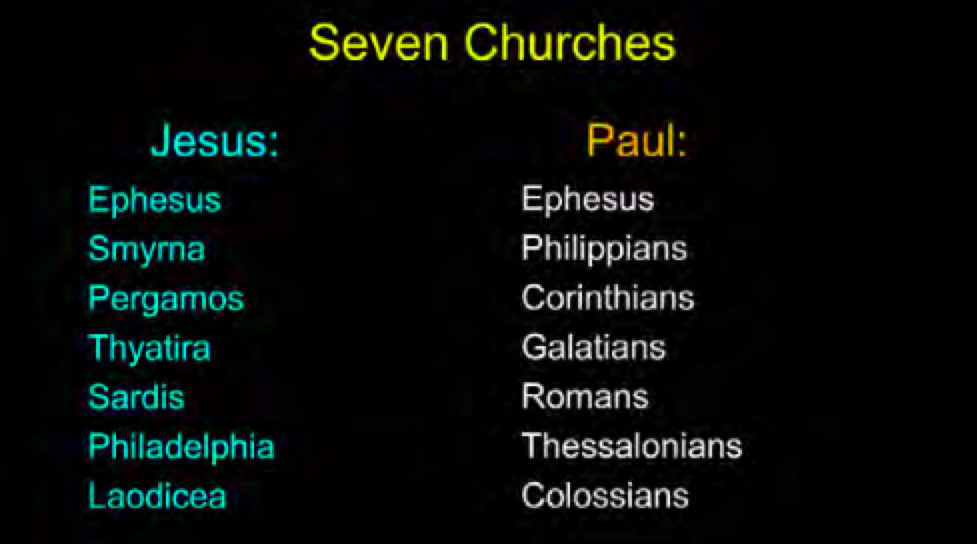
This chart points to the comparison betwen the letters Jesus wrote and the letters Paul wrote. While I do see that they both wrote to Ephesus, none of the others correspond directly. I do not see an immediate connection between Smyrna and Philippians. Were they the Persecuted church? I just don’t see the connection between the two. Jesus’ letters in Revelation 2-3 are concise, focused on both praise and reprimand, and include promises for the faithful. Paul’s letters are broader in scope, dealing with theological teachings and practical advice for living a Christian life. While both sets of letters together provide a comprehensive guide to faith and practice for the early Christian church, they are not similiar.
Explain the significance of the Old Testament allusions encountered in Revelation 2 and 3.
There are many references in Re 2-3 to the Old Testament if you know what you are looking for. There is the Tree of Life (Re 2:7) which is a reference to the tree found in Ge 2:9 and 3:22-24. There is the hidden manner (Re 2:17) which alludes to the food God provided for the Israelites in the wilderness of Ex 16. There is Balaam (Re 2:14) which references the prophet mentioned in Nu 22-24. There is Jezebel (Re 2:20) who is the prophetess that connects to the Queen in 1 Ki 16:31). There is the Crown of Life (Re 2:10) which is linked to various passages pertaining to God’s blessings in the Old Tesatment. There is the Synagogue of Satan (Re 2:9) which refers to opposition the Jews faced throughout their history. There are the White Stones (Re 2:17) which can be traced back to the casting of lots for a decision from the Lord (Joshua 7:14; Ex 28:21). Lastly, there is the Iron Scepter (Re 2:27) which is what Jesus will rule with, echoing Psalm 2:9.
K-W-L Self Assessment: L- Describe what you LEARNED from this session.
Nothing to add.
Conclusion
I have come to the end of Silver this morning as I finish the second class in Acts at KI. I’m excited to have this part of my life close for good. It has been a long road to get here. I started KI back in the end of 2019 (Nov 2 to be exact). Five years. And I have completed every discussion question put in front of me rather than the two suggested. Many of the courses have resulted in book-length responses (I think a few were 30,000 words or more). The Mere Christianity course produced a whopping 56,000-word response! But, I’ve learned a great deal through it all. I would not have done it any other way.
Now I’m wrapping up lose ends, closing opened circles in my process. After this I will be taking a short break from KI to rest a little (not really), and to focus on finishing my Hermeneutics class at Forge (I have 13 days remaining to write two papers). Once I’m finished with that, I will be returning to KI and will focus on the IKP 710 course for a while to get my bearings on the final project. I will be shortly ordering the Silver Medallion and the four coins to add to my collection. I will then be focusing on courses at KI that deal with persecution as I develop the persecution and suffering curriculum fro our church, small groups, and will hopefully have the opportunity to use in the future months and years with other churches here in the Northwest, and anywhere else God calls us, to stir up, prepare, and strength the church for what I am convinced is certain to come to America.
After that, I have 28 more classes and the final project(s) to complete for Gold. I have also ordered a display book from Amazon that I will be using to collect my work and credentials from KI, to include the handbook (or at least the introductory parts), my updated transcript, all the certificates to date for the program and maybe highlights from my discussion questions and work completed while in the program.
I am estimating that I will be finished with the entire KI program in another year or two which will somewhat correspond with the full launch of our writing, publishing, and teaching ministry, which can be accredited in large part to the KI program itself. Without them (and without my wife’s support and encouragement) I don’t think I could ever have thought such work possible.
Until my next assignment….

Please consider supporting my writing, my unschooled studies, and my hermitic lifestyle by purchasing one or more of my books. I’m not supported by academia or have a lucrative corporate job – I’m just a mystical modern-day hermit trying to live out the life I believe God has called me to. So, any support you choose to provide is GREATLY appreciated.
Excerpt from Sacred the Circle:
There was a knock at the door.
Campbell got up from the chair and crossed the small distance so he could open it.
A young man stood in the doorway, probably in his early twenties.
Campbell could tell he looked a little disheveled.
Confused.
He had deep rings around his eyes, as if he hadn’t been sleeping much, and he kept checking the hallway in both directions, as if half expecting someone to be stalking him.
“Hey,” Campbell said.
“Uhm….is…this….?”
The kid was stumbling over his own words.
Campbell leaned out into the hallway, checking to make sure there was no one else listening.
This guy wasn’t the only one who was becoming paranoid.
There were two students hanging out at the foyer, near the stairs, but the rest of the floor was clear.
“I’m sorry,” the kid said. “Must be the wrong place. I’m mistaken.”
He started to leave.
“Wait,” Campbell said, putting a hand out. “Hold on a second.”
The kid paused.
“What’s your name?”
“Uh, I’m….Lloyd…”
He fidgeted with his collar.
“I know it sounds crazy, but – ”
“You’re not crazy, Lloyd,” Campbell said, grinning.
“Did you – ? ”
The kid paused, as if unsure if he should continue.
He looked back toward the stairs, then at Campbell.
“Did you know I was coming?” he finally asked. “I mean, that’s not possible, but, were you expecting me?”
Campbell chuckled to himself.
“What’s so funny?” Lloyd asked.
“Well – ”
Campbell pushed the door open all the way so Lloyd could see inside his dorm room.
The entire room was full of them, students, non-students, ranging from what looked like eighteen to even a few middle-aged men, scattered about the room, sitting wherever they could find a comfortable spot.
Lloyd’s mouth dropped open.
“I wasn’t really expecting them, either,” Campbell said. “So, I hope you don’t hold it against me when I tell you, I had no idea you’d be showing up here. Do you care to join us, anyway?”
Buy my book Sacred the Circle to find out what these men are hearing from the supernatural realm. Will they answer the questions tugging at them? What are the visions saying? Who are the Multitude? Why are all these men being brought together? By whom? And why, above all else, are they being convicted….to pray?
Get your copy of Sacred the Circle today! Get the upcoming sequel, Sacred the Sent as well so the story never ends !
But, trust me when I say, you’ll be white knuckling this one with every turn of the page!

What do you think?