

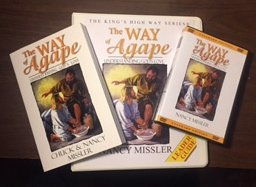
The next course I selected as part of my Unschooled Master of Theology program was the KI course, The Way of Agape, a topical course by Nancy Missler, which covers God’s love and how we can love others. Here are the Discussion Questions for the entire course along with my responses.
As a reminder, you can all of my course assignments for the uThM here.
So, let’s get started….
KWL – What I Knew Before Starting This Study?
I don’t know much about love or agape. I started this course with my wife, but quickly she discovered that it was not what she was expecting and decided she would rather do it on her own at a later time. So, it is still a requirement for me so I will be finishing the course now independently.
Love is peculiar to me. I’m not sure what it is exactly or how it manifests itself or what it comes from or what its origin is. I do know that I have seem many a counterfeit of it in the course of my life. I’ve also seen it twisted into other things. I do know that “doing” love is hard. It is difficult in relationships and families. It is difficult in the church. Most people enjoy the pleasurable aspects of love, but rarely do they enjoy or appreciate the difficult parts.
I would assess that love is: 1 Cor 13:4–7.
KWL – What I Want to Find Out in This Study?
I would like to develop a better understanding of what love is according to God. I would also like to be able to develop a mechanism by which I can exercise love toward those God has brought into my life. People tend to frustrate me. I hope that in learning to love people actively, I will also be able to develop patience with them.

Lecture 1 Discussion Questions
Have you ever experienced any situation or struggle similar to those shared in this chapter? What was God trying to teach you in this trial?
I went through a divorce and the renting of myself from my first wife. I still don’t know exactly why I had to go through that experience. I’m not sure if I just chose poorly or if I did not do enough in the marriage. I don’t know if God was giving me an example of what not to do next time? Would he even do that, given his stance on marriage and divorce? I often wonder if there was ever a chance my first marriage would have worked, could have worked? Or if had been a sham from the beginning? I also wonder that about Sabrina, but I’m pretty certain that if I had actually convinced her to marry me, we would have had a few kids and ended in divorce, and I would have been severely embittered and probably would have started killing people for sport.
Overall, I am so very grateful to God for rescuing me from that first marriage. I lost everything. But, there was nothing there really that I truly wanted. Afterward, God gave me over 13 years alone, on my own, in near isolation, and exceedingly more so in the last 8 years, and especially in the last 4 years. I was certain at that time that God was calling me (for good or ill, to help people or do so by protecting them from me) into solitude, isolation, and prayer for the rest of my life. I wanted it. I longed for it. But, then, at the last minute, he once again turned my life upside-down. Now he has given me more than I could ever have asked for, and, though my new life is very full and often stressful and difficult and trying, it is so very rewarding and fulfilling and satisfying and quite like a dream I wonder when I might wake up from. Sometimes I think I might have actually died on the lake back in 2018 when I had my heart attack and the last several years have been just the residual moments just before my death playing out in an instant before I finally die. I would be okay with that, knowing that my life had become so much more than I could have ever fathomed.
Life is not perfect. The flesh makes sure of that. But, I am grateful to my God for what he has done and is doing and will do in my life going forward.
What is our purpose as Christians and how are we to fulfill this purpose?
Our purpose is the Shema, “Thou shalt love the Lord thy God with all thy heart, and with all thy soul, and with all thy mind. This is the first and great commandment. And the second is like unto it, Thou shalt love thy neighbor as thyself” (Matthew 22:37-39).
Our purpose is to surrender our lives to our Lord, Jesus, who is the Christ. We are purchased possessions (Eph 1:14), and we must “confess Jesus as Lord and believe in our hearts that God raised him from the dead” (Ro 10:9). This leads us to being sealed by the Holy Spirit for the day of redemption (Eph 4:30).
We are called by God, as new creatures in Christ (2 Co 5:17), to fulfill our “reasonable service” (Ro 12:1), and exercise whatever gift we have been equipped with by God to bring the body into growth, for the work of service as each member provides (Ephesians 4:11-16).
Lastly, we are to remain watchful, sober, waiting for and hastening the day of the Lord (2 Pe 3:12), longing earnestly for the “revealing of the Sons of God” (Ro 8:19), when we will then step into eternity and we will for the first time in our existence see him as he is, for we will be like him (1 John 3).
Have you ever held on to justified hurt feelings? What happened? What was the result?
I have had a lot of hurt feelings over the years, to the point that I just stopped trying. Justified? Aren’t they all from our own perspective? I think it was justified to be offended when I found out that our group at the call center was just getting together because there was free food rather than a real friendship forming between us all. I think it was justified to be offended when Rod and Debbie turned on me and tried to hurt me just because I would not tolerate Rod taking up drinking again or lying about getting fired. But, these all were worked out for my benefit, ultimately. I learned a valuable lesson on assessing people’s motives before I invest in a relationship. The damage Rod and Debbie tried to inflict on me was futile. In no time they imploded and came apart at the seams and were neutralized as a threat to me or anyone else. It’s sad. The friendships I thought I had were revealed for what they really were on both accounts, and I’ve been hesitant to befriend anyone else after that time in my life.
But, God is, of course, good. It took several years and a lot of solitude and isolation before I could trust people again. Now I’m married, have ten children, am active in ministry full-time (overtime), and the lessons I learned back then are still able to protect me, guide me, and help me in those pursuits. I’ve learned that ministry is about serving, not about people who wound us. The wounds are inevitable. But God’s love is able to overcome all of these things. I’ve even found that God brought me through those times of hurt and pain and loss so that I can minister to another man who also is quite sensitive to the hurts or perceived hurts others cause. I pray God’s will be done in all this work.
Read Mark 10:17-22. Why do you think the rich young ruler could not give up his possessions? What would be difficult for you to give up?
The text gives us the answer, “he was sad at this word, and went away sorrowful, for he had great possessions” (Mark 10:22). He couldn’t sell what he had and give it to the poor because he was relying on his material wealth to sustain him. He probably had a standard of living that he was comfortable with, that he had grown accustomed to, and he could not separate himself from this lifestyle or the pseudo-security his wealth brought him.
Jesus talks at length about this idea: do not lean on material possessions or the estimation that money will protect you or sustain you. He says this in Matt 6:19-20; Lk 12:33; Mark 8:34; 10:23-27.
I do think it is interesting that Mark says, “Then Jesus, looking at him, loved him” (Mark 10:21). Did Jesus love this man because he had been devout and had kept the law from his childhood? Did he love him simply because of who it was? Mark really doesn’t elaborate on it.
What would be difficult for me to give up? I think it would be hard for me to give up my health or to have it taken from me. I know first hand that becoming sick really changes the state in which we exist, it alters how we perceive the world around us and how we interact with other people. I’m not so transfixed on money, though, over the last two years I have become accustomed to a more affluent lifestyle. Money is not as much of a concern or issue, though when I was single it was not a “concern” as much as a stewardship with no purpose. But, now that purpose has been revealed. I would have a difficult time giving up my wife. I do not want her to die and I often worry about that, though I try not to, and I know if it is in God’s plan it will come to pass. We have only so much time for everything. And God gives and God takes away (Job 1:21). I am thankful that God has blessed us with ample housing…seemingly too much housing for us. But, I know and trust in God that all this is for a grand purpose greater than what we can comprehend. I trust that God is doing the very best for us, working all things together for our good. We are embarking on a grand adventure that God seems to be in favor of. It will be up to him if it comes to fruition. I know, firsthand, that God works his own will in us and can and does use our own motivations, our own desires, and our own plans to fulfill his purposes (Pr 16:33). If God does not want us to have this house we are currently living in, I know that he will provide another. If that means we are living in a tent down by the river, in an RV, or are homeless – I trust that our God will provide. It would not be pleasant. And I would be trying everything in my power to get out of that situation for the sake of my wife and children. But, I know God has a plan and his plan is better than I can even fathom (1 Co 2:9). It would also be somewhat difficult for me to give up my children at this point. I remember that night when I was engrossed in fitful, tearful, argumentative prayer, and he told me in no uncertain terms, where I argued against the idea of remarrying, stating that anyone who would be interested in me would have children already and I did not want to be a step parent to anyone. That I did not want to raise another man’s children when the man was involved at all. But now, looking back after two years, there would be no way I could have imagined this was what he had in store for me. It is so much more tangible, so much more rewarding, and God blessed me with a family of 10 children with really no other fathers involved. These are my kids. And I am grateful to God for that.
I would ask this question of my wife: what would be difficult for me to give up? She said, “Sleep. You would have a really hard time to give up study or think or use your intellect. If you lost your ability to read or write.”
Why is it important to spend time alone with the Lord everyday in order to live God’s “Way of Agape?” Describe your own quiet times. What do you do? What are some of the things that interfere?
Our relationship with God, through Jesus Christ, is of the utmost importance. To understand God’s will is to spend time with God, to learn from him, to follow him, to pursue his good pleasure. To seek him. If we do not spend time with him, if we do not get to know him, if we do not allow our defenses to come down for him, then we will never live a life of God’s love.
My quiet times are fleeting, often spontaneous. A few simple moments when I’m walking somewhere, or I find myself alone, or I am wandering around in a store, I can pray. Or, sometimes I find myself in a car driving somewhere on my own and I can turn the music all the way up and sing God’s praises, and I can talk with him and give him my heart and my problems and my joys and my gratitude. Sometimes it is nothing more than the Jesus Prayer, “Lord, Jesus Christ, Son of God, have mercy on me, a sinner.” This is the declarative of Phil 2:11 “Jesus is Lord,” and Luke 1:35, “the Son of God,” and the penitent prayer of the tax collector, with “a sinner,” in Lu 18:13. These mended together form the prayer of the heart, the cleansing of the soul, the mind, and the spirit.
I would love to have the time and resolve to pray and meditate (melete) for 30 minutes each session, seven sessions each day. This is based on Psalm 119:164, “Seven times a day I praise you, because of your righteous judgments” (Psalm 119:62; 55:17). I would have different kinds of prayer: adoration, petition, intersession, etc. Then I would recite Scripture so that each of the 7 are on an annual schedule, ending the year with the Bible having been read through seven times. These would be the traditional times of prayer that have been upheld for centuries:
Prime (sunrise)
Terce (9am)
Sext (noon)
None (3pm)
Vespers (sunset)
Compline (6pm)
Matins (12am) [the Night Watches]
This would be intentional to experience God rather than study him or his Word. It would not be aimed at the acquisition of knowledge, but the encountering God intimately.
Laziness interferes. Excuses interfere. Busy schedule.
1 John 3:14, tells us if we are not loving with God’s Love, then we are dying. What does this mean to you?
This appears to be saying that if you do not, at some point, in your walk in Christ, manifest genuine love for the brethren, then you are not actually saved by grace through faith, but you have deluded yourself. This is because salvation WILL produce fruit. It is not a question of if, but only when. If we are fruitless, then we must really reconsider our salvation.
Share what 1 John 4:17, means to you.
This is how love has been perfected among us: we have boldness in the day of judgment; as he is, so are we in this world.
- The love of Christ, the love of God the Father, it has been perfected in us (made perfect).
- We have boldness in the day of Judgment, meaning, we have a confidence that defies logic, reason, or common sense, because we have been transformed by Jesus and the Holy Spirit now intercedes for us in this life.
- Jesus is resurrected. This is “as he is.” We, too, are “resurrected” in this world in that we are being transformed by the renewing of our mind daily, being drawn closer and closer to Christ-likeness.
K-W-L Self Assessment: L- Describe what you LEARNED from this session.
Nothing to add.
Lecture 2 Discussion Questions
Are you willing to be a “Hosea” so God can manifest His Love through you? If not, what areas are you still struggling with? What negative thoughts and emotions are tending to quench the flow of God’s Love through you?
I am currently struggling with the notion that being right justifies me to be unloving to others. I’m somehow equating their wrongness with unworthiness before God, and thus I am not obligated to love them as Christ loved me. But the problem with this is, I was wrong when I was unsaved, unregenerate, and without Christ. Matthew 6:15 and Mark 11:26 are very clear: if you do not forgive, you will not be forgiven. He even elaborates in verse 25, “whenever you stand praying, if you have anything against anyone, forgive him, that your Father in heaven may also forgive you your trespasses.”
So even our prayers are hindered if we do not forgive (cf. 1 Pe 3:7). This means I must step out in faith, relinquish my “rightness” before God because I am anything but right before God. None of us is right before him. And then allow God to love others through me. I’m not doing the love. God is. And I must truly embody Phil 2:3-4, 1 Co 10:24, Ro 15:1-2, Ga 6:2, Ro 12:10, and consider their best interest, even over my own. I must “give preference.” I’m not seeking my own, but each one the other’s well-being.” I must operate in a “lowliness of mind.”
I would say the negative thought and emotion are the justifications I feel that I am “right” and who cares what the other person is going through because they are wrong.
What are the two sides of God’s Love? Give an example of where you needed to “take a stand” in God’s Love? How was this different to confronting someone in your own strength?
So, we are in a particular predicament currently. My wife and I were called to a small church here on the Oregon Coast more than two years ago, we thought to come alongside the pastor and his wife because it was clear “something was wrong.” There was a great deal of apathy in the church. A great deal of “nothing happening.” They were resistant to a kids’ program. They were resistant to a kids’ clubhouse. They were resistant to the Christmas play starting practice too early. We were not prepared for what is happening now.
Several months ago, I discovered inadvertently that the church does not operate according to the Bylaws, but is run practically under a dictatorship, claiming he is the only one who can be a “deacon/elder,” even though he states he is not qualified to be an elder. This man is the patriarch of the church and has a large family involved in the church. But, over the course of several years, his family has been leaving. He is down to one daughter, son-in-law, and their children. I brought it to the attention of the leadership that we needed to establish eldership so that we would be not only biblical but also in compliance with the Bylaws. I was rebuffed. We discovered that others have very much desired to have an elder board at the church for many years, but could not find a way forward. I presented my case, and it was rejected. Their first claim was that if you start eldership, anyone who is not accepted will leave the church. Their second claim was that there are no men in the church who are qualified for eldership, and so the patriarch can continue as he is out of practicality. But the reality is, the patriarch does not get along very well with other people who stand their ground, who have an opinion, or who are willing to stand up to him or to stand up for biblical truth. He wants no dissent. This is the real reason, I believe, he does not want leadership. He does not want to have to work with other people and would refuse to submit to the other elders. Even our pastor, who was initially in favor of eldership, stated that we could probably get everything we wanted expect the patriarch would demand to have the final say on every decision in the church.
At this point, we have exhausted all avenues to reason with the current leadership. I am convinced that I must now wait and bring it before the congregation at the next Members Meeting. But, I am conflicted. I’m called to love people. Several people in the congregation are telling me that I need to wait on God to resolve this issue (people have been ‘waiting on God’ for over 20 years, maybe he wants us to actually do something). The leadership has no standing from Scripture or from the Bylaws.
It is my intention now to send a letter to the entire church congregation spelling out what has happened over the last several months and let them know that I intend to put forward motions at the meeting to establish eldership and to dissolve the current leadership. But, I don’t know if this is the right thing to do. No, that’s not it. I am convinced that what I’m doing is right. But I am having doubts. I am having second thoughts. I’m growing tired and weary of the drama and the nastiness the legacy family is showing to my wife. I’m very upset and offended, and wounded by the pastor of this church, who feigned friendship with me when I first arrived so that I would take work off his plate, and then he stabbed me in the back as soon as he thought his personal safety was in jeopardy.
So this is my example of having to take a stand in God’s love. This is what is best for this church and for the individual people involved, as they will never accomplish anything and will slowly die if they are not corrected and set straight. Normally, instinctively, I would leave them to their church, to their misaligned interpretations, to their dead religion. But God put us in this place, he arranged it so that we would be here, so that I would teach at a seminary, begin studying leadership, and then inadvertently discover the discrepancy between our bylaws and how we are currently governed.
I pray God will bring a weighty outcome that brings unity, strength, and power to God’s people. But, Jesus said, “I have come to ‘set a man against his father, a daughter against her mother, and a daughter-in-law against her mother-in-law’; and ‘a man’s enemies will be those of his own household.”
Think of a situation where you were able to love with God’s Love regardless of your feelings or others’ responses. Describe what happened. What did you learn about the unique attributes of God’s love?
Three years ago, I would have never been caught inside a church, never driving a car in the middle of the city, never homeschooling children, and never at a kid-themed water park lodge with 2000 other people. I would never have chosen this life I am now living. Not for myself and not for those around me. Yet, God did choose this for me. He wrote it in the books of my life long before he ever created me. Then I was content with my life, I was fulfilled, I was pursuing God with conviction that what I was doing was the correct and right way for me. But, then, he changed it all and instead gave me a love for a woman that I didn’t even know. Gave me love for her in so many ways, and it was not developed over time, not incited by lust or preoccupation or happenstance. Instead, it was a love that was sparked by supernatural phenomena, and quickly fanned into a flame built on the Word of God.
I met my wife shortly after that, and we courted for two and a half months before we were married. It has now been a little over three years, and though married life is certainly not perfect (it is, after all, borne out of weakness), it has brought me so many joys that it is incalculable. But, more than anything, God brought me a helpmate, a support, a mechanism to break through the shell of self-doubt and recrimination, prodding me along to not only embrace the gifts God has given me, but to do so also with a call toward Christ and service to his Church.
I do not want to do this work. I would never have chosen to do it. But I now love people while simultaneously despising them. I am living a life of godly conviction and practical ministry, while internally I am full of contradiction. While I do not want to do these things, or say these things, or teach or put myself in front of people when writing books, God has me doing these things, yet still. And it is not something I could have done on my own.
So, the love of God that flows through me, first to my wife, then to my children, then to my church – these are supernatural loves that I would be incapable of expressing of garnering, or of executing before. But, now, by the grace of God, I do love, I do care, and I do serve.
What is God’s Love? Why is God’s Love so important? What were some of the Scriptures that particularly ministered to you this week?
God’s love is self-sacrificial in its wholeness and complexity. It is the only love that exists for the sake of others, for we as fallen people are incapable of excising such a kind of love on our own. There are no creatures in the created world, or apparently in the supernatural one, that can love as God loves. He loves without partiality. He loves despite the cost (Acts 10:34).
Is having and passing on God’s Love the whole meaning and purpose of your life? Have you experienced emptiness and meaninglessness in your own life and /or see it in others around you?
I would not say it is “my purpose.” It seems to be God’s purpose. It seems that this life is preparation for something else to come. Something later. Something on the other side of creation. Something is waiting for us to join. His purpose flows through me, even against my will, even now, I do not think, left to my own devices, I would choose this life. But God has chosen it for me, and so I walk in it. I trust him to provide. I trust him to equip. I trust him to correct me when I am led astray. I know that he has sealed me supernaturally with the Holy Spirit who now dwells within me, and that spirit serves as my conscience and is the mind of Christ.
I have recognized the emptiness of the world in myself. Before I was saved, I was wondering, blind, naked, and presuming the entire time that I knew what the world was and what it was constructed of, and how to navigate through it. But I had no idea. I was a chained man in a cave of shadows, and I mistook those shadows for the creatures and beings that surrounded me – monsters and demons and twisting, turning, slithering creatures. But, I was completely unaware of what would come when those chains were broken and I was able to walk out of the cave for the first time, and am now forever free of the dead works of man’s religious pursuits.
The Bible says having God’s Love is the only way others will know we are Christians (John 13: 35). Why is this so? Are others able to tell that you are a Christian by your lifestyle?
God’s love is shown by how we show love to one another. This is the verse quoted. And it plays out to varying degrees in and through our lives as we interact, intercede, correct, and comfort those around us. This is a mystery, to be honest. The entirety of our creation, of this “program,” our circumstance (the gospel), our redemptive narrative, is fundamentally fixed to this kind of sacrificial love. But, it is not actually “for” us. It is for whatever is to come.
“ἵνα ἐνδείξηται ἐν τοῖς αἰῶσιν τοῖς ἐπερχομένοις τὸν ὑπερβάλλοντα πλοῦτον τῆς χάριτος αὐτοῦ ἐν χρηστότητι ἐφʼ ἡμᾶς ἐν χριστῷ Ἰησοῦ·” (Ephesians 2:7).
That shows in the ages to come the exceeding riches of his grace in kindness toward us in Christ Jesus.
- “ἵνα ἐνδείξηται = that shows. This is the purpose of our salvation, of our redemption, of this apparent iteration, our creation, and the fulfillment of that creation, the reason for the birth pangs that we are and will in the future experience as we are one day revealed as sons of God. It is for God to make an illustration in the future about our current future, which will then be our past.
ἐν τοῖς αἰῶσιν τοῖς ἐπερχομένοις = in the ages to come. This word for ages is plural. That means there will be a multiplicity of ages. More than one future age, possibly “multiple” in three or more.
τὸν ὑπερβάλλοντα πλοῦτον τῆς χάριτος αὐτοῦ = this is the object of the verse, the purpose, the objective. That is: the exceeding riches of his grace
ἐν χρηστότητι ἐφʼ ἡμᾶς = the kindness toward us. This is what he accomplishes from the work of #3. He expressed the “exceeding riches of his grace” through the kindness he has shown us. Or, this “kindness” exemplifies the “overflowing grace which is abundant and prized and worth tremendous value.”
Lastly, we are asked in this question if “Are others able to tell that you are a Christian by your lifestyle?” The only way I can answer this is through the testimony given by other people. I have no idea if people see Christ through me, or if he is exhibited in my life. I provide the testimony of my wife, who has stated that I live my life by the authority of God’s Word, to the point that it can be annoying and uncomfortable for her. She has told me that I take in Scriptural truth, and then apply it in life toward those around me, looking for the benefit of others above myself. She said I do what is in the best interest of others, even if it is difficult for me to do so.
I would say I am in no means perfect. Before God, I stand convicted already. I am dead in my sins. But, thankfully, I also stand simultaneously alive in Christ in hope of the resurrection to come, that if God would raise the son, then I will, indeed, likewise be raised to new and eternal life.
Nancy states, “God’s Love is the ‘perfect bond of union,’ not only between God and me, but also between others and myself.” What does this statement mean to you in your everyday life?
This can also mean the bond (or the bringing together and combining of objects) of perfection (or maturity). So “love” is the bringing together of that which is matured. This is the purpose and point, and process of our redemption. The maturing of the saved to the point at which we might be a finished work in Christ. That we might be presented then to God as Sons of God, that we would become like and equal to the angels who are somehow our fellow servants (σύνδουλος = fellow slave). We become like them in state and equal to them in status in the redemption. We step into eternity and a new realm. Into a new dimensionality that is simply beyond comprehension.
This is what we are to grow into as individuals and as a church, exemplifying the love God has shown us by showing it to others.
K-W-L Self Assessment: L- Describe what you LEARNED from this session.
Nothing to add.
Lecture 3 Discussion Questions
Explain the difference between loving with God’s Love and loving with human natural love. What should we do when we find we are not functioning on God’s Love?
Human love is terrestrial. It is also selfish. It is driven by reciprocity, by emotion, and by a sense of our own right and our own justice. Regardless of which kind of human love we are referring to (storge, eros, and phileo), we are attempting to get something from the object of our love. God’s love, on the other hand, is agape, or a self-sacrificial love. God exemplified this love by sacrificing his own son on our behalf. It is the death of self that he has exemplified for us.
When we are no longer functioning in agape, we need to return to Christ, surrender to him our life, our possessions, and anything else that might be between us and God and between us and the other, and then pray and listen to what the spirit is telling us to do. Godly love is dying to the self for the sake and benefit of the other, without recourse, without condition, and without any guarantee of that love being returned.
Why do you think “Agape Love” is growing cold in these end times?
There are several reasons and circumstances for this, and two distinct groups need to be considered. First, let’s discuss the two groups. The first are non-believers. The second are believers.
- Non-believers = these individuals often do not know agape, and are sold under sin to the other human loves as the only love they have ever known. They are not frequently able to exercise any kind of agape because they have only experienced transactional love: from their parents, friends, and later their spouses and their children. This exercises the identity of the individual, the will, the core of what we call the heart (not the blood pumping muscles). It can be said that, in actuality, non-believers can’t show agape as they remain unregenerate and are enemies of God (Romans 1:18ff).
Believers = So, I will not include in this discussion the realities that some, if not many, who claim to be believers are not, but are the unregenerate lost. Despite this, believers fall into trouble when they seek the law, seek human wisdom, or seek some form of compensation for their work. Jesus said that they will have their reward. What they are doing in these situations is not led by the Spirit. But, many who are genuine believers tend to fall away from exercising agape because they cease to conform their lives to the word and instead find authority in something else. They sometimes harbor wounds that are robbing them of peace and, thus, set them up to sacrifice themselves for themselves. Others, though they claim to believe, have not surrendered to Jesus as their Lord, or they are resistant to the sealing work of the Holy Spirit in their daily lives and walk. They continually return to the flesh, seek fleshly answers, and are confounded by spiritual meat.
What kind of love do you find yourself functioning on most often?
This is difficult, for I make a clear demarcation between my will and God’s will. There are many things that I do out of my own efforts, my own emotions, my own will. I do not socialize with people because I have been hurt by them in the past, and so I simply cut them out of my life entirely. Yet, this is a selfish love that is based on previous pain and not on current circumstances.
But, then, in moments where God can break through my defenses, he instructs (often commands) that I love others as he first loved me. He did this just in the last session of this course. My wife and I are currently undergoing a terribly difficult and uncomfortable season of correction in our church. There are several individuals in a particular family who are not surrendering to the final authority of Scripture, and they are attempting to lord it over the rest of the congregation. We are scripturally in the right. We are obligated to speak out, to correct those who contradict. But, I wrote a letter to the congregation the other day (have not sent it yet), that outlines in detail all that has been happening and how we as a church. But my wife and I were unsettled by it. It was not in agape, but in some other kind of love that had more to do with us being vindicated rather than helping the other and protecting the church.
I read the previous two chapters and came away with a clear understanding that, though it is right to correct them, I need to be sure that I’m wording it in a way that is uplifting or at least is concerned for those toward whom the correction is directed. So, I rewrote the letter, keeping this thought in mind. After I finished, I gave it to my wife to read, and she told me that it was much, much better, and that I had come from a completely different place when writing this second letter.
Being right is no excuse for being cold. Though I am guilty very often of doing this very thing.
Briefly define the three human loves: storge, phileo and eros. How do each of these apply in your life?
Storge – this is a familial love, such as with a parent and their children. It is innate, instinctual, and often involves deep-seated emotions.
Phileo – this is the commonality between mankind. It is friendship. It is camaraderie.
Eros – this is sexual or intimate love, one that is marked by physical affection, and can often be equated with or can lead to lust and sin.
Why is it important to ask God to expose the “root causes” of our thoughts and feelings? Why do we need to “see” these buried things? What have you “seen?”
Paul tells us to “bring every thought into captivity to the obedience of Christ” (2 Cor 10:5). He also said, “do not be conformed to this world, but be transformed by the renewing of your mind” (Rom 12:2). If we do not actively seek to uncover our motives, we can easily be misled or deceived into thinking we are following God’s conviction but are, instead, following the desires of our own heart.
I use the example from a few questions above for this example. .
Our need “to be loved” brings us our security and our identity. Our need “to love” brings us our meaning and purpose. Give some personal examples of each.
I see this with my daughters often. They are very affectionate with me, with many hugs, and the older one will take hold of my hand when we are walking around the grocery store. But, when that attention is withdrawn, I am often a wreck, because I need that affection for myself, because I have not had it most of my life from others, or any affection requires some kind of cost. But I have to continually remind myself that this relationship is not necessarily a two-way street. I must operate as the parent in a position of steadfastness – I can be depended on, regardless of what I might or might not get in return. Even if my daughters say they hate me, and they say they want me to die, I still need to do what is in their best interest, I need to still love them with agape and not with any of the others.
Read John 14: 15 – 21; John 15: 1-10; 1 Corinthians 12:31 and 1 Corinthians 13:1-4 & 13. Explain why loving God’s way is so important. Explain why we have the need “to love” and “be loved.”
This is the command we have been given. To love others as we were first loved by God, when we were still sinners. When we love in any other way, it is accounted for nothing. It is flesh. It is straw. It is dung. But, when we love one another with the love that God has loved us with, then we declare and identify in the sight of others that we are followers of Christ (John 13:35).
Our need to love and be loved is a peculiar phenomenon. Being someone who can function effectively without interaction with others, it is often foreign and uncomfortable, almost alien, to love others. It is much harder to be loved by others. As for myself, I spent many years with no desire to love or be loved by or toward another person. I simply did not possess what I considered to be a curse or ailment in others. So, left to my own devices, I would never have ventured out of the woods or out of my hermitic calling. So, God did a miracle in me. One day, he changed me, and as I woke, I could tell there was something different inside of me. I thought strange thoughts. I felt foreign emotions. But these were suddenly understood and accepted, and part of who I was now.
Because of this, I am convinced, at least for myself, that the reason I want to be loved and want to love others is due to what God did to me while I was sleeping that fateful morning. He put it in me and now I love with God’s love, despite my resistance to doing so.
K-W-L Self Assessment: L- Describe what you LEARNED from this session.
Nothing to add.

Lecture 4 Discussion Questions
If God’s Love is our total identity and security, what happens when we stumble and fall? What do you depend upon for your own identity and security? What happens when these things let you down?
If we have God’s love as our total identity and security, then it would stand to reason that we would never suffer the calamity that comes when we stumble or fall, given that God never ceases to love us, even in the midst of our sin. There is actually nothing so grave, nothing so severe, so evil, so sinister, that can separate us from God’s love. And, so, we are secure if we know that God’s love is established forever.
I would say my dependence rests primarily on how God sees me. What is his personal assessment of my work, my efforts, my time, my everything in this life? If given the chance, would Jesus say, “Well done!” or would he not say anything at all? Or, would he say, “Depart from me, I don’t know you!” And, because God sees Christ and not myself, the effort is sustained and endures the fire of judgment. I am secure in this, that God is for me, and has the very best in mind for me to walk through. I cannot say that about everyone I meet. Many seem to be without hope. Without security. Without any genuine identity of who they are, they are bounced to and fro on the waves of this life.
I thank God for what he has done in my life. To me. For me. I am truly grateful for the mercy and grace he has shown me.
Nancy says that many of us have been “programmed” to believe that God doesn’t love us and that we are worth nothing. Experientially, do you agree with this statement? What do you see as the solution to this?
I would say, after 30 years of reading and studying – consuming Scripture – intellectually, I can say that I know this is false programming. But, that being said, I do think I still believe the lie that I am not “lovable.” That I am not worthy of another person’s love. I can’t say this about God’s love, though. I experience God’s love every day. When I was watching an emotional movie last night with my family, I could feel it. When I’m driving in the car alone and the music is turned up, I can let go of my conventions and simply praise my Maker for who He is. I know that God loves me. I can look back throughout my life and am utterly convinced that God has been very active and involved in the direction I’ve gone and the steps I’ve taken. When I was a believer and also when I was not.
It is humbling to see his handiwork in my life, and yet, so many others seem to be unaffected by his grace. They seem incapable of responding to him. I’m not sure why me and not them. There is no difference between us.
When we sin and do something that causes God’s Spirit to be quenched, what happens to God’s Love in our hearts? What removes the blockage?
I don’t think I agree with this idea. While intellectually I would agree that if we continue along the road of habitual sin, we sear the voice of the Spirit in our lives until we eventually do not hear him at all. Yet, at the same time, I would argue that sin does not separate me from God. It does not quench the Holy Spirit, because, if I am truly reborn and the Holy Spirit dwells within me, “as a seal for the day of redemption” (Eph 4:30). But, Romans 4:23 says nothing about the Spirit being quenched, but that anything that is done not in faith is a sin. It says nothing about what the consequence is of this. Those who are evil, who are defiled, it doesn’t matter what they do, they are defiled in everything they do (Titus 1:15). But the one who is predestined to be saved (Rom 8:29–30), he is saved from before the foundation of the world and is being saved and will be saved in the glorification of his soul and body in the rapture. I don’t think there is a give-and-take process for the believer concerning sin and our sanctification. There are just our sanctification, many points and challenges, and roadblocks along the way. But Jesus died for all of our sins when all of our sins were yet to be committed. They were all future sins. Even the ones I have not committed yet. And he knew every one of them before he climbed up onto the cross and died on my behalf to pay for them.
When I commit sin, I’m not committing anything new for God. He already knew I would commit those and those in the future. Even when I turn away from him, walk into sin headlong, he is still there, convicting me, nudging me, guiding me patiently, relentlessly, so that I will continue in my sanctification, because God is the author and finisher of my faith. He will complete his work.
But, this does not take into account 1 Th 5:19, which says we should not quench the Holy Spirit. Given this, I do not know. Paul routinely speaks of not grieving the Holy Spirit. I will have to consider this more.
Share why knowing God loves us is the first step toward living God’s “Way of Agape.” How can you know God loves you?
If we do not recognize that God has loved us and given himself up for us as the example of what we are to do for one another, then there is no way we can do that, since our human, frail love is nothing like the love God loves us with. Once we recognize that God loves us, experience that love first-hand, then we can turn and love others as God has first loved us.
I experience God’s love personally, intimately. I can’t describe “how” one should do it. I would argue that a person needs to read the Bible and see if they can sense and feel and recognize his love and his working in their lives. There is nothing we can do other than to listen and wait and hope, and pray. God will do what he will. He is sovereign. He will have his way. You can read the accounts in the gospel, read Paul’s letters, and read Revelation, but if God is not actively calling you to Christ, there is nothing you can do. In fact, I would contend that if God is not drawing you to himself, you will be actively repelled by the gospel and the Bible and its truth. It seems that those who are resistant to God’s word are hostile to the truth. It is as if they have been turned over to their own devices and their consciences seared so they cannot hear, even if they wanted to.
Are you aware of any negative thoughts and emotions that are preventing you from experiencing God’s Love? Why is it critical to give these over to God? How does knowing that God loves you help you to lay these aside?
I do have a lot of negative thoughts and emotions. They sometimes prevent me from experiencing relationships with other people. The limit my exposure to the risk of being hurt by others. I hesitate in giving myself over to trusting another person because they are not to be trusted. It is not if but when they will betray you.
But, this does not appear to have a bearing on God or recognizing or acknowledging the love he shows me. God has been my rock and mainstay for most of my adult life. He has been the only one there who has never betrayed me or abandoned me, or been cruel to me. I don’t believe these are “critical to give over to God” because God already knows about these things. He is, through the Holy Spirit, working on me and working to transform me into Christ-likeness. I do not know what that process looks like. I know that I will have to give up everything that is of the flesh and everything that is of my own will for this process to be completed. But it is not I who does it. It is the Spirit who works and dwells within me. When I became a believer, I entered into his rest. I no longer work, but he works in me and through me.
If we really knew how much God loves us, we would never “fear” what He allows into our lives. Are there situations in your life, which are causing you to “fear?” What about your “future hopes?” What can change your attitude?
Yes. Our current situation, while not “fearful,” is extremely uncomfortable. Yet, God has, in spite of this, given us hope in other opportunities on the horizon. But it does not make the current situation any less uncomfortable. I’m concerned about what the church will do. I’m concerned about what the leadership may try to do. I’m concerned that I am causing this problem, and it will end up in the church blowing up, and I have to wonder if we should leave the church the way it is (in its disfunction and lack of fruit, and leave everyone in their places, mired in their apathy) if it means they will not be divided and disrupted. Or, are we called to stand on biblical principles, biblical truth, and to proclaim that, and to correct our brothers and sisters when they stray from the truth?
I’m also having a difficult time loving the family in question. Their hostility is hard not to take personally. The pastor’s betrayal is hard not to take as a personal wound. What do we do with all of this? Forgive with blindness to the situation or circumstances? We are told, “do not share in other people’s sins” (1 Tim 5:22). If we know something is wrong and do not correct it, do we not hate our brother and are just as guilty as they are? James makes this clear, “Therefore, to him who knows to do good and does not do it, to him it is sin” (James 4:17). “By sound doctrine, both to exhort and convict those who contradict” (Titus 1:9). This is the responsibility of the elder, “in humility correcting those who are in opposition, if God perhaps will grant them repentance, so that they may know the truth, and that they may come to their senses and escape the snare of the devil, having been taken captive by him to do his will” (2 Ti 2:25-26).
My fear, or apprehension, or concern-whatever label you want to use – originates not from my doubt that God can or could do something, but that humans tend to do the wrong thing, the hard thing, the stubborn thing, and the manipulative thing. I cannot fathom why our pastor is doing what he is doing. How does he sleep at night? But all I can conclude is that he is deceived. That he thinks he is doing what is right.
Maybe my fear stems from the fact that I don’t think God is going to or will correct them and let them be pulled back from the flames, that we have come here to put the last nails in the coffin of this church before it implodes. Churches are not to be run by one person. It is not to be a dictatorship; it tells us this clearly in 1 Pet 5:23. We just have to listen. But, I am trying to fulfill the truth of Scripture, James 5:19-20.
What key points in this session are you still meditating on? Is there an area in your life right now where you can apply this teaching? Use relevant Scriptures to share what they are.
I’m still considering the idea of quenching the Spirit, and that this occurs when we sin. I struggle with this because I have not found that God moves away from me when I sin, but he seems to move closer to me. Becomes more intimately entangled with me, to rescue me from myself and others.
There is a lot of self-doubt, negative self-talk, and this may be hindering me in service to him and to his church. Yes, pride does come before the fall, and I would rather be cautious than jump in without knowing what I’m doing or if God has even called me to a place or task to begin with.
K-W-L Self Assessment: L- Describe what you LEARNED from this session.
Nothing to add.

Lecture 5 Discussion Questions
Define the Greek word agapao (to love). How does agapao differ from storge, phileo and eros? How does it differ from the noun “Agape?” Give some examples from your own life.
Ἀγάπη is translated as “love” in English, but it is more precise in Greek. This love is based on sincere appreciation or high regard, to have concern, affection. It is a self-sacrificial love, in that the individual must put forward the interests and well-being of the object of their love even above the interests and well-being of themselves. We are never commanded in the Bible to love one another with φιλέω or φιλία, though it is wrong to assume that φιλέω and φιλία refer only to human love, and ἀγάπη, divine love.
God commands us to love Him with all our heart, will, and soul. Summarize what this means to you.
We are called to love God first and to put our relationship with him and our devotion, and our loyalty to him above every other thing in life. We are called to do this because we, as those chosen to be vessels of mercy, have been forgiven a great and terrible weight, and we are to recognize the truth of Romans 8:28, “And we know that all things work together for good to them that love God. To those who are called according to his purpose.” We are to trust God, to not look to what can be seen (He 11:1), but to the unseen, to trust fully and completely in God who, we are assured, has our best interest at heart. The very worst calamities to befall us are Father filtered and approved by him. He has chosen, for our ultimate good, to be subjected to such suffering. This is how we love God with all our heart (the seat of our emotions, of our wants, our volition), our will, though I’m not exactly where they got this for the question. The verse reads, “Love the Lord your God with all your heart, with all your soul, and with all your mind” (Matt 22:37). Will is not included. It might be instead of mind, which is διάνοια. Nonetheless, soul or ψυχή is the normal term for the essence or substance of our identity. Collectively, this would entail loving God with all our “will, autonomy, volition,” all of our identity (everything that we are), and with all of our thinking, rationalization, and our intelligence.
We cannot love God in part only. We cannot be double-minded (Rev 3:15-16; Matt 6:24; James 1:6-8).
To love God means to lose “self.” What exactly does “self” mean in this context? Explain what it means to “become one” with God.
Matthew 16:24 tells us that we must “deny ourselves” that we might come after Jesus (in the same manner in which he has gone before us). This is not the same as in Zen Buddhism, where the individual is striving to remove all attachment to the world, to cease having a desire, so that we can lose ourselves in a sea of consciousness, to become part of the whole, the etherial form. To lose ourselves in Christ is to put him before ourselves. Practically, that means we are to put others before ourselves. He is to “deny himself” (or what he wants, his desires, his likes, even his needs) for the sake of others. This does not include pushing away our own feelings. It does not mean negating the existence of our true emotions.
Summarize the three steps to loving God. How can you apply them every day?
- Continually obey God’s Word. This is one of the most important attitudes, approaches, traits, or behaviors that one could have in loving God. We must consume his word if we want to become more Christ-like.
Continually trust God’s Ability. This is crucial to be in alignment with God. If we are constantly doubting him, continually seeking, assuming the negative outcome, then God will not provide for us what we desire, for we desire it with a duplicitous mind.
Continually serve God’s Purpose. Once we are invested and involved in God’s Word, and we are in direct alignment with his ability, then we need to put all of our gifts, our talents, our abilities to work for the kingdom and on behalf of God. It is God’s purpose that everyone be saved in this world (1 Tim 2:3, 4; 2 Pet 3:9; John 3:16, 17; 1 John 2:2). Because of this, our actions cannot be isolating. They cannot be self-centered or self-driven. They must be for the good of the kingdom of God.
Define “truth.” Why is Jesus called “the Truth?” How does this relate to being able to trust God? How much do you trust God? Why?
Eph 4:21; John 1:14, 17; 14:6; Rev 3:7; 19:11 – in several places in the Bible, he is called true, or that he is true, or that he is “something” and Faithful, and true.” Is he the personification of truth as an inherent substance or ideation? I’m not certain. We know he is called Wisdom (1 Cor 1:30). Truth is ἀλήθεια, and this occurs 110 times and contains within it the domain of “being truthful, that which is true, something that is certain, and truth itself.” John 17:17 quotes Jesus saying to the Father, “Your Word is Truth.”
Regardless, we need to trust him. This is the purpose of this life. It is the aim. As Dr. Missler often conjectures, God says every day, “Are you willing to trust me?”
Summarize the three temptations Satan constantly throws at us. Why does God allow these temptations in our lives? As you look at your own life, can you see any examples of the three temptations?
The three temptations of Satan are considered, “the lust of the flesh, the lust of the eyes, and the pride of life” (1 John 2:16), summing up for us all that can and does befall a human being in the context of our fallen nature. I would say God not only allows these temptations into our lives, but he designed the very path we will walk down. He designed us in such a way that we would choose that path and only that path, that we would make the decisions that we make and only those decisions. He designed all of this before he created anyone or anything (Psalm 139:16). Our lives are outlined in such a way as to bring about his purpose and his glory. It is designed for us to grow in Christ-likeness. The entire creation eagerly awaits the “revealing of the Sons of God” (Ro 8:19-22). This is the entire purpose of life in our dimensionality. In our creation. In our universe. We know of nothing else but this.
As for my own life, my wife tells me that I’m the humblest person she knows. But, I wonder. Of the three temptations, unfortunately, I would say I’m susceptible to all three. Lust of the flesh, I would argue this is sexual sin in all its many forms. The lust of the eye, of course, could envelop the one of the flesh, but it does not limit itself to just sexual gratification in its myriad forms, but extends out into every area of human depravity. This is greed, envy, and malice. It consumes us. Lastly is the pride of life. This is the sheer existence of living, which relegates us to a prideful state of mind. To render ourselves better than we possibly are. If we are successful, that will inflict itself on our psyche in one form or another. It is truly a rare breed who can withstand any kind of thought of our having deserved what we have received, even if just the smallest.
But, despite being guilty of all three, God has provided for me. To choose any is to choose out of God’s provision. For he has provided amply. But, when the time comes that what he has given, that he might take away, I pray I will be able to stand and withstand the coming of the Lord.
Why is Satan so intent upon keeping us from experiencing “abundant life” (Eph . 3:19; Rom . 8:2-6)
If being honest, I don’t know if we can say with any certainty why the devil does what he does. We do not really know what his issue is with humanity. We don’t even truly know who he actually is. We know he was “the anointed cherub who covers” (Ezek 28:14), but not much else, or even what that means. We are told that the devil “walks about like a roaring lion, seeking whom he may devour” (1 Pe 5:8), but we are again given no explanation why. In Revelation 12:12, we are told, “the devil has come down to you, having great wrath, because he knows that his time is short.” We know that sin was found in him at some point, though little of what is included is very descriptive. The Bible seems to presume the background is known by its reader, or it purposefully and intentionally leaves much of the context out of the record.
In the end, we are not able to answer the question posed here. We don’t know what his issue is with humanity. We don’t know where he came from, what his origin story is, or what caused things to go so wrong. We don’t know what his ultimate grievance is with God either. We know what he is doing. We know that “his time is short.” But this is it.
K-W-L Self Assessment: L- Describe what you LEARNED from this session.
Nothing to add.
Lecture 6 Discussion Questions
What is the purpose of comparing Solomon’s Temple with the architecture of our bodies? Why don’t we use Herod’s or Nehemiah’s Temple as a model of a New Testament believer? Does this model enable you to love God more?
God often speaks to us using symbols and pictures to express the most important aspects of his plan and purpose for us and the nature of our existence, of who we are and who we will one day become. It is something that God would do – to insert into the biblical text, utilizing something as central to the Israelites as the temple blueprint, to express the makeup or architecture of the human being. As for why we should not use the other two temples (Herod’s or Nehemiah’s) is that these are both incomplete, in that neither of them contained the ark of the covenant as did Solomon’s temple, which was the only temple to do so. It is important to note that historically, these two later temples are considered one temple, the 2nd Temple. This leaves room for the third temple to still be built in the future, which will be a sign to usher in the tribulation and is a prerequisite to the resurrection and subsequent rapture of the church.
Does the blueprint of our architecture allow us to love God more? I don’t see why it would. We do not need to understand how we are made, or from what substance, or in what quantities those substances are present for us to exercise our own volition, that which God predestined us to walk in, toward God. In fact, I would argue that knowledge often conflicts with our ability to worship God in “spirit and in truth.” I’m not saying that we should not examine closely the symbolism contained herein the temple type, but that we need to keep it in our proper perspective. It is interesting. It is a provocative idea to think about. But, to love God is a supernatural and spiritual endeavor and has much more to do with living a life given over in its motivations and loyalty to our king, rather than an intellectual exercise.
Do you think the temple model is useful in identifying our heart, will and soul? Do the temple model charts help you to understand yourself better? Explain.
I would say it is useful, as the terminology for our anthropology is quite convoluted. It says it as much in 1 Cor 6:19–20 that “our body is the temple of God.” To refer to the heart, though, often elicits an idea of the blood-pumping organ. But, rather, it refers to a location within our “livingness” that contains our will, our emotions, and our desires. It is not the physical organ, but the reservoir of our volition, and this is why it is considered deceptive and impossible to understand. As for our will and soul, I think it is interesting that Nancy here connects the soul and the body and refers to them as “the flesh.” I’ve only previously considered the flesh to be synonymous with the body, not the soul. Yet, at the same time, I knew that the soul too had been corrupted by the fall. We have not been given a “new soul” or a “new body.” Instead, we have been given new hearts. This makes me wonder if, in the resurrection and rapture, if we won’t receive both a new body and a new or renewed soul.
At the same time, I would push back on the idea that the soul has been corrupted by the fall of Adam. The soul represents the identity, collectively, the personal “I” that is the individual. Nowhere in Scripture does it reference us receiving a new identity (other than κτίσις· in 2 Co 5:17, which states we are a new “creation” which is something that has not previously existed). We do not become “new people” but are transformed by the renewing of our minds, by being given a new heart (those mechanisms in which dwell our emotions, our will, our volitions). That newness is paired imperfectly with the old flesh. But the soul, I would contend, remains the same and unchanged. The soul, then, is paired with a new spirit (the Holy Spirit) and the new heart (our volition), is aided by these in the process of sanctification, which is soul renewal.
I personally am very interested in the temple blueprints and would like to examine them in more detail.
Colossians 3:8-10 tells us we are to “put off” the old man and “put on” the new. What exactly does this mean? Spiritually, what is this process called? Did you ever try to change or improve yourself before you were born again? If so, what happened?
Putting off the “old man” is to remove the sinful heart and the human spirit, the spark of life that animates us and enlivens us; it is the process of our sanctification. But, to say that we need to intentionally “change” or “improve” ourselves without the direct, primary, and overarching involvement of the Holy Spirit is to say that we are transformed in our sanctification by our own merit, our own works, and we then trade the grace of God and his work in for our own. There is no Christian ethic other than persistent and continual surrender to God and Christ. There is no Christian morality but to say “Yes, Lord. Here I am.” Then God does in us and through us what is impossible for us to do.
To try and change or improve myself before I was a believer has the same result as doing it as a believer. It is the accumulation of dead works and results in debt. We, as Paul says, need to walk continually by and in the Spirit, rather than through the flesh.
Why do we so desperately need to be born again? What are some of the things we receive when we are born again? What is God’s purpose for the new Life He has placed in our hearts? Define the “new spirit” we receive.
If we are not born again, if we are not truly transformed by the God who created us, if our heart has not been replaced, if our spirit is not replaced, then we are without hope of change. I find Ezek 36:26-27 fascinating. “I will give you a new heart and put a new spirit within you; I will take the heart of stone out of your flesh and give you a heart of flesh. I will put My Spirit within you and cause you to walk in My statutes, and you will keep My judgments and do them.” But, this does not explicitly state that he removes the old spirit, the spark, and replaces it. He simply states that he will put “his” Spirit within you. It is this spirit that will “cause you to walk in his statutes.” I would argue that our heart is somehow replace during conversion, but that our spirit is not. Our spirit is “added to” which is why we can walk in the “flesh” or the “spirit.”
Describe the “new heart” we receive when we are born again. What is the primary difference between our old heart and our new heart? With this difference in mind, can we ever have a real and lasting life change, before we are born again? Share any personal examples you may have?
The “new heart” is the reservoir of our personality. It is where our emotions, our desires, and our longings are all kept and operate from. This is the origin of our will and our sense of autonomy. It is wholly corrupt at birth, maligned, malformed, etc. It is incapable of pursuing God or doing what is right. When we are born again, we receive a living heart, one that is distinct from the one we had before. The former is incurable. The latter is capable of pleasing God, but only in direct and intimate conjunction with the Holy Spirit.
I would argue that we are incapable of making any real or lasting change in our lives as non-believers. We will shift from one fleshly pursuit to another. It is only in the regeneration, probably even before the rebirth experience, that we are given the ability to pursue God. This is not possible without being drawn by the Father. This does not mean that lost people are not spiritual or religious. They are often more so. But that is because they are trying desperately to find something, someone. They are seeking a solution to their plight of human existence and will go to great lengths to find it. But, without God’s direct intervention, they will continually grope in the darkness, unable to find the light.
Describe what our “new willpower” is and why it is such a critical area. What are the two parts of our willpower? What do the two bronze pillars on the porch symbolize?
In the book, the author attempts to describe our new will by representing it through the temple. She states that while the Golden Vestibule represents God’s will and power, the Bronze Pillars (Jachin and Boaz) represent our free will and choice. She says that we are given the Golden Vestibule at our new birth (John 3:3-8; Eph 2:8-9), but that our will and volition are Jachin = “in his counsel” and Boaz = “by his strength.” This would indicate that we make decisions based on God’s guidance and that we rely on God’s power to carry out our choices (2 Co 12:9; Pr 3:5-6).
We make choices by faith when we follow God’s will and trust and rely on him fully (Matt 26:39). But, if we make choices in the flesh, then we are following our own desires over God’s will (Ja 4:4). This presents us with a constant decision to choose either God’s will through faith or follow our own feelings and desires through the flesh (Ro 12:2; Ga 5:16-17).
I would disagree with this assessment, though. Without God, it is impossible to please Him in any aspect of our lives (Romans 3:10-12, 23; 8:8). After rebirth, we gain the ability to please God; however, it is God Himself who works within us to fulfill His purpose, for there is nothing we do purely by our own strength (Philippians 2:13). Our sanctification progressively aligns us with Christ’s likeness, a process driven by the Holy Spirit’s molding and shaping work (Romans 8:29). The idea that our ‘free choice’ is entirely autonomous is a stubborn illusion. We constantly face multiple options—A, B, C, D—and it may seem that we have the personal capacity to choose any of these. Yet, God designed us in such a way that, in every situation, we are inclined to choose a specific option—predestined to select B. While other options remain open, God’s sovereign design ensures we choose according to His plan. Furthermore, according to Psalm 139:16, every decision and life event has been predetermined, written in God’s book before we existed: “Your eyes saw my substance, being yet unformed. And in Your book they all were written, the days fashioned for me, when as yet there were none of them.” This reveals that all our choices were established before our birth. We are, in essence, walking in the life that God has preordained for us (Ephesians 2:10).
Our soul is a neutral area that can either be filled with “God’s Life” or “self-life.” What is it that determines which life will be expressed? If, as born-again believers, we have “God’s Life” in our hearts, where does our “self-life” come from?
I would argue that the soul is not necessarily neutral. First, he who is made particularly for destruction is incapable of being neutral. He is as he was made, evil and wicked (Ro 9:22-23). There is no hope for this individual. He is condemned because he was made for condemnation. The other, the Vessel of Mercy, was made to show mercy by God. It is likewise an impossibility for his soul to be neutral, as, even in his sin, he is pricked, convicted, corrected by God through the Holy Spirit to change direction, to forsake his sin. It is not a “self-life” that fills the soul, but sin and wickedness erupt from within the heart. Once we are regenerated, while the heart is made new and alive, the flesh remains and drives our sins, grabbing hold of them and multiplying them.
We have not yet attained. We are not yet perfected (Phil 3:12–14). It is only when we are raptured that we are transformed into the image of God, the way in which we were originally intended to be.
K-W-L Self Assessment: L- Describe what you LEARNED from this session.
Nothing to add.
Lecture 7 Discussion Questions
Describe the two aspects of becoming one heart with God. Using examples, explain how understanding your new heart enables you to make godly choices.
In the book, Nancy states that we become one heart with God in two distinct ways. First, we do this when we are reborn. This is when we first come to accept Jesus as our Lord and are saved. This process includes the removal of our old, stony heart and is replaced by a new, living, fleshly heart. She states this is the only life that now exists in us, God’s life.” Second, she states that we become one heart with God whenever we allow his life (that is now in us) to motivate, prompt, and instigate us toward the right choice of God’s will. This, she says, is the continual doing of his will.
First, De 6:5, “You shall love the Lord your God with all your heart, with all your soul, and with all your strength,” in the LXX, the word for heart is replaced with the word διανοίας for mind indicating that the mind and the heart are possibly more or less synonomous. Both are ethereal, in that neither has a physical component or property, or substance to them.
We have something very similar to this concept of becoming one heart with another in the first-century church. We see in Acts 4:32, “the multitude of those who believed were of one heart and one soul; neither did anyone say that any of the things he possessed was his own, but they had all things in common.” This is in line with John 13:34-35, if you have “love one for another,” in that the first church became one in heart with God by their loving concern for each other.
I’m not sure that receiving a new heart means we can make godly choices. I would conclude this is the result of the Holy Spirit that dwells within us. Otherwise, it is stating that we have the capacity to do good independently of God. After all, Paul tells us, “it is God who works in you both to will and to do for his good pleasure” (Phil 2:13). And he continues, “What I will do to, that I do not do, but what I hate, that I do” (Rom 7:15–25). I recognize that they would most likely say this is evidence of our free will. But it remains to me unconvincing.
Define sin. Given that Rom 8: 35-39 tells us that nothing can separate us from “God’s Love;” how does sin “separate us‟ from God? What role does pride have in this separation? What is the solution?
Sin is not hitting the mark. It is not fulfilling God’s will in our lives, moment by moment. But, I would argue that if we are created as vessels of mercy, then there is indeed nothing that can or will separate us from Christ or from the love of God. I would say that “sin” is included in this list in Rom 8: 35-39 because it states in verse 39 “any other created thing” which would include the sum total of all of our sins. And, this is true because it is not stating here that we would be separated from our salvation in God, because this sin can and does do. It can separate us from an eternity with Christ and God and the saints of God. It can remove our name from the book of life (or, better, reveal that it was never written there to begin with, or that it was predestined to be blotted out in the first place) and separate us for eternity from the inheritance we could have received. But it never separates us from God’s love. For it says, “God demonstrates his love toward us, in that while we were still sinners, Christ died for us” (Rom 5:8 cf Eph 2:4-5). It is, after all, God’s desire that “all men be saved” (1 Ti 2:3-4; 2 Pe 3:9), for “he himself is the propitiation for our sins, and not for ours only but also for the whole world” (1 John 2:2).
If we are truly in Christ, then we enter into his rest. Everything we do is surrender, and the rest is the work of God through the Holy Spirit, continually and persistently bringing us ever toward Christlikeness, regardless of our pride.
What is the purpose for God’s supernatural Life in our hearts? What must occur in us for God’s Life to come forth? (Rom.6:11-13) What happens if we choose not to do this? Give examples.
I fundamentally disagree with this idea that we have a choice in any of this. It is simply not what I have experienced in my walk with Christ. Maybe that is because God deals with each of us in different ways. Maybe for others, he gives them free will and free choice to choose to do right or to do wrong. While those like me, who would never choose right, are not given the option. After all, Paul tells us, “For he who is called in the Lord while a slave is the Lord’s freedman. Likewise, he who is called while free is Christ’s slave” (1 Cor 7:22).
But, this leads to the fundamental problem of Rom 7:15-25, “what I do I do not understand…but with my mind I serve the law of God, but with my flesh the law of sin.” This does not make sinning right, and we are dually held responsible for whatever it is we do in this life. That is simply the reality of the situation we find ourselves in. It is an impossibility from the beginning for us to please God in any way. But, this is why God provided a way that we might have grace, so that there was a period in which we might live the rest of our lives without the penalty for our sin being exercised. Sin and its consequences are nullified for our sakes, so that we might have the space to work out our salvation with fear and trembling, through the power of the Holy Spirit, who does all the work in us from the beginning to the end. For he is, ultimately, the author and finisher of our faith. He began the work in each of us and he will by the end of all things finish that work.
What do the phrases, “fat as grease,” “pure water coming out bitter,” and “double-mindedness,” all have in common? Name some common sins that lead to these conditions. Why does this grieve God? What is the solution?
These are attributes of the individual who is not aligned with God’s will and sin has mixed into their lives, allowing them to sear that part that “has an ear to hear.” Pride of life can lead to this kind of condition, where you find yourself relying on your own perceived skills and abilities, your own wealth, your own status to get you through rather than on God.
The solution is quite clear: “Turn to Me with all your heart, With fasting, with weeping, and with mourning. So rend your heart, and not your garments; Return to the LORD your God, For He is gracious and merciful, Slow to anger, and of great kindness; And He relents from doing harm.” (Joel 2:12–13). And “if My people who are called by My name will humble themselves, and pray and seek My face, and turn from their wicked ways, then I will hear from heaven, and will forgive their sin and heal their land.” (2 Chronicles 7:14). And lastly, “Draw near to God and He will draw near to you. Cleanse your hands, you sinners; and purify your hearts, you double-minded.” (James 4:8).
In the “Parable of the Sower” (Luke 8:11-15), four types of heart are described. Briefly describe them, in relation to loving God with all your heart. What have you learned about the state of your own heart?
Over the years, I’ve known people who fit each one of these types. I’ve had a few family members who have always been resistant to the message of the Bible. They are the first type. No matter what is said, no matter what they read, they simply cannot come to a belief in Christ or surrender to him as Lord. I have had a friend for some 25+ years who seemingly moves in and out of faith in God, struggling to maintain just a fledgling faith. The temptations of life are a continual challenge for him. I also remember one young man coming to the church one time who was struggling with alcohol and just struggling in life. I agreed to start a study with him, to go through the Bible from Genesis to Revelation. He made it maybe two weeks before I went to visit him and he was unable to continue, was drinking again, and ultimately fell away from the church and shipwrecked his faith. The third one, there are many multitudes who are able to maintain a profession of faith, but who never grow in their walk or in their faith in Christ. While they might enter the Kingdom of God, they will do so as if being plucked out of fire, their very clothes smelling like smoke.
The last one, though, I can recognize in myself. I am not boasting in this, for if it had been left up to me, I would have chosen the first or second. I never wanted to become a believer, never would have, if God had left it up to me to decide. God has done a work in me; this is clear. He receives any glory that might come from that work. I am grateful and thankful to him for the many blessings he has poured out onto me in in that time.
1st = This individual hears the Word, but the devil comes and takes away without belief or salvation ever becoming a reality. These are those who look at it but walk away unconvinced.
2nd = This individual hears the Word, though it is sown in the perverbial rocks, he receives it with all joy and truly believes for a while. But temptations cause this individual to fall away and shipwreck the fledgling faith he had.
3rd = This individual hears the Word, but it is sown among thorns. It is choked by the cares, riches, and pleasures of life. Unfortunately, though this one may be saved, he produces no fruit to maturity. He is the one who will escape the Lake of Fire in the judgment, but it will be as if they are saved “through fire” and “as if you were pulling them out of the fire” (1 Cor 3:15; Jude 1:23).
4th = This individual hears the Word with a noble and good heart, the seed falling on good ground. This individual keeps what he hears, and he bears fruit with patience.
Use examples to explain what it means to allow God’s Life in our heart, to be the motivation for all we choose to do. What tends to motivate your choices and actions? What happens as a result?
While I would not use this exact terminology, “allow God’s life in our heart,” I do think we would agree that this is something that every believer needs to do at some point in their walk and continue to do so with every breath as they work out their salvation with fear and trembling. I would call this “walking in the Spirit” as Paul does. It is the moment-to-moment pursuit of God’s will by a broken individual, who is alone, incapable of fulfilling the law of Moses, let alone that of Christ. For our life to be motivated by God’s will is to surrender to God’s will for our lives. It is ultimately to trust God for everything, to provide for everything, and to give Him the glory for everything that transpires in us, through us, and for us. This means we are to give glory to him for the good as well as the bad. Adversity produces in us patience, and that patience produces Christlikeness.
I am like Paul, a dichotomy. For that which I know to do, what I want to do, that I do not do. Or, more so, that which I know I should do, that I do not want to do, and that which I know I should avoid, that I jump into headlong. That said, I don’t necessarily consider what I want to do to be a sin. It is the overriding desire to separate from the world, to isolate from people, to keep everyone at arm’s length. This is to avoid the risk of being hurt. It is to avoid over-complication in life that is already complicated enough. It is to avoid distractions, and the creeping of the world, and the pride of life. It is to keep myself extricated from uncomfortable situations, which the involvement of people seems to always require.
My wife has commented before that I am motivated predominantly by my desire to serve others and to align that ultimately with Scripture. She states that the Bible is the final authority in my life, and that I attempt to hold that standard to myself and everyone else. I don’t know how to respond to such a statement. All I see are the myriad ways that I fall short of Scripture, and how I’m unable or unwilling to conform to the standard of Christ.
I am a Jonah, and the reason why is purposeful and realistic in my estimation. First, God often calls me to do things that I don’t want to do. He places me in the lives of people, places me as an obstacle, as grit in the oyster, of people who neither want to change, and most often do not. But, it is God who cares for these people because I do not. I don’t care if they languish in their sins, if they remain steadfast in their false doctrines, or if they are deceived by error. I am convinced that everyone has the Word of God and can read it and understand it for themselves. If they are resistant to it, let them be. Leave them to their own devices. I have little time or patience for correcting people who do not want correction. Let them die in their sins and let Judgment take them by surprise. I have no vested interest in them.
But God does not see it this way. So, he sends me to stand in their way, and to remind them what Scripture says, and then to stand on that principle and to tell them that their perversions, their twisting of Scripture, are not pleasing to God and that they are living a delusion. This is a message rarely received well. This was the message of the prophets, and they were stoned and murdered for it. For several years and up to three years ago, I was perfectly at peace with the idea that I had not been called to any direct ministry. I had come to terms with the idea that I was some kind of malformed, broken toy of God’s who had been put on the shelf and out of the reach of other people. Why wouldn’t I be okay with it? He still gave me the desire to study his Word. He still gave me a thirst for it. I could pursue Christ in isolation and without need or desire for fellowship with other people. History was on my side. There have been more monastic expressions of Christianity in this world than there have been evangelical ones.
But now he has drawn me out of the contemplative, the isolated, and has put me in the direct path against heretics and traditionalists, and cultural Christians who have no concept of what it means to be Christlike. And, not to gain, he has put me into a community of roughneck people, drug addicts, the poor, the rich looking down on them, and he seems to be indicating that he wants me to build here a church from the ground up. Simply put, I do not want to do this work. I would much rather labor in obscurity, writing books and spinning stories, to reach out indirectly to people in this world rather than to meet them face to face on the roadway and have to render immediate and long-term spiritual aid.
And, so, I board my ship to Tarshish, certain that if I go in the opposite direction, God will have to relent and leave me be and not force me to engage with people that I fundamentally despise, and conclude that if they truly wanted to pursue God they would already have done so. The Bible is ubiquitous in our affluent, Western world. Yet, there is no reasoning with the individual to change, and rightly so. We are predestined. If this, I am thoroughly and completely convinced. Yet, he draws me still to this work, and has simply taken the decision out of my hands.
So, the result of this is simply put: I do what I do not want to do, and what I want to do, that I do not do. I want to live at peace, in isolation, at arm’s length from everyone and everything. But God, in his will, has trained and equipped me for this work. Now I must complete the task he has given me. For God desires a return on his investment. And, God has blessed me beyond my imagining with a devoted wife who loves me, and children who adore me, and want nothing more than to spend time with me and return the unconditional love of God to me. How can I not, in good conscience, offer this same blessing to others?
But, again, I do resist on every level.
How can we know what the will of God really is? Can you give a personal example of how God has led you?
There is only one way in which we can affirm that our convictions are within the will of God is that those convictions are in alignment with the whole counsel of God. The Bible is the final authority in all that we do and all that we are in this life as believers. If we want to be guided instead by our culture, our intellect, our own idea of wisdom, then we are blind and lost and destitute of the truth from above.
God does not often “let me in” on what he is doing, or the reasons why he provides what he provides. He did not inform me early on why he saved me at 17. He simply did it and gave me an insatiable thirst for his Word, and let me plunge headlong into that work, to study and to learn and to acquire knowledge. I would never have thought he would put me in front of people to expound on the Scriptures and lead people or advise people. He brought my wife and I together for ministry, of this we were certain when we met. But that ministry, we had no concept of. We were brought to our current (recently former) church, certain that we were brought to help and support the pastor and his wife, only to find, after investing into them and intertwining our family and children with their children, that the real reason we were brought to that church was to correct them, to stand up for Scripture and declare that what the pastor an the other leaders of the church were doing terrible things in the name of Christ. This has recently been confirmed publicly by the church. And yet, as far as we can determine, this reality has fallen on deaf ears. And, so, now we must start over, and extricate ourselves and our children from their friends and all they have known to date of Christ. Otherwise, we would be compromising Scripture and would not be a thorn in the flesh because there is no possibility of us submitting to the authority of leaders who are openly and unapologetically in rebellion to Scripture and Christ.
Yet, I have to continually bring myself back to the Word of God. It is our standard. Relationships do not take precedence over God’s truth.
K-W-L Self Assessment: L- Describe what you LEARNED from this session.
Nothing to add.
Lecture 8 Discussion Questions
What does the word “mind” (dianoya) in the First Commandment mean? Why didn’t God command the Old Testament saints to love Him with all their will? How do we love God with all our will?
διανοίας = thought, intention, purpose, mind (only found in the LXX in the OT).
“καὶ ἀγαπήσεις Κύριον τὸν θεόν σου ἐξ ὅλης τῆς διανοίας σου καὶ ἐξ ὅλης τῆς ψυχῆς σου καὶ ἐξ ὅλης τῆς δυνάμεώς σου.” (Deuteronomy 6:5). (Grk LXX)
“And you will love the Lord your God from your whole mind and from your whole soul and from your whole strength.” (Deuteronomy 6:5). (Eng LXX)
וְאָ֣הַבְתָּ (you shall love) אֵ֖ת(x) יְהוָ֣ה (YahaVaha) אֱלֹהֶ֑יךָ (Elohim) בְּכָל־לְבָבְךָ֥ (all your heart) וּבְכָל־נַפְשְׁךָ֖ (all soul) וּבְכָל־מְאֹדֶֽךָ׃ (all strength)
“You shall love the Lord your God with all your heart, with all your soul, and with all your strength.” (Deuteronomy 6:5). (Eng Masoretic)
Jesus quotes Deuteronomy 6:5, “You shall love the Lord your God with all your heart, with all your soul, and with all your strength,” but he adds “and with all your mind” and removes “with all your strength” in Matt 22:37.
In Mark 12:30, he includes heart, soul, mind, and strength.
Luke 10:27 includes all four, but in slightly different order: heart, soul, strength, and mind.
Presumably, Jesus combined the Masoretic with the LXX. If we go to Deut 6:5 in the LXX, it reads, “And you will love the Lord your God from your whole mind and your whole soul and your whole strength.” They must have been quoting from the source document that the LXX and Masoretic both drew from, but the different veins in which they had direct connection had dropped one or the other, “strength” or “mind.” It’s pretty fascinating that Jesus reunites them together again.
Why are Christians the only ones who possess a “supernatural willpower?” What are the different parts of this willpower? Do all people have “free choice?” Why or why not?
I would push back on the idea that it is a supernatural “willpower.” I would argue that believers are indwelt with the Holy Spirit, which is distinct from the spirit that is given them to animate them to life (body+soul) to make a living being. This does empower us with the ability to choose right, but it is neither we choosing that rightness nor completing that work of rightness. This is God working through us to fulfill his will.
Those who lack the Holy Spirit’s presence have no choice. They cannot do what is right in God’s sight. He sees only them, standing in their sin. He does not see them with Christ’s eyes. He does not see Christ in them. Without Christ there is nothing but sin and debt remaining between us. There is enmity between us and God. With Christ covering our sin, he bridges the gap, the distance, and pays the price for the debt of our sin and brings us into right standing by proxy through his work that he has worked in us, and that work is working in us, perfection through the work of the Holy Spirit.
Use Scripture to contrast “walking after the Spirit” with “walking after the flesh.” Is it possible to improve our “self-life?” Give some real-life examples.
The contrast between Spirit and flesh describes the internal conflict within every believer [Gal 5:17]. As a new creation in Christ, the heart is renewed and the soul redeemed, yet the flesh remains fallen and cursed. This creates a struggle between the flesh’s sinful nature and the indwelling Spirit’s desires [Gal 5:17]. While the power of sin has been defeated through Christ’s work [Rom 8:2], this struggle is a daily reality [Gal 5:17]. Although believers are freed from the second death, the consequence of the first death remains, as we are part of a creation still held in chains by sin [Rom 8:10-11].
This conflict is most clearly seen in two distinct mindsets: one that is “carnally minded” and one that is “spiritually minded” [Rom 8:6–7]. A carnal mindset leads to death and corruption [Rom 8:6, Gal 6:8], while a spiritual mindset yields life and peace [Rom 8:6]. The former is characterized by the “old self” or “old man,” which is corrupted by deceitful lusts [Eph 4:22, Col 3:9]. In contrast, the “new self” or “new man” is created in righteousness and holiness and is continuously renewed in the knowledge of Christ [Eph 4:24, Col 3:10].
The fruit of these two natures is evident in our lives. The “works of the flesh” [Gal 5:19–21] are destructive, leading to a life that will not inherit the kingdom of God [Gal 5:21]. These include acts like revelry, lust [Rom 13:13], and covetousness [Col 3:5]. In stark contrast, the “fruit of the Spirit” [Gal 5:22–23] manifests the will of God in a believer’s life. This is the difference between sowing to the flesh, which reaps corruption, and sowing to the Spirit, which reaps everlasting life [Gal 6:8].
Ultimately, the choice lies in what governs our lives. The sinful nature seeks to be ruled by worldly desires, specifically the “lust of the flesh, the lust of the eyes, and the pride of life” [1 John 2:15–17; Col 3:5]. However, the path of the Spirit requires us to set our minds on “things above” where Christ is, rather than on earthly things [Col 3:1–2].
Read 2 Samuel 11: 2-4. Use this story of David to show “where sin begins?” What is the consequence of allowing sin to proceed? What happens to God’s Love when we sin?
Sin often begins with idleness and a lustful gaze, as illustrated by David’s story in 2 Samuel 11. David was left spiritually vulnerable by neglecting his duty to lead his army. This led him to gaze upon Bathsheba, allowing temptation to become desire. He then pursued this desire, inquiring about her and using his kingly power to summon her. This shows that sin is a deliberate process, starting from a moment of weakness and growing through conscious choices to indulge a temptation rather than turn away.
The consequence of allowing sin to proceed is a destructive and compounding cascade of further wrongdoing. David’s lust for Bathsheba quickly led to adultery, then escalated to deception when he tried to cover the resulting pregnancy. When that failed, his plan devolved into murder, as he had Bathsheba’s loyal husband killed. David’s secret sin eventually brought shame and strife to his own household, and he suffered divine judgment through the death of the child born from his affair. His story shows that unaddressed sin does not stay contained; it branches out and causes widespread devastation.
Despite the severe earthly consequences of David’s sin, it did not cause God to stop loving him. God’s love is unconditional and does not diminish because of human failure. However, sin does grieve God and damages our relationship with Him, as it did with David before the prophet Nathan confronted him. God’s grace ultimately brought forgiveness and restoration after David’s genuine repentance. Even amid the mess caused by David’s actions, God’s mercy prevailed, and the messianic line continued through Bathsheba, demonstrating that God’s love provides a path to redemption, even when we have fallen.
What three things happen when we make “faith (contrary) choices” to follow God in spite of our feelings? Give an example from your own life where you had to make a “contrary choice.” What miracle did God perform as a result?
Choosing to act on faith despite our feelings strengthens our spiritual resilience, helps align our emotions with God’s will, and allows His power to work in our lives. When we repeatedly trust God’s objective truth over our subjective feelings, we become spiritually stronger and less swayed by our emotions. Over time, this faithful obedience can transform our desires, bringing our emotions into harmony with our faith. This allows God to act supernaturally, confirming His faithfulness in our lives.
For example, I spent the last 13 years of my life as a hermit, living in the woods, certain this was how I would spend the rest of my life. My life, previous to this, had been fraught with five years of a miserable marriage. But, out of nowhere, after all these years of living single and on my own, with little to no social interaction with anyone, God made it clear to me that I should “prepare for a wife.” I did not want to get married. I did not want to venture back out into the world and have responsiblities or the pressures of family life. But, I ultimately surrendered to his calling and the changes he was bringing about in my life. This was, of course, always what he intended. My solitude was always meant to end at the right time. Since submitting to his will and moving forward despite my own reservations, God has blessed me with a wonderful wife, great children, and the life of my dreams, where I can devote my time to study, writing, and teaching full-time on my own terms.
Every decision, every choice I made that seemed like a waste, a dead end, or had no purpose before I was married, even many years ago, has come to pass in a way that has been utilized by my new life and has helped the people in my life. God has blessed me with every good thing. It is now up to me to seize the opportunity and do what God has always intended.
Share your experience with being in a “holding pattern?” Would you agree that healing is a “process”? What battles have you encountered in this arena?
After my first marriage, I held a holding pattern for approximately 13 years. I did not socialize, removed myself from most of society, communicated only with a select few people online, and spent much of my time alone, immersed in nature. I thought this was the end, what God wanted me to do all along, and for the rest of my life. But I did not recognize what God had in store for me. I could not have known that he would later have me be a father, a husband, and a teacher, and I could not be convinced that he was having me work as a writer of fiction books. But this has all come to pass. I am very much in his debt.
Explain what it means to be “mature in Christ.” Where are you on this journey? How can we pray for you?
A mature Christian pursues God above all the other distractions and interests in his or her life. It is the one who will surrender to God’s will regardless of the cost—even when it will cost them everything. Our journey is promised to be fraught with tribulation, but if we are mature, we weather this by continually and consistently returning to him rather than ourselves. Are we becoming more Christlike in our journey? This is the sign of a mature Christian.
Where am I on this road? I can’t say. I know what others have said of me and my walk in Christ. I know what I think I see. But at times, it feels like I have gone nowhere and am not worthy to be called a Christian. Yet, this is the very reason why Jesus died for us: so that our worthiness no longer comes into question.
Pray that I would fulfill God’s purpose in the chosen way and timing. Pray that I will finish the race well.
K-W-L Self Assessment: L- Describe what you LEARNED from this session.
Nothing to add.
Lecture 9 Discussion Questions
Describe the difference between our souls and our hearts. Name the three areas of our soul and explain the “chain reaction” that occurs when we act. Our soul is a neutral area that can be filled with “God’s Life” or “self-life.” What determines which “life” will be lived?
The soul is both the container and the essence of our identity. It is the “I” that makes us “us.” This vessel is neither physical nor ethereal, nor intangible, but it is also not housed within the physical realm we call the physical world (our creation). Yet, it simultaneously exists and is contained within the body, the fleshly vessel that allows us movement and presence in our physical space.
The soul comprises several components that form the “living being,” including the mind, emotions, and will. The mind encompasses our capacity for thought, reasoning, and intellect. The emotions hold our sentiments and feelings, from which passions, moods, sensations, and affect originate and shape our overall mental state. The will involves our volition—our drive and motivation behind our actions. These three (mind, emotions, and will) work together to produce our consciousness—the awareness that distinguishes humans from many other creatures. Our ability to be present in the moment, project into the future, and remember and reflect on the past defines our conscious thought. This core (mind, emotions, and will = consciousness) is often called “the heart.”
We combine the soul and all its inner parts (mind, emotions, and will, or consciousness/heart) with the body—the vehicle through which we navigate and exist within the physical world (though much of this universe is inhospitable). Fused with this combination (body and soul) is the spirit, which comes from God and is known as the “breath of life.” When these three (body, soul, and spirit) unite, the “living being” is brought to life—becoming a conscious, feeling, thinking, willful entity that moves, acts, and engages with its environment. This is the essence of life, living, and being “alive.”
When an individual dies, the body ceases to function. This decline and loss of homeostasis are consequences of the curse. The body fails to maintain its functions, the soul departs from the body (or is unnaturally rent from it), and the spirit returns to God who gave it. This returns the soul (the person, the “I,” the personal identity) to a disembodied state, where, though no longer alive, it continues to exist with all its core faculties—thoughts, feelings, emotions—and possibly sensations. The soul outside the body appears to exist on a different plane, within a separate dimension, since we cannot see the soul, its substance, or its functioning.
It is said that, at death, the soul is guided (or naturally finds itself) to the underworld, where it remains disembodied until judgment. Before judgment, each soul experiences a resurrection. Christians will be reembodied at the first resurrection (of all the church universal—those “in Christ”). Subsequently, all Israel—whether religiously observant or not—will be resurrected as described in Ezekiel 37:10. Finally, at the Great White Throne Judgment, the rest of humanity—those who have ever lived but were not part of the first two resurrections—will be resurrected and stand before God’s and Christ’s judgment seat.
Thus, the difference between the soul and the heart is meaningful but not entirely separate. They are not separate components of a greater whole; rather, the heart resides within the soul, providing it with faculties, abilities, and identity.
I would question the idea of the soul being neutral. It could be corrupted along with the body, but this remains uncertain for me. The Bible indicates that our thoughts are initiated within our souls—a chain reaction. Our thoughts trigger emotions, which fuel our desires or will, leading to actions. I can agree with this, if only reluctantly. Our senses (sight, hearing, taste, touch, smell) immediately translate everything we see and hear into our thoughts, often without us being consciously aware of the subconscious thoughts we embed in our souls because of what we perceive.
Loving God with all our souls means, “exchanging our self-image for the image we were created to bear, which is Christ’s Image.” Explain what this means and how this is possible. Summarize what causes us to have a poor self-image, even after we become Christians?
We are no longer born in God’s image but instead only retain God’s likeness. Only when we are revealed as sons of God are we reunited with our original destiny. When we are born again, we are born anew in the Holy Spirit; our old hearts (our minds, emotions, and wills) are replaced with a new heart. But our flesh (the body) is still present; the fallen nature (the original spirit or breath) must reside within us until death (when it returns to God). Histories, experiences, and trauma do not change. We carry with us a great deal of cognitive dissonance. We are continuously and consistently deceived. Because things are not as they seem, or as they appear, or as they are presented by those around us, or the world at large, this can lead to our misunderstanding of who we are in Christ. Because of this dissonance, we can experience opinions and draw conclusions about ourselves that do not align with God’s perspective of us (such as poor self-image).
How can we tell the difference between God’s voice, Satan’s voice and our own? What does the term “strongholds of the enemy” mean and why are these strongholds harder to get rid of? Give examples from your own experience.
God’s voice will never contradict Scripture. Satan’s voice will always, in some way, maybe even subtly, contradict or challenge the validity, accuracy, or authenticity of Scripture. Our voices are all over the map, ruled and mainly led by our emotions, without grounding in anything absolute. The term “strongholds of the enemy” is most likely derived from 2 Co 10:4-5, stating, “the weapons of our warfare are not carnal but mighty in God for pulling down strongholds.” These “strongholds” are any resistance that we might experience or that might be exhibited toward us from others who resist or object to the will of God. These can be our own idiosyncrasies. It could be our trauma speaking for us. Mostly, we have no idea that these strongholds are ruling us. We believe we are in control, while we are being controlled. We often don’t even know what we don’t know.
For much of my life, I have had a very low opinion of myself and my capabilities. This has led me into a straightforward, minimalistic life geared so that I could control just about every aspect. I would forgo many blessings that I now enjoy simply out of fear or anticipation of difficulty or perceived failure. I have recently discovered that maybe I can work through these negative beliefs and allow God to remove them once and for good. We will see.
What happens when we “share” and “rehash” our negative thoughts with others; or constantly “dwell on” our past? What does God want us to do with our negative thoughts and past experiences?
He does not want us to actively dwell on our past, on our negative thoughts, or rehash our misfortune. Instead, we are to focus on that which is true, noble, just, pure, lovely, of a good report, virtuous, or praiseworthy (Phil 4:8). Our negative thinking exalts itself against God (2 Cor 10:5). Instead of being led captive by it, we are instead to be conformed and transformed by the renewing of our minds (Rom 12:2). We are called to be heavenly minded, to set our minds on the things above (Col 3:2), and not our current distress. I think Paul clearly articulates the command to us: “Brethren, I do not count myself to have apprehended; but one thing I do, forgetting those things which are behind and reaching forward to those things which are ahead, I press on toward the goal of the prize of the upward call of God in Christ Jesus” (Phil 3:13-14).
What are our “weapons of warfare”? Where is the battle waged? Explain why our thoughts are so important.
Paul uses weapons and armament terminology in several places when he describes the battle before us in Christ. We possess, after all, the “armor of light” (Ro 13:12), and while we walk in the flesh (in this physical, fallen, bodily world), we do not wage war “according to that flesh” (Rom 8:12–13). Instead, we are told our weapons are not carnal, but are “mighty in God” and are used to pull down “strongholds” and the “casting down of arguments” (2 Co 10:3-5). The front line of this war is not on a skirmish line between two physical factions, but between “principalities, against powers, against the rulers of the darkness of this age, against spiritual hosts of wickedness in the heavenly places” (Eph 6:10-18). This war aims to eradicate “arguments and every high thing that exalts itself against the knowledge of God,” (2 Co 10:3-5). To arrest every thought until all is in obedience to Christ.
This war is about us, for us, and we are the ultimate prize, trophy, and spoils of an interdimensional war. We actually know very little about it. We know that it began at some point or will begin in Rev 12:7ff, and it has been raging since before the creation of the human race. The devil, the dragon, Satan, Lucifer, fell at some point after his own creation (Isaiah 14:12-15). He was the “seal of perfection,” and was in the Garden, the “anointed cherub,” and “walked back and forth in the midst of the fiery stones” (Ezek 28:12–15). It is unclear what this really means, but it was “by the abundance of your trading you became filled with violence within, and you sinned” (Ezekiel 28:16). He was beautiful, and it was this beauty that caused him to be puffed up with pride (Ezekiel 28:17).
Because the devil is a “roaring lion, seeking those he may devour” (1 Pet 5:8), we must take “every thought captive” (2 Cor 10:5) as we traverse our way back into the state in which we were originally destined to participate.
Why does God often allow negative feelings to remain even after we have made the right “faith choices?” What other step of faith must we take in order for God’s life to flow through us? Give examples.
First, I would like to review a few things mentioned in the book. It said, “We are not responsible for changing our negative feelings. We can’t do that! Our responsibility is to put in charge the person who can change our feelings, God.” Okay. This sounds a great deal like the ideology behind Transformation Prayer Ministry, which I’m reading the manual for currently. They would also state that it is impossible to change what we believe without being persuaded by an authority higher than the one that persuaded us of what we currently believe. I can buy this idea to an extent, yet with some skepticism. But then she states, “We have chosen to entertain, and keep those negative thoughts and feelings over what God has told us to do in His Word.” Likewise, Nancy states, “As we walk by faith, we’ll find that God is always faithful to align our feelings with our choices.”
So, which is it? Is it impossible to change our negative thinking, control our thinking in general, or transition by force of will how we feel, or are we responsible for how we think because we have chosen to dwell on those feelings and thoughts? If we can “take captive” every thought and submit it to Christ, then we exercise some decision-making, autonomy, and volition over how we act/think.
And does God always align our feelings with our choices? This does not ring true for my journey in Christ. If I’m walking by faith, that does not mean that I will feel good about what I’m doing. Jonah is the perfect example. He rebelled because he had powerful feelings about the Ninevites. Once he repented and surrendered to God’s will, and moved into his calling in God (preach to the Ninevites), his feelings about what he was doing and what would be the consequence of his actions did not change at any point. Afterward, when the Ninevites were saved, he called God and concluded that it would be better now that he died than have to endure the reality that his enemies had just been spared by his own God (they were pagan worshipers of a fish god after all).
So, I do not see a direct correlation between God’s will, our walking in faith, and our emotions/thinking/feelings. God may will and desire for us to execute plan A. We have choices here (but, of course, they are not genuine, since we are predestined to walk in the choices that have already been made for us). We can agree with God about plan A. We can disagree with God about plan A, but still do it. We can disagree with God about plan A and not do it. We can agree with God about plan A but still not do it (we see this most often in personal, habitual sin, where Paul exclaims, “the good that I will to do, I do not do; but the evil I will not to do, that I practice…O wretched man that I am! Who will deliver me from this body of death?” (Rom 7:15-25). We can agree that what God wills and desires is right and just and perfect, but still pursue and revert to our sinful patterns and our sinful behavior, even though we think it would be better to do otherwise. This is the conflict between our souls and our bodies. Paul concluded, “With the mind I myself serve the law of God, but with the flesh the law of sin.” This, of course, would not be too readily accepted in the purity culture of modern Christianity. But, as John concluded, “If we say that we have no sin, we deceive ourselves, and the truth is not in us” (1 John 1:8–10).
We are, in the end, at the mercy of God and what he is doing in us through the Holy Spirit. We often see our trajectory as being in one direction or another. We make our plans. We want xy and z. But this may not always align with God’s plan for us or what has ultimately been predestined for us. We might want to remain single the rest of our lives, devote ourselves to solitude, contemplation, and pursue God in a context of our choosing. But, it may be entirely likely that God has already decided and put into action the choices you have made and will make in the future that will lead you into a completely different context. Instead of singleness, celibacy, and solitude, it might be active, busy ministry within marriage and children. The pastor of the church we are currently in fellowship with has stated that it was his original intention to attend seminary, get his PhD, and then become an academic and dedicate his life to academia. Instead of this, when he was in college, God directed him to get married and become a pastor of the church he is currently shepherding. This was not his choice. It would not have been his choice if he had been given an autonomous choice. But God chose, led, prepared, and then put him on the path to walk in the works predestined for him.
What is meant by the “lusts of the flesh?” Are there any areas in your own life now, where the enemy is trying to ensnare you? How are you resisting him? What is God’s desire for you?
There are always areas in which God is working on us, perfecting us, refining us, and bringing us into greater submission to his will and to the guidance of the Holy Spirit. As John said, if we claim we have no sin, then we have deceived ourselves. The lusts of the flesh are an interesting phrase. These are also called “works of the flesh” and are adultery, fornication, uncleanness, lewdness, idolatry, sorcery, hatred, contentions, jealousies, outbursts of wrath, selfish ambitions, dissensions, heresies, envy, murders, drunkenness, revelries, and the like. They are the antithesis of and the reason for creating the fruit of the Spirit. By walking “in the Spirit, “ we will avoid fulfilling the “lusts of the flesh.” We fulfill the lusts of the flesh because we have made a “provision” for it (Rom 13:14). We harbor a desire for those lusts, and by doing so, we pursue them with our minds, hearts, and souls.
We resist making provision for the flesh by surrendering, moment by moment, to the leading, direction, and teaching of the Holy Spirit. Only in surrender to him can we even begin to hope for release and freedom from the bondage of our flesh.
K-W-L Self Assessment: L- Describe what you LEARNED from this session.
Nothing to add.
Lecture 10 Discussion Questions
What are the four attitudes we must constantly have to love God in the way He desires? Do we need to “feel” any of these attitudes? Why or why not?
- Being a willing living sacrifice (Ro 12:1) – This is a willing act and is a faith choice rather than a feeling or a choice based on emotion or desire. The act of being a “willing” and “living” sacrifice is essential, as we must actively and wholly surrender our own will to the determination and will of God, and we also differ from the dead animal sacrifices of the Jews in that we can get up from the altar at any moment. We, by our willingness to surrender to God’s work in us, choose to remain on the altar and submit ourselves to his fire.
Denying Yourself (Matthew 16:24) —We must continually set aside our feelings, rights, and desires, regardless of our beliefs about their validity or justification. This is an inner denial of who we are at the core, the essential essence of our heart, the will, the impetus behind all of our emotions, and that which drives our every belief and action.
Obey God’s will in Actions (James 1:22) – It is not enough to know the truth or to be intellectually aligned with God’s will. We must put that alignment and that reality into action. We must be willing to act on God’s Word and out of his will, regardless of how we feel about whatever that will is (whatever it might be that he is asking us to do). While #2 dealt with the inner man (or essential driving force behind everything), #3 deals directly with our outer actions. They are the direct result of what occurs in #2. This becomes the active expression of our trust that God will do as he promises.
Take every thought captive (2 Co 10:5) – As we continue, moment-by-moment, walking in the Spirit (surrendering ourselves as a living sacrifice, denying ourselves, moving in action according to God’s will), we must respond continually in capturing and dealing with every thought, testing to see if our thoughts are in alignment with God’s will or if they are attempting to exalt themselves above the knowledge of God. We must then deal with ungodly thoughts at their source, stopping the chain reaction of negative emotions that lead to desires that result in ungodly actions.
This process is not based on feeling, on our own volition, on our own ethic, or personal determination that what we or God is doing is right, correct, ethical, good, or righteous. Rather, we present ourselves to God unfettered by our own will. This is the very nature of surrender. True love is commitment rather than feeling. It is by nature non-transactional. Human love is, by its own nature, transactional. It declares that I will love you if you love me. I will do xyz for you as long as you do 123 for me and continue to uphold your part of the agreement (most people presume the deal without actually setting terms or even discussing it). If you fail to uphold your end, I am not obligated to continue doing xyz. Unlike human love, agape love is a choice and a commitment to keep that choice once it is made. This is done regardless of our feelings about it, or if we have a valid justification for not doing it. It is not dependent upon emotional states, as they remain unstable, unreliable, and inherently selfish. True love is demonstrated through true action, and we show our love by denying ourselves for the sake of the other.
Romans 12:1, tells us we are to “present our bodies as a living sacrifice.” What does this mean? How does this relate to “denying ourselves” and “giving things over to God?” Are all Christians capable of denying themselves? If so, why aren’t more of us doing so?
If we present our bodies as “living sacrifices,” we are operating daily, moment by moment, in surrendering to God’s will. At the same time, I would conclude that all Christians are theoretically capable of doing this (as they possess the Holy Spirit within them so that they could choose), but many if not most, fail to do so because they are unwilling to lay down their justified feelings and desires for God’s will.
This is a deliberate action rather than a passive one that involves allowing the Holy Spirit to reveal and cleanse anything in our lives that is not “of faith.” As living sacrifices, we remain on the altar daily, allowing God to work in and through us for good purposes.
Why is it so important to “take every thought captive?” What do we do with those captive thoughts?
This idea describes what I would call “walking by/in the Spirit” rather than fulfilling the lusts of the flesh. To do so, we first must surrender to God’s will. Jesus said that we will “keep his commandments if we truly love him.” But, we are not capable of doing so in the flesh, and so it is the Holy Spirit who seals us for the day of redemption, allowing us to take on his work (as he kept the commandments perfectly) and yet still paid the price of not keeping the law. This had a quantifying effect, in that one died, but he was innocent, and so God accepts this on behalf of us all.
If we do not take every thought captive, then our thoguhts will initiate a chain reaction where we are enticed into sin. Capturing our thougths and turning those over to Christ short circuits this process.
What are the four mandatory steps (the “Inner Court Ritual”) that the Old Testament has laid out for us? Have you been applying any of these steps to your own life in the past? What difference will they make to your future?
The Inner Court Ritual consists of four steps. Applying these steps can prevent spiritual stagnation, restore closeness with God, strengthen love for others, and foster emotional healing by addressing inner struggles and renewing the mind.
- Recognizing and acknowledging ungodly thoughts.
- Confessing and repenting of them.
- Giving them over to God, and
- Replace lies with the truth of His Word..
Why is it important to ask God to expose the “root causes” of our thoughts and feelings? How do the things pushed down in our “hidden chambers” affect our lives? What do we enable Satan to do when we don’t deal with them? How are you applying these truths to yourself?
Too often, our behaviors (sins) manifest as a defense mechanism or a by-product of our root beliefs. Addressing these secondary behaviors does not in any way fix the issue. Rather, it is a temporary pain-management fix that is temporary. The driving force behind it still exists, still holds sway over the individual. Only by God revealing to us the root cause of the behavior (a belief) can we give that belief to God and allow him to persuade us of the truth.
When we instead put beliefs, emotions, or memories into the hidden chambers of our soul, we are burying those deep wounds, hurts, fears, and spiritually charged memories and trauma that affect us by not remaining buried. They accumulate and continue contaminating our thoughts and feelings, eventually driving our actions and behaviors subconsciously. This produces lie-based beliefs about ourselves, others, and the world around us that filter or cast a lens on everything we perceive.
I can attest that I have carried a multitude of beliefs with me from childhood into my adult life, and they have shaped, guided, and curtailed much of my life and how I live it. These beliefs have hindered my ability to pursue a successful career and marry earlier in life. They have driven me to isolation and a lifestyle centered on protecting myself physically, emotionally, and spiritually from other people. God has chosen now to possibly remove or resolve some of these issues or false beliefs so that I might better serve those around me and the greater body of Christ in the future.
Define “confession,” “repentance,” and “forgiveness.” In what way are they “Steps to Survival?” How much should we forgive? What role have these things had in your own life in the past? What role will they have in your future?
- Confession is the acknowledgment of ungodly thoughts and agreeing with God that they are something I should not pursue or covet.
- Repentance is actively turning from our sin and moving toward God’s will by belief, thought, and action.
- Forgiveness is the interaction between us and those around us, both friends and foes. It is not a feeling-based transaction but an agape-driven love that is self-sacrificial, putting their best interest first above our own.
These steps are essential for spiritual survival. They prevent moral decay, restore our connection to God, and release us from negative influences.
What role will these play in my future? I cannot say definitively — confession, repentance, forgiveness; I struggle with all three. I’m pretty consistent with confession. My pursuit of God includes much in the way of bringing to his feet my shortcomings, my limitations, and my faults. He fully knows all of these imperfections in me. Repentance is something I leave for the Holy Spirit to convict and replace. I do not believe we as believers should do anything or refrain from anything unless explicitly told to do so by God (through the conviction of the Holy Spirit, or found in the Word and dually convicted). The last one is forgiveness, which I struggle with. Especially, as Dr. Missler often states and was communicated in the book, when my grudge, my wound, is justifiable.
Why is it so important to “get into the Word” after giving everything to the Lord? What is the role of “Praise”? Give some examples where you didn’t and what happened? Why is it so important to pray and read the Word daily?
I don’t think this is actually something we are to practice or put effort into doing regularly. I think if we are drawn, driven, compelled, and convinced to do so, then we certainly should surrender to his will. But outward habits are empty in themselves if alone and not brought about by the direct intervention and direction of the Holy Spirit. My praise, my worship is inwardly driven. It most often does not occur during a Sunday service. In fact, I find the entire process of the local modern church to be numbing and absent any genuine or authentic spirituality. I do not hear God’s voice through the sermon, through the singing, or any other activity. Instead, I hear God’s voice in stillness, in the absence of others, when alone, often in nature (but not required). I have spent many hours not in “prayer” as is typically espoused (a mini-sermon to signal summaries of teaching to others) but in communion with my creator. Sometimes this entails words, but often it includes nothing but me sitting and listening. It often includes tears. It included many questions that I had for him.
Why is it important to be in the Word daily? It is not essential to do so. I know a man who has been a Christian for much of his life (in his 70s), and he has very little desire to read or study Scripture on a daily basis. But this man is a servant and has the gift of hospitality. He knows all of his neighbors. He takes people to their doctor appointments. He feeds cats and dogs and waters your gardens when you are away. This is faith in action, and all the reading in the world, if not translated into genuine action, is wasted effort.
K-W-L Self Assessment: L- Describe what you LEARNED from this session.
This chapter appears very similar to the process of Transformation Prayer Ministry. Do the Misslers have any experience with this form of healing/prayer ministry?
Lecture 11 Discussion Questions
In review, what does agapao mean? Who are we to agapao? John 13:34, tells us that Jesus is our example. How did Jesus love others? Why don’t we see the Christian Body today loving like Jesus did? What have you learned about your own heart?
Agapao is the verb form of Agape, a supreme choice of the will to be completely committed to and consumed by something or someone. Its object can be either good or ill, and it is a deliberate decision rather than a feeling. Agape, on the other hand, is the unconditional, selfless love of God, which is poured out into the hearts of genuine believers. This love from God is supernatural, distinct from emotion or conditional love of the flesh.
Jesus loved by sacrificing his needs to the will of the Father and the needs of all of us, fallen and broken souls. This is the essence, true manifestation, and perfect example of agape. His love was and is not based on the worthiness or actions of the object of his affection. We have not earned his love. We do not maintain his love by our actions. He loves and has loved us from the beginning and will love us forever, even to all ages.
Many Christians, if not most, self-identified struggle to love as Jesus loved because they are primarily not saved. Their faith is in religion, tradition, intellect, or the doctrines of men (or demons). They confuse the gift of God with dead works of the flesh, and think their way into delusion. They do not surrender, and cannot, because the Holy Spirit has not actually indwelt them. They are working from their own effort, from their own intellect, their own moral sufficiency. They ultimately desire the things of the world, rather than the fruit of the Spirit, and cannot please God.
To actually live out the agape of God, we must first be made from the foundation of the world as vessels of mercy. If we are not, we cannot in any way, in any fashion, regardless of our own effort, will, volition, or trials, reach a point at which we become the recipients of his mercy. It is impossible to please God on our own efforts, and only those who are indwelt by the Holy Spirit, in our dispensation of grace, can please God, for he pleases himself through his working in and through us. If, indeed, we have tasted God’s good pleasure, mercy, and grace, then we must surrender. But, this cannot be again by our own effort, under our own power, or initiated by us. We can pursue God, purposefully, intelligently, aggressively, even. But the actual transformation of us will never occur without God doing the work himself. As Paul tells us, “neither he who plants is anything, nor he who waters, but God who gives the increase” (1 Cor 3:6–7). God makes it grow. We do nothing and can do nothing without his invitation, his empowerment, and his volition to bring about what he desires in us (Phil 2:13).
In Leviticus 19:18, God tells us to love one another. But in John 13:34, Jesus calls “loving one another” a “new commandment.” Why is this now a “new commandment?” How is it possible to love others before or instead of ourselves? Give examples from your own life.
Leviticus 19:18 is part of the Law of Moses and was given to bring guilt upon the entire human race. We cannot keep the full extent of the Law, and by missing just one mark, we become lawbreakers and are subsequently condemned. The Law leaves humanity without hope, destined for torment in Hades, and subject to the Great White Throne judgment, where they would be judged, condemned, and sentenced to the Lake of Fire. This would wipe out the entirety of the human race.
But, Jesus died for us, that we might appropriate his sinlessness, so that we might stand before God at the judgment and while still being found guilty for our sin, not consumed or condemned by it (much in the same way the burning bush was on fire but not being consumed). He revealed a new commandment, the law of Christ, which raised the standard for us to impossible levels. Under the Mosaic Law, we were equally and universally condemned. Under the Law of Christ, we are rendered without hope to alleviate or rectify the condemnation that the law brought. The essentials and unequivocal placement placed us in desperate need of a savior.
This love we must have one for another; it is impossible for us to do it in our fallen state. It might be even impossible to do so in an immortal state, such as Adam and Eve experienced or the angels experience now. It must be a provision and gift from God, as he works in us to bring about spiritual and supernatural transformation so that we might, in turn, be part of the process of bringing about the same kind of transformation in others. The Holy Spirit enables and empowers us to act, move, think, believe, and show mercy to others in everything we do.
I am experiencing a new and profound love, now with a wife and children. I see how God is working in me as he challenges my preconceptions, lie-based beliefs, and stubbornness so that I might do what is in the best interest of my children and for my wife. There is often a choice, a decision, a trajectory that would be better, wiser, and more effective, but I am unable to take that route because it is not in the best interest of my family. It is a new kind of experience, since I have spent much of my adult life without need for or want of interaction, hassle, or complication of other people in my life. I was perfectly content being alone, living in the woods, and enjoying my simple pleasures, studying God’s Word, and pursuing a relationship with him. And in this life, he allowed me ample time and comfort. But what I thought was probably an unfathomable gift from God was in his plan, preparation for what would come next.
Do we need to love ourselves first in order for us to love others? Why or why not? Are we ever to love (agapao) ourselves? Describe the two primary ways we naturally love (are consumed with) ourselves. Give examples. How has this teaching changed your thinking?
This idea that we are to love ourselves is rooted in the profane wisdom of this world. It is earthly, sensual, and demonic. It is a twisted lie based on a spark of truth that twists the minds of those who accept it.
We have already spoken of true love in this lecture: agape, loving others before ourselves. More so, putting their best interest ahead of our own, regardless of their position with us (friend or foe), and walking out their benefit at our own cost.
We can be consumed with ourselves by loving ourselves or by hating ourselves. Both are center-focused and in opposition to true love as exhibited in Christ.
I’ve known for a while now that earthly understandings have no place in our walk with Christ. Psychology, at best, sees truth dimly and gets more wrong than right. But I’ve also found interesting parallels between such modalities as EMDR and Transformation Prayer Ministry. They are essentially the exact mechanism at work, but with some different (and often inferior) tools (bilateral stimulation). Ultimately, we do not need to get ourselves to a particular place before God can begin to use us for his good purpose. We can be the worst Jonahs in this life and still be used by God. We can hate and abhor those God has called us to minister to, and yet, we can minister nonetheless. He empowers us. He directs us, and he comforts us in the midst of the pain and anguish.
Define “identity”. Give the four steps in building a healthy identity? Explain the difference between “Christ esteem and God confidence” and “self esteem and self confidence.” Has your own sense of identity changed, as a result of this course?
Identity is the core of who we are and how we interact with the external world around us. It consists of individual components or traits such as the soul, the heart (the epiphany within the soul, at the center), our memories, and our mind (which contains our consciousness, emotions, and imagination).
To build a healthy identity (though I’m not sure that many people intentionally strive to develop their identity, but instead passively engage with life while their identity is built automatically or on autopilot.
I would disagree with the book’s conclusion that a “healthy identity” can only be defined by a relationship to God. I would rather describe such an identity as independent, functional, able to process challenges effectively and appropriately, and able to engage in various kinds of relationships productively. I am not in any way saying that such a person can please God or rectify their current supernatural and spiritual position before God if they are without Christ. However, I would argue that defining a “healthy identity” should not require a Christian walk. I say this because many people were predestined, created, and walk as vessels of wrath. They were made specifically and purposefully to illustrate to those predestined and designed to be vessels of mercy, God’s mercy, grace, and loving kindness. These individuals who are made expressly for destruction (as an example for another kind) still are born, still grow up, still live their entire lives appropriated to them. To say that these individuals are incapable of living healthy lives is disengenuous because they cannot actually live a Christian life or a life that is pleasing to God. Their natural, supernatural, predestined life is absent from any relationship with God and will always be without that relationship. But these individuals are still capable of loving others, even self-sacrificially. They can develop a balanced, resolute, and beneficial identity in all areas of life. They can even develop healthy, functional, and beneficial religious or spiritual traditions that can mold them and make them strive to be better than they are.
Self-esteem vs Christ-esteem finds different perspectives at work. Self-esteem is internal, based on one’s own inherent “worth,” including talents, achievements, and is often tied to feelings and external validation, which can be fleeting. It is based on one’s own worth, which is self-generated. Christ’s esteem is external. It is rooted in the love and sacrifice of Jesus. It can be secure because it is based on God’s unchanging nature and promises. God’s grace gives the individual worth and is not built upon anything within ourselves. Believers are “chosen, loved, and defined by his righteousness.”
Define “sloppy Agape” or unbalanced love. If someone asks us to do something ungodly, or we encounter someone who is immersed in sin, what should our response be? Why should we be careful about “making judgments”? What experience have you had of needing to “hate the sin” and “love the sinner”?
While I do not care for the term itself, this is possessing and exercising a low view of accountability before Christ and before one another in Christ. We are often told in Scripture that we are to confront, correct, and rebuke each other if we are not abiding by the commands of Christ (2 Tim 3:16–17; 4:2; Titus 1:9). The problem comes in when we instead of correcting our brother, we allow sin to not only manifest in their life but to ignore it, or deny it actively.
This is often found in church groups that value professionalism and tradition and are either very conservative (and uneasy with uncomfortable topics) or more progressive (and desire money over correct doctrine). Too often, the individuals in leadership simply believe their role is to proclaim the truth of the Bible, but any actual application is up to the individual.
If we find another believer caught in a sin or behavior that is not according to Scripture, we are to approach them in genuine love while maintaining biblical accountability (biblical truth is more important than any human relationship, including those of family). While we cannot participate in the individual’s sin (which should be obvious), we cannot simply tolerate or ignore it either.
We cannot approach someone with a heart of judgment or self-righteousness, but need to have a heart toward reconciliation and a spirit of peace. It was said that changing people is not our role, as this is the role of the Holy Spirit. But I would add, this is correct up to the point that the individual who is sinning is doing so to the harm of another believer or other believers. Leadership is often prone to this and quite oblivious to their plight and the damage they cause. With this we are required to stand firm on Scripture and change is demanded for the sake of all. This is possibly different for an individual whose sin is not harming anyone else (is this possible since if one is harmed in the body all suffer for it?), but even these individuals need to be handled very carefully so that we do not enable them to continue in their sin (Matt 18:17; 1 Cor 5:11–13; 2 Thess 3:14–15; Titus 3:10–11; Rom 16:17–18).
We must use caution to keep from judging others. But Paul says, “For what have I to do with judging those also who are outside? Do you not judge those who are inside? But those who are outside God judges. Therefore, ‘put away from yourselves the evil person’” (1 Co 5:11-13). So it cannot be just a blanket statement, “Do not judge,” for this is not what the entirety of Scripture demands of us. It demands us to be discerning, to be humble, to be direct, honest, and tactful while not in any way compromising Scripture. Many find themselves immersed in a Christian culture and may have faith, belief, and a relationship with Christ. Yet, when placed in a difficult position, an uncomfortable position, the first thing that is compromised is scriptural truth.
If we are willing to abandon Scripture or ignore portions of Scripture out of our own preconceived morality or belief, then we risk poisoning the entire congregation within which we fellowship. If this happens, the congregation becomes wholly without Christ, a human shell that does not serve God but mere men.
What basic principle of the Gospel has been forgotten in many of our Christian marriages and homes today? Are you “living the truth” in your home— do your actions inside your home match your words at church? Can your spouse or family tell you are a Christian by your actions?
I would say the basic principle that is missing from our families, marriages, and even the church proper, is a genuine and lasting integrity. This is the very first qualification for eldership: ἀνεπίλημπτος (anepilemptos) or “blamelessness, above reproach, irreproachable. It is a misunderstanding of our culture, especially church culture, to presume blamelessness means the same as our modern definition. It does not. The Greek word means something or someone that “cannot be criticized.” The individual is above criticism, beyond reproach. No one is perfect. No one can be blameless as we understand it. But we do know that the individual who has an internal and external integrity as they move through life is an individual who cannot be criticized.
Integrity is absent in many, if not most, homes. We will not touch the non-Christian world, for theirs is the lot of the lost, and they have nothing good or holy or right within them. They cannot please God no matter what good they might be able to do. But the Christian family is almost wholly devoid of integrity. Dealings within the church. Dealings with our spouses. Dealings with the public. In business. In our personal lives. We must operate the same throughout all these different contexts, and our “Yes” must be our “Yes” and our “No,” our “No.” It does not matter if someone is watching us or not. It doesn’t matter if it is okay to do so just because no one else will be hurt or no one is watching, for our convictions and ethics come from God.
Am I living the truth in my own home? Would my family affirm that I am a Christian by my actions? I do not know with any certainty. My wife has made such comments in the past, but I struggle to accept such accolades as genuine. My children are responding well to our instruction, but I am wholly without context for what they think or think of me. In the end, I must do what God convicts me to do. I must speak when God convicts me to speak. I must continually surrender to his will. In that I am content. I do not perform for men. I am forthright. I try to be tactful. I try to consider other people’s feelings and where they are in their walk with Christ. But, at the same time, I have a very high view of Scripture, and it is the final authority in my life (I’m working on this). I do hold people to the same standard as I have for myself. If you claim Christ, your actions need to relay that even without a word. As Dr. Missler often states, the third commandment has little to do with foul language but has everything to do with how we represent Christ to the world—woe to him who claims Christ and follows the world instead.
Summarize God’s Way of Agape. How has this course changed your life? If possible, tell us about a situation where you experienced God’s Love flowing through you. Did the situation or the other person change?
Agape is self-sacrificial love. It is the putting off of our desires and needs, all for the sake of the other. It is unconditional, and is sustained entirely by supernatural means rather than by human will. It is not based on emotion, and is not transactional, but is based entirely upon commitmemnt to our promise.
Did this course change my life? Hardly. But I find it fascinating that Nan’s book’s material is very similar in many respects to Transformation Prayer Ministry content. I also appreciate how she presents a pathway throughout our sanctification toward Christ-likeness without pretense or the typical drivel.
An example of God’s self-sacrificial love flowing through me? Over the last three years, I have found that this love does come to the surface for me with respect to my children. They are adopted and have come to us through much hardship, many challenges, and much trauma. But I find that I love them more and more with every passing day. It gives me insight into how God must view us as his adopted children. I want what is in their very best interest. I want them to be genuinely happy, fulfilled, and productive.
K-W-L Self Assessment: L- Describe what you LEARNED from this session.
I thought it was interesting that in my notes it says, “In extreme cases, such as adultery, child abuse, or spousal abuse, obedience to God must take precedence over loyalty to a spouse.” Too often, Scriptural obedience is used as a crutch or excuse to force an individual to remain in the marriage. The outline of steps I thought was great. Seek professional and competent counsel. Unfortunately, this is very often not the case in the local church, as they are filled with unprofessional, amateurish imitators who have an invested interest in brushing challenges to their authority or bottom line under the rug. Consider temporary separation. This is what I did when my first marriage fell apart. My wife at the time dropped a bombshell on me out of nowhere, stating she was not happy and that she wanted a different arrangement. I told her that we needed to seek counseling. We went, but she told the counselor that she only came to the session to find a way to tell me that our marriage was over. She wanted to stay “married” but no longer wanted to live in the same house together, and wanted us to split our time taking care of the children (her children from previous relationships). I responded by saying that if we were going to move forward, we needed to do it with the view that we would resolve our issues and live as a family and husband and wife. If she could not or would not do that, she needed to tell me to leave. She did. And I went a few weeks later.
It was not until I confirmed that she had moved someone else into the house that I filed for divorce. I recognize that God may not have wanted me to divorce at that moment, but I was at that point demoralized, devastated, and a shattered person. I came away with a resolute belief that marriage as an institution was too risky, regardless of the variables and due diligence done beforehand. I swore off marriage and relationships altogether. I then entered into a celibate state, and for 13+ years, I lived alone in the woods.
As they stated, I used my time apart to focus on my relationship with Christ, and this was the very reason why my wife was leaving me in the first place. I realized that she had been faking her faith throughout our entire marriage. That she did not have the Holy Spirit indwelling her, and that she was operating entirely in the flesh. She said as much when she revealed that, despite our promises to each other that divorce would never be on the table for us, she secretly always knew that if things did not work out or got hard, she would leave the relationship. She also told me during our breakup that marriage and relationships should not be hard, should not be work, but should be an elated feeling of love and mutual give and take. If that feeling stopped or was lost, the two people parted ways and found others with whom they had those feelings.
I spent 13 years in a solitudinous existence. I did very little. I slept, I ate, and I studied the Bible, which was an all-consuming passion of mine. I also wrote novels and watched television for the sheer joy of it. But I avoided relationships of any kind, especially those of a personal or romantic nature. It was truly the very best part of my life up to that point. Then, out of the blue, after those years, when I was convinced I would be alone for the rest of my life, God brought me out of the woods, prepared me, and brought me not only a faithful Christian wife, but three kids I adore who need me more than I could have imagined.
Lecture 12 Discussion Questions
Post your personal response to your reading of “The More Excellent Way.” There is no word limit or size limit on your post.
Jesus embodies God’s love (1 John 4:9; 15:9) as the perfect example of agape love. He is tangible, touchable, and reachable because he indwells believers. I would want to push back on this a little, though, because God is all of these things without the involvement of others. When I was saved, or at least, when I had a spiritual and supernatural encounter with God, it was not through any individual, any book, any argument, or any influence. I was alone in a room with the Bible, and I read 2 Peter 2. That was it. The rest was a supernatural, mystical transformation within me. My soul, my spirit, my heart – they were all changed. My thoughts were changed. My worldview was transformed or removed and replaced with a theistic one where I abruptly, suddenly, and inextricably knew (beyond a shadow of a doubt) that the God of the Bible was real and that the message of the Bible was valid. With that, I was given an unquenchable, insatiable thirst to consume, study, and meditate on his Word.
I disagree that “an open and pure heart allows us to experience His love.” I could experience his love long before I had a renewed heart (unless this occurred before where I think it happened). He touched me in a dream with the words of a small boy. He touched me through lyrics from Ozzy Osborne’s songs “Fire in the Sky” and “Center of Eternity” while wandering through the woods as a child. All of these, though, occurred before I would say I was given a new heart and a renewed mind at 17. In addition, I cannot in good conscience say that we have a “pure heart,” as ours seems to be continually contaminated by our flesh. I would argue that it is more our surrender, submission to God, and his providence over us as we work out our own salvation with fear and trembling, and our predestined walk in him that opens us up to experiencing his love. More so, it allows us the ability and desire to show that love toward others (even those who do not deserve it).
God’s love is indeed unconditional and non-transactional. I thought it interesting that Nan finished the book by saying, “Life’s meaning lies in relationships: first with God and then with others.” Three years ago, I would have strenuously disagreed with this conclusion. But since remarrying, having children, and serving in a local church, I have understood this might be so much more so than I would ever have given credit if I had not experienced it myself. I do not think this is all there is, though. I believe that outside of our reality, our dimensionality, our physical universe, is an incomprehensible existence that is more real than we could imagine. When we become sons of God and are revealed as such, everything will change forever. Of this, we have no context.
Conclusion
Alright! Another course in the books. This was interesting, as I found many of the concepts from Nan’s book coinciding with my reading on Transformation Prayer Ministry, which I am very excited about. I find it refreshing that the Misslers provided a framework for sanctification rather than just clichés and tropes. I recommend this course if you want to dig deeply into what it means to be human and what God is trying to do with us. I disagreed with everything, especially the framework of the “living being” (soul, body, spirit, etc). But, regardless of this, it was still a good read.
Until my next post……

Excerpt from The Light Aurora:
The door’s lock released and Dr. Lewis looked around at each of them.
“Stay close, and be ready for anything. I’m not sure if they’re all in the Command Center or if they are trying to secure Level 4. Hell, they could all be evacuating.”
He stared at Scott as he came up onto the landing.
“Let’s go,” Scott said.
Dr. Lewis pushed the door open and walked out into the hall, followed by the others – in ones and twos. Level 2 was similar to the other level, with a long corridor, doors on either side, all with security displays recessed into the wall next to them.
But, as they entered the corridor, Scott’s breath caught in his throat. As he stood there with the others, he couldn’t believe what he was seeing. In front of them, probably no more than a few yards away, were three bodies lying on the floor. One was sitting up against the wall, the side of his face melted, exposing his right eyeball and a good portion of his right skull. Another one was laying face down, his entire back opened up at the spine, as if his spinal cord had been ripped out of him from behind. The last one was a few more feet away from the others, on his back, his eyes seared from his head, black, burnt flesh where his eyes used to be.
The intercom came back to crackling life.
“Professor?” Derrick said over the intercom.
“Don’t worry. You can answer,” he said. “I can hear you.”
Scott looked up, then fixed his gaze on the security camera at the end of the corridor.
“Yes?” Scott finally asked.
There was a pause, static.
“What are you doing, Derrick?” he asked. “Did you do this?”
“Indeed,” Derrick said, coming back on.
“Why?”
“They refused to help me.”
“What are you trying to do, Derrick?” Scott asked.
There was another pause.
“I want to go home, Professor,” the boy said.
“Home?”
“Yes,” Derrick said, his tone soaked with some other-worldly confidence that did not belong in an innocent, ten year old boy.
“I want to go home, Professor,” he said again. “Would you be interested in coming home with me?”
Buy the entire story The Light Aurora today and get ready for the thrill ride of a lifetime! What is this foreign and hostile place these strangers find themselves in? What does it all mean? Will all of them survive?
Click here and grab your copy today! All three books in one!
But, trust me when I say, reading this book will change your life forever.



Leave a Reply to Isaac HunterCancel reply