

The next course I selected as part of my Unschooled Master of Theology program was the KI course, Human Nature, which is a topical study on what it means to be a human being.
As a reminder, you can all of my course assignments for the uThM here.
So, let’s get started….
KWL – What I Knew Before Starting This Study?
The course objectives here are:
1. To understand our makeup and how it makes a difference
2. To comprehend the meaning of being “created in the image of God
3. Understand what causes our natural responses and how we change them
I would argue that for #1 we are a trichotomic or tripartite being. This means that we are body, soul, and spirit, that these three are separate and distinct components that make up the “living being.” I would argue this over and against both the dichotomic and materialistic (or monistic) views of biblical anthropology. We see this in several places in the Bible (1 Thessalonians 5:23; Hebrews 4:12; Luke 1:46-47; Ps 104:29-30; 146:4; Jas 2:26; and Job 33:4). The heart is euphemistic for the core of the soul (Jeremiah 17:9-10). All parts are included in Luke 10:27.
Then again, the Bible does not define our anthropology. It simply assumes it. Mainly they have oscillated between the definitions of three distinct substances: the body (σῶμα), the soul (ψυχή), and the spirit (πνεῦμα). During my dissertation defense, I was challenged by one of the committee members, he stated, “…there really is no basis for trichotomism and Isaac merely assumes it…”
I would argue that this is fundamentally and categorically incorrect. In the dissertation any assumption I made was based not on a lack of evidence but on the demand for brevity in order to make my point . In the dissertation I also assumed that Christianity was a valid worldview, in fact, I assumed it was “the” valid worldview, and that the Bible’s predictive teaching was relevant and applicable (i.e. the prophecies would be fulfilled in the future). Yet, there was no issue here from the committee on this subject. the trichotomic view has a rich and varied history of support within the universal church, especially in the early years. It was supported by the likes of Justin Martyr, Clement of Alexandria, Origen (though the more I learn of him the less I’m certain his support is of any benefit), Didymus of Alexandria, Gregory of Nyssa, and Basil of Caesarea.
The UBS Handbooks say of He 4:12, “What is intended by this figure of speech is to emphasize that the word of God penetrates deeply, so that there is nothing in the total personality which can possibly be hidden from the revealing nature of what God says.” Paul here is not actually speaking specifically of the soul from the spirit. He is using the relevant fact (as they understood it), that the individual is made up of body, soul, and spirit, so that he could get across to his reader that the Word of God is so sharp it can separate that which is but for God inseparable. Can you separate the soul from the spirit? We can barely do so between the soul and body (though how much of that actually lies at independent human volition is debatable). In fact, we are reassured by Jesus that it is impossible for another human to harm an individual’s soul (and apparently the soul and spirit are intricately tethered, while still remaining fundamentally distinct) (Matt 10:28). What is crucial to understand is not that the Word of God can do this (though important in its own right), but to Paul the Trichotomic view was common enough knowledge to use it as an example to illustrate his point.
Another scholarly reference is from Dr. Heiser. He states in the Faithlife Study Bible on a Biblical Anthropology, “For example, Heb 4:12 refers to the Word of God’s ability to “divide the soul and spirit.” However, this does not indicate an actual division between soul and spirit. Rather, the verse claims that the Word of God can penetrate the inner person in such a way—not that such a division exists prior to its work. Soul and spirit are no more separated in Heb 4:12 than “bone and marrow” of the same verse.”
It’s clear in Heiser’s conclusion that he’s recognized that it is not about bone and marrow or soul and spirit, but about the working of the Word of God in the heart of man. Yet, his interpretation of this passage is typical of how the dichotomists do. yet, this not only violates a plain, straightforward reading of the text (bringing in presuppositions and eisegesis), but he assumes the bone and marrow are not separable (which they are). Separating bone and marrow is a very, very difficult task, though it was done by some cultures in the past as marrow was a good source of nutrients. But marrow is the core of the bone itself and the place where the two come together is difficult for humans to assertain. The same is true (apparently) for the place where the soul and the spirit come together. They are so intricately tethered together that only God could divide them.
All this, of course, to say, the Word of God does likewise to the individual, laying them open to the core constituent parts before God, as can be seen in action in 1 Co 14:24.
The Pulpit Commentary states of 1 Th 5:23, “The apostle here divides human nature into three parts—spirit, soul, and body; and this threefold division is not a mere rhetorical statement…but a distinct statement of the three component parts of human nature. The “spirit” is the highest part of man, that which assimilates him to God; renders him capable of religion, and susceptible of being acted upon by the Spirit of God. The “soul” is the inferior part of his mental nature, the seat of the passions and desires, of the natural propensities. The “body” is the corporeal frame. Such a threefold distinction of human nature was not unknown among the Stoics and Platonists. There are also traces of it in the Old Testament, the spirit, or breath of God, being distinguished from the soul.”
And the Eerdmans Commentary on 1 Th 5:23 states, “This benediction emphasizes that the whole person of believers, their body, soul, and spirit, must be kept in holiness and integrity until the parousia. In contrast to those who adopted the Greco-Roman mind-set, reflected in the behavior of the ataktoi, which tended to give the spirit priority over the body, Paul hopes for the sanctification of the whole person.”
This idea of giving the spirit priority over the body is, of course, very similar to what many in modern evangelicalism have done today. They render the spiritual as some kind of ethereal realm, almost fantasy, and the physical as less-than.
The JFB Commentary states of 1 Th 5:23, “All three, spirit, soul, and body, each in its due place, constitute man “entire.””
While the UBS Handbooks state of 1 Th 5:23, “This is the only place in which Paul makes the threefold distinction: spirit, soul, and body…Luther seems to think that the first includes the second and third: “your whole spirit, together with soul and body,” but this sense is unlikely. It is clear from the context that spirit is here a part or aspect of human nature, that the Holy Spirit is not referred to.”
So, as you can see, this idea is not a wide eyed interpretation. It is established in modern scholarship, though it does vary in degree, and is often found presented even if the author disagrees because it is a common view.
Arguments against the Trochotomic view, on the other hand, are often difficult to follow. One argument states that Ge 2:7 limits the creation of man to the dust of the earth and breath of life. But it actually includes all three elements. This is best illustrated by using the Greek LXX:
And God formed the human with earth from the land (as in σῶμα) and blew into his face the breath (πνοὴν) of life, and the human came into being as a living soul (ψυχὴν ζῶσαν). It is a fascinating idea to consider, that the soul was created at the intersection between body and spirit. He came into being “as” a soul. The preposition “as” is actually in the Greek as “εἰς.”
In actuality, the “living being” cannot exist without the integration of all three. When one dies, the tether between soul, spirit, and body are severed, resulting in the death of the “living being” and rendering the soul as existent yet not living.
The issue, really, is not that the words “soul” and “spirit” are synonymous, but that they are used today synonymously. It is a presupposition being anachronistically read back into the text to assuage modern Christian sensitivities and uncomfortabilities with biblical truth.
The Trinity is the same kind of issue. It’s not in the Bible in a direct sense. There is no particular passage that says “this is about the Trinity” like there is with the special dispensation for some to be single rather than married in this life. Yet, despite no direct reference, this doctrine is aggressively defended on all fronts.
The same is true of the Trichotomic view. It is evident throughout the text of the Bible, but nowhere does it explicitly say humans are made up of three distinct but currently integrated parts. Rather, it is assumed by the biblical writer in many different places as if it were common knowledge in their day.
In Ecc 12:7, “…the dust will return to the earth as it was,
And the spirit will return to God who gave it.” From this statement we clearly see the direction of two of the three elements that make up the “living being” of Genesis 2:7. Now, in Genesis 35:18, we can see clearly that the soul does indeed depart and is separated from the body at death, and Luke 16:19ff provides the destination for that disembodied soul after the dead decoupling is complete (either Hades in Torment or Hades in Paradise or simply Paradise).
Fundamentally, the very nature and purpose of death is a consequence and penalty for sin. It is, by its very nature, unnatural to how the original human was designed (and subsequently how we originally should have been). And I can only imagine death will be an extremely traumatic event and it’s state will be foreign, unnatural, and unsettling at best for the whole of its duration.
Look at the only other disembodied creature in existence on earth that we know of: the demon or “unclean spirit.” Now, there is no origin story provided for these creatures in the text. Nothing. They simply show up during the time of Christ as though their existence was common knowledge. These creatures clamored to embodied something, anything. If they were expelled, they would gather together their friends and drive back even harder until the fate of that person was worse off than they originally were. They in fact preferred embodiment of pigs than whatever it was Jesus had planned for them. If this is how it is with demons, how is it for humans when they are separated from their bodies at death?
Now, it is clear there is a self which remains unchanged throughout the duration of life for the “living being.” The true and essential and accurately depicted nature (or essence) of the “living being” or its constituent parts that make up that “living being” are, aside from the glimpses given in the Bible, completely unknown and most likely unknowable to the human entity.
We are simply constrained by Scripture to harmonize all portions into the greatest whole available to us and pray this is enough to get the picture we need of the elemental and disparate realities of existence.
Interestingly enough, in his book Are People Basically Good?, RC Sproul made an incredible comment. He said, “Theologically, we recognize that the Holy Spirit can distinguish between spirits, souls, minds, and consciences, but to simplify it, the church has said that there is a physical dimension to our lives and a nonphysical one.”
This is quite a fantastic statement. For one, it assumes that humans are incapable of discerning spiritual truth from the Scripture for themselves without the Church having to dumb it down for them (which is rather arrogant), and for two, Sproul here is clearly admitting the fundamental reality of biblical anthropology is Trichotomic, but only those in a divine state can discern such distinctions.
So, not only is the Trihotomic view clearly seen throughout the Bible, but it was also predominate in the writings of the Early Church (with some interesting variations and definitions), and is clearly seen to be viewed (though often and oddly warily) by modern scholars and theologians. Yet, many would argue ferociously against it, defending instead a kind of quasi-Gnosticism, alluding to the physical being bad and the spiritual, ethereal plane being better or somehow more holy or pure.
But, even if the terms “soul” and “spirit” are used interchangeably in the Bible, how does this discredit the view that these two terms do in other places concretely define three elemental segments that conjointly constitute the “living being?” Even if only one verse could be found that states the Trichotomic view, would this not have to be harmonized with the rest of Scripture, and without sacrificing it on the altar of human orthodoxy?
Of course, harmonization of Scripture using the full counsel of God is not typically done in modern theology. Instead, theologians and pastors and teachers often tend to provide knee-jerk responses based on presupposition rather than clear and straightforward reading of the text.
When in doubt, allegorize it out.
KWL – What I Want to Find Out in This Study?
1. I am very interested in where this course content diverges from Missler’s Anthropology of Man course.
2. I’m wondering if this course focuses more on the psychological motivations and drivers of the human condition instead of the fundamental essences and substances of the human being?
3. What is our Human Nature? Is it faulty or fallen? To what extent is the “whole” living being contaminated by sin? To what degree? Is it entirely soul, spirit, and body? Is it all of our faculties, all of our emotions, all of our contemplative and reasoning functionings? Is there any part of us that is morally neutral or are we all slanted toward deprivation and immorality from the start? Where we created faulty by nature (from our inception), a perversion of what we were originally intended to be, or have we already been destined to be created “this way” and the only transformation we will undergo is future not from the past? Was this the intention of God to birth us, create us, fallen from the beginning? Were we designed this way or is our existent malformed, maligned, and malignant?
4. Is there any support for us being created in the Image of God? Do we retain the image of God or was the image lost in Adam and Eve and now we are formed from inception in the image of Adam? What is the difference between the image of God and the likeness of God? Have we retained either? Both? Neither?

Session 1
Okay. This was an interesting session. Matsen was very specific on several elements of Human Nature and the makeup of the individual living being. This first lecture was apparently his version of “the Architecture of Man” which was the title of Dr. Missler’s course. But, I actually think Matsen did a better job explaining at least some of the aspects of biblical anthropology.
First, Matsen laid out the main process of taking an individual from the “lost” condition to the saved “condition” by going through the following steps:
1. The individual must understand the existence and character of God.
2. The individual must understand the authority of the Bible. It is through the enlightenment of the Holy Spirit that we are able to discern God’s message.
3. The individual needs to understand the person of Jesus who is the Christ. They need to recognize and accept that Jesus is the sole source, the singular mechanism by which all people find salvation.
4. The individual needs to understand the nature of man. This is essential, fundamental nature we exist with today and have existed with since the fall in the Garden. This human nature, it is how we were created, it is our status quo, it is our reality, regardless of the original state in which we were initially intended to be create in.
5. These four steps prepare people to hear the gospel. At this point, once all four have been accepted by the individual, they are to be considered fertile ground for the decision. It is here where they can hear the gospel and make a choice.
Matsen goes into detail about how our architecture is how we are made, fundamentally, and this is extremely complicated (Psalm 139:13-14). We all have a worldview in which we subscribe. None of us remain neutral for very long, if ever. If we accept the evolutionary worldview, then we accept Darwinian thinking that man is simply a complex machine, and they operate as strict materialists, viewing reality only as the three-dimensional world we can experience as phenomena with our senses. This worldview negates the non-materialistic aspects of the living being, such as ideas of the soul or the supernatural realm. This is aligned with modern psychology which views the internal makeup of the living being as Psyche (Id, Ego, Super-ego).
Matsen then addresses the issue of the Image of God and likeness of God. I thought he did a commendable job. He states that in Genesis 1:26, God created them (let us) as male and female. These are representative of his attributes. It could also be argued that the attributes of “eternal, omnipresent, omniscient, omnipotent, immutable, and sovereign” where all included as well in the first human to have been created (Adam). But, the image is not a duplication but a representation.
The Hebrew word tselem is used 18 times in the Old Testament, and it is indicative of “symbol rather than substance,” such as the hand traced out on the wall is a representation of the real life hand the tracing was modeled after. But, the drawing is far inferior to the actual hand. It cannot do what the actual hand can do. But it is, in at least some sense, representative of the hand.
The point I would argue against Matsen is that we (as in everyone born after Adam) were not made in the image of God, but in the image of Adam. We retain the likeness (similarity) of God but not the attributive (quality or character) representation of God.
Next, Matsen deals with the characteristics and attributes of man:
1. The living being consists of: the body, flesh, mind, heart, soul, and spirit.
2. The Body – consists of the physical, material, tangible, “fleshly” vessel by which we exist and operate within the physical dimension we know as our present reality. It consists of the head, frame (torso), the extremities, the brain, the central nervous system, the respiratory system, the circulatory system, the various internal organs, the skin, the skeletal system, the ligaments, the muscular system, and fat deposits. Together, it persists through a maintained system of stasis by which the body is allowed to function, grow, and repair itself. It is the major repository for all other aspects of the living being, both tangible and non-tangible, terrestrial and extra-terrestrial. It serves as the center of our expression, is a temporary residence, and shares component parts with our promised eternal body from the future.
3. The Flesh – consists of our residing appetites. It is not synonymous for the body (Ro 7:5), but is representative of the will, the craving, the compulsion that drives us. Paul talked about the struggle between the flesh and spirit and was argued against the doctrine of the Epicureans who claimed that the presence of fleshly desires was a reason to gratify those desires. the Bible tells us that the flesh needs to be crucified (Ga 5:24), despite it residing with us until the day we die. We need to bring it into subjection (by way of the Holy Spirit).
4. The Mind – is not equivalent to the brain, nor does it reside in the locality of the brain. Rather, it is tethered, connected, assigned, mirrored by the brain and is the center of our intellect, our thoughts, our consciousness, and our memories. It processes our reasoning, our considering, our pondering, our contemplating, our meditating and houses all mental faculties. Our actions are primarily controlled by our mind and consists of the subconscious mind (automatic), the unconscious mind (preplanned action), and conscious mind (cognitive thinking). The consciousness the mind perceives produces our thinking and reasoning, and the subconscious is the hardware (ANS – automatic nervous system) to our conscious which is the software. Around 90% of our daily mental function is processed unconsciously. The unconscious mind is programmed by the conscious mind, and it is in the unconscious that we witness the illusion of multitasking. Our conscious mind is fed by sensory input and this can be misleading, as our perception is entirely faulty, as is memory. Recorded experiences can be flawed, can be misconstrued, misfiled, misinterpreted, and could even be artificially manufactured. The mind is also the repository and engine for our imagination, which is a unique facet of the mind of man. If we were the product of evolution there would be no reason for imagination to have developed. It is only because creativity is an attribute of God do we possess its capacity. But, it can lead to pseudo experiences and virtual experiences that can be inherently deceptive. All of these form the building blocks of the world we navigate through in the giant simulation we call reality. The way we navigate is through the perception of the world around us. Do not be conformed to this world, but renew your mind (Ro 12:2). WE should pay attention to what we pay attention to . We often devote ourselves to things that are ultimately meaningless or they work against our aims and the plans and purpose of God. We often focus on that which is of the world and not on the things of God. Our mind needs to be taught by the Holy Spirit (1 Co 2:13-14). The agent to teach us is the Holy Spirit.
5. The Heart – is not synonymous with the soul, but is the center of our emotions. Within it resides our will (our intent), and our desires are its outpouring. It drives our motivations. It controls our direction and our actions. It becomes the rudder for the soul. Pr 4:23 states that from out of the heart spring the issues of life. The heart is the key element and everything else springs from it. The heart guides the soul which produces the work of the flesh overriding the contrary desires of the flesh. Jeremiah 17:9 says, “the heart is deceitful above everything, desperately wicked, no one can know it.” Does this mean just the unregenerate heart or everyone’s heart? We are given a new heart (Ez 36:26; 11:19; 18:31). Who is guiding your heart? If not the Lord, the Holy Spirit, then it is the prince of the air, the ruler of this world. 2 Pe 2:13-14 states that the heart needs to be trained, will be trained. It is trained in the ways of the world, as we are again and again instructed to “follow our heart.” This is deceptive advice, for the heart is itself deceptive. It needs to be tamed and trained, not by the world but by the Holy Spirit (Psalm 86:11). Our heart needs to be pure and needs to be purified (Matt 5:8; Pr 2:10-11). The heart resides within the soul, just as does the mind and the flesh. Proverbs 14:33 states, “Wisdom rests in the heart of the one who has understanding, but what is in the heart of fools is made known.” Matsen claims that the unregenerate heart is a dangerous thing to trust in, but that the heart in submission to God can be trusted because they are a new creature in Christ. He says the will of God is for us to “Love God and then do whatever we want.” Because, he argues, that the believer is aligned with God in his heart and thus God wants to give us the desires of the heart if we are in alignment with him (James 4:2-3).
6. The Soul – I would argue that this is NOT the center of our will (this resides in the heart). The soul, instead, is the residence of the individual. We know much about the body, less about the flesh, but next to nothing about the soul (which also includes the heart, the mind, and everything within them). Ezekiel 18:20 states that the soul can and does die. But James 1:21 tells us that the soul can also be saved. It needs to be purified (1 Pe 1:22) and it can and does prosper (3 John 2).
7. The Spirit – this is the spark of life that is given by God to men. Genesis 2:7 states that God “breathed into him the breath of life” and “he became a living being.” Matsen claimed that no other creature on earth has this “breath of life” but this is not correct. We see that this “spirit” or this “breath” is present in the animals as well, for Scripture says, “All in whose nostrils was the breath of the spirit of life, all that was on the dry land, died. So He destroyed all living things which were on the face of the ground: both man and cattle, creeping thing and bird of the air. They were destroyed from the earth” (Genesis 7:22-23). This spirit, it was originated in Adam by God, but also in the other creatures when they were created (Zech 12:1).
The Identity:
1. There is the idea that the individual identity is residual, meaning it persists beyond changes that would otherwise cause the identity to cease or fundamentally change to the extent that the identity would no longer be considered the same identity from before.
2. Matsen argued that we, as Christians, are to “magnify” the Lord through our bodies. That it matters what we do with ourselves, that we are responsible to honor the Lord with our bodies, to be careful in how we adorn it, treat it, while simultaneously not being overly concerned about it.
Personally, I would argue for the following on these matters:
1. The “living being” is a tripartite creature existing as a unity of three component parts: body, soul, and spirit. These three are the requisite components to bring about animated and conscious life, for it is from the combination of these three that consciousness arises.

2. The Body is the physical shell of the individual, it is the mechanical machine that we utilize and are given at conception to navigate the world in which we live (this world is a separate topic in need of defining). It is somehow tethered to the other two components as they reside most likely within the body in some corporeal way.
3. The Soul is the central reservoir for the individual identity and the hub from which the various faculties derive their function. These faculties are the: flesh, mind, heart. Within the mind are the: memories, intellect, and imagination. Within the heart is the will, emotions, and intentions. The soul is resistant to the first death, but not to the second. While the first death is equivalent to disembodied prison, with experiencing comfort or torment, the second death is certainly not annihilation, though what it actually or exactly is is unclear. The soul is the core essence and substance of what is the individual “I.” It is essentially eternal. It has possibly been infected by the curse along with the body, but this also remains nebulous.
4. The Spirit is the animator of life. This is the universal spark given to man. It is often misconstrued or misrepresented as being synonymous with the soul (He 4:12; 1 Th 5:23), or it is misconstrued to be the Holy Spirit, which it is not one and the same. The spirit is the ruach, the “breath” the “wind.” It is the immovable mover, the tender of the cave flame. Without the spirit, the living being ceases to live, and is somehow severed from the physical reality. https://isaachunterthewriter.com/wp-content/uploads/2024/05/screen-shot-2024-05-22-at-11.20.28-am.png
5. The Mind (intellect, reason, consciousness) resides within the soul and is responsible for our general consciousness (it is from within the mind that consciousness arises), for our ability to think and reason, and for our intellect. Derived from it are creativity, rationality, irrationality, madness, sanity, and all manner of contemplation and meditation.
6. The Heart (emotions, will, intent), while it too resides within the soul, contains within it our motivations in life. From it springs our emotions, our driving will, and our intents. Jesus said that which comes out of the mouth comes from the heart, and it is this that defiles him (Matt 15:18). It is the central point from which our desires emerge and tempt us (Mark 7:21).
7. The Flesh (appetites, desires, wants) is the reservoir from which comes our actions, our appetites, our desires, our longings, our wants, and these work as a lever with the heart and often against the mind in order to realize those desires from the heart. The heart imagines the sin, the mind ponders it, but it is the flesh that executes it.
8. The World is the reality, the dimensionality, the realm in which exists all creation. It is the creation by God, and it is finite, incredibly complex, diverse, and is of a physicality and tangibility that cannot be denied. It is perceived by, in essence or derivation, our five senses: sight, smell, hearing, taste, and touch. We can measure it, weigh it, catalog its processes, and to some extent we can manipulate it. It is the firmament upon which we live and move and have our being. All that we know is contained within it, and it includes within it principally the earth and other planets, the sun, other stars, other galaxies, the stretch of space that is our universe and all the multitude that is found within it, and lastly the far reaches beyond our sight of the universe that exists. All that is this and to the point at which this ceases to be.
9. The Supernatural Realm is parallel and superimposed upon the World or our physical reality. I would proffer, while it is not physical, it is tangible, it is “real” in that it does certainly exists and is contained within a space, just not a space manifest within the boundaries of what the World or the Universe or the Physical dimension is.

Session 2
Matsen claims that this lecture, rather than the Architecture of Man, which was covered in the first lecture, is about the Accountability of Man. That is, how we go about the transformation of our behavior. How do we, from point A, be turned into point B?
He argues that the heart is the “engine” that drives our ways, our works, and our worship (regardless of its object). It is in a sense the center of our soul (Matt 12:35). It is influenced by both the mind and the flesh simultaneously.
The mind he likened to the walkway around the top of the “watchtower” of the soul. The mind spends its time looking out, making choices and determinations about the external world. It determines what is allowed inside the gates.
The flesh is the gateways to the soul. They are the doorways to the tower. These include the natural senses, both proverbially and literally, the five senses. Our passions and desires of the body arise from these. They are the feelings and sensations from the flesh that drive the meditation of the mind, and capture the heart. If the mind is not “watchful” it becomes the gatherer or the dweller upon the fruit of the flesh (Ro 8:5-8).

https://isaachunterthewriter.com/wp-content/uploads/2024/05/screen-shot-2024-05-22-at-11.20.41-am.png
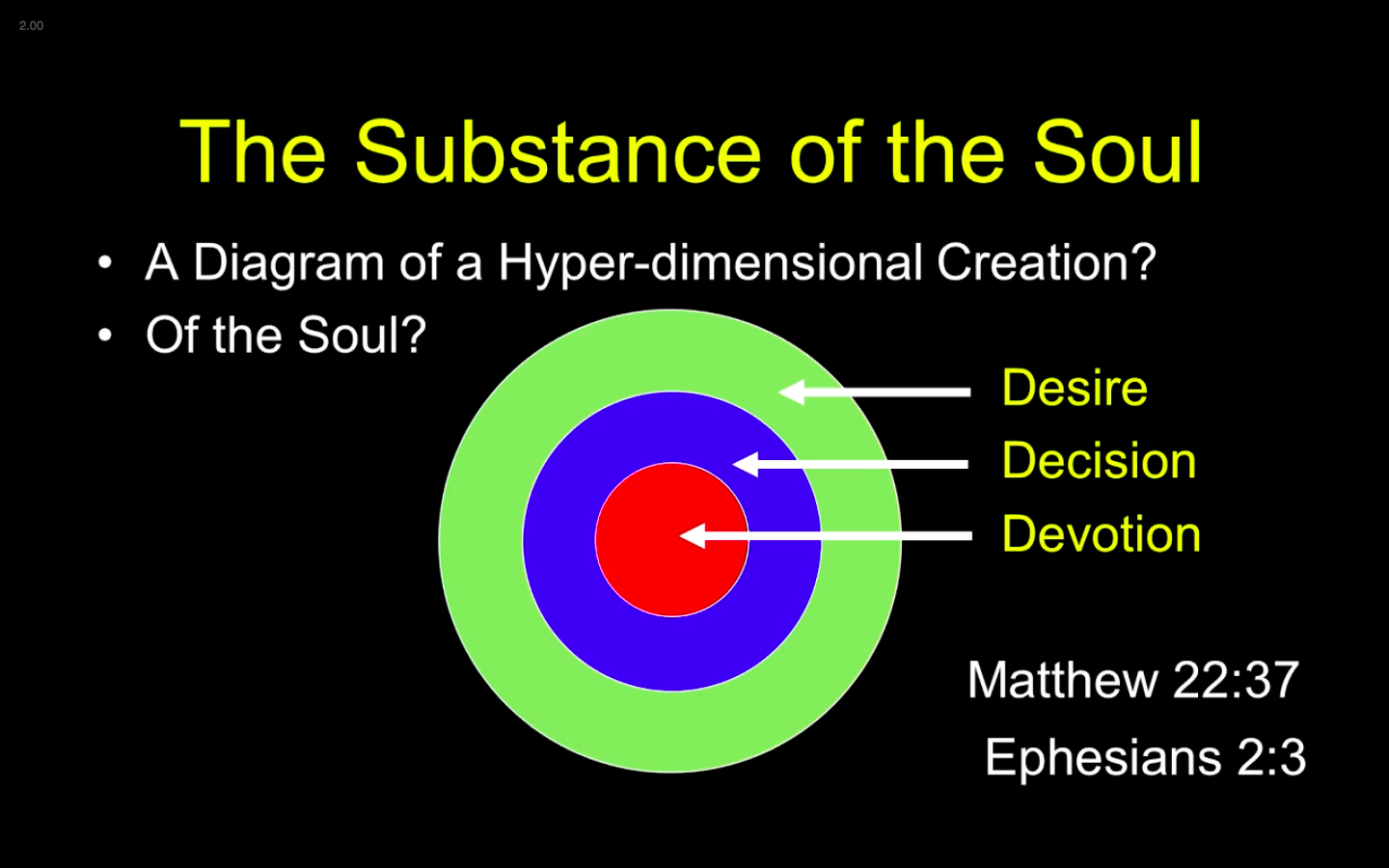
There is a war between the flesh and the spirit. It is a hyper-dimensional battleground (Ro 8:12-13) and the major front upon which it is fought today, at least in Western Culture is in Entertainment. This is the greatest source of input into the human mind today. It is the opiate of the masses. From the Colosseum to the theater, entertainment serves as the primary mechanism by which the multitude are indoctrinated.

https://isaachunterthewriter.com/wp-content/uploads/2024/05/screen-shot-2024-05-22-at-11.29.51-am.png

What did the apostles or Jesus do in their free time? Did they occupy themselves with fiction, with flights of the imagination? Examples of this would be Mars Hill in Acts 17:18, the “Areopagus.” Here men occupied themselves with all manner of fooling and futile thinking. They were perpetually engaged in the seeking of “something knew.” This is the obsession of academia today, to a fault. It is also the aim or byproduct of social media, which encourages people to open their lives up to the public and share everything about their lives with everyone. The companies mine this information and also monitor everything you watch, everything you click on, to then sell advertising to you and cater to you through their algorithm what you like the most so you will stay on their platform as long as possible and keep coming back as much as possible so they can sell as much advertising space to you as possible. That which was a means for entertainment is now molding and reshaping the society in which we live.
He defines the Illusion of Information or the quest for the knowledge of evil as the futile pursuit of information outside of the context of God. It is the pursuit and use of inebriates for the aim of altering the mind in anticipation of seeing or experiencing some glimpse of the supernatural realm or some other fantasy land.
Matsen claims that an individual cannot love the world and love God. How do you know if you love the world? Because it manifests itself in the: Lust of the flesh; Lust of the World; and the Pride of Life. But we are cautioned in Ro 16:19 to be wise according to what is good and innocent according to what is evil.
His Tolerance Stack Up is similar to a death by a thousand cuts. One or two or even ten will not be a problem. The error, if only 1 degree off from the mark, will not be enough to spoil the shot. But, add error upon error, and in aggregate, you will never be able to hit your target.
Conclusions
This course provides me a rudimentary framework for further investigation. I would love to spend significant time considering the biblical anthropology in more exhaustive detail. Especially the potential triadic nature nested within each component level.
Until my next assignment…..

Please consider supporting my writing, my unschooled studies, and my hermitic lifestyle by purchasing one or more of my books. I’m not supported by academia or have a lucrative corporate job – I’m just a mystical modern-day hermit trying to live out the life I believe God has called me to. So, any support you choose to provide is GREATLY appreciated.
Excerpt from Sacred the Circle:
There was a knock at the door.
Campbell got up from the chair and crossed the small distance so he could open it.
A young man stood in the doorway, probably in his early twenties.
Campbell could tell he looked a little disheveled.
Confused.
He had deep rings around his eyes, as if he hadn’t been sleeping much, and he kept checking the hallway in both directions, as if half expecting someone to be stalking him.
“Hey,” Campbell said.
“Uhm….is…this….?”
The kid was stumbling over his own words.
Campbell leaned out into the hallway, checking to make sure there was no one else listening.
This guy wasn’t the only one who was becoming paranoid.
There were two students hanging out at the foyer, near the stairs, but the rest of the floor was clear.
“I’m sorry,” the kid said. “Must be the wrong place. I’m mistaken.”
He started to leave.
“Wait,” Campbell said, putting a hand out. “Hold on a second.”
The kid paused.
“What’s your name?”
“Uh, I’m….Lloyd…”
He fidgeted with his collar.
“I know it sounds crazy, but – ”
“You’re not crazy, Lloyd,” Campbell said, grinning.
“Did you – ? ”
The kid paused, as if unsure if he should continue.
He looked back toward the stairs, then at Campbell.
“Did you know I was coming?” he finally asked. “I mean, that’s not possible, but, were you expecting me?”
Campbell chuckled to himself.
“What’s so funny?” Lloyd asked.
“Well – ”
Campbell pushed the door open all the way so Lloyd could see inside his dorm room.
The entire room was full of them, students, non-students, ranging from what looked like eighteen to even a few middle-aged men, scattered about the room, sitting wherever they could find a comfortable spot.
Lloyd’s mouth dropped open.
“I wasn’t really expecting them, either,” Campbell said. “So, I hope you don’t hold it against me when I tell you, I had no idea you’d be showing up here. Do you care to join us, anyway?”
Buy my book Sacred the Circle to find out what these men are hearing from the supernatural realm. Will they answer the questions tugging at them? What are the visions saying? Who are the Multitude? Why are all these men being brought together? By whom? And why, above all else, are they being convicted….to pray?
Get your copy of Sacred the Circle today! Get the upcoming sequel, Sacred the Sent as well so the story never ends !
But, trust me when I say, you’ll be white knuckling this one with every turn of the page!
What do you think?